

Abstract
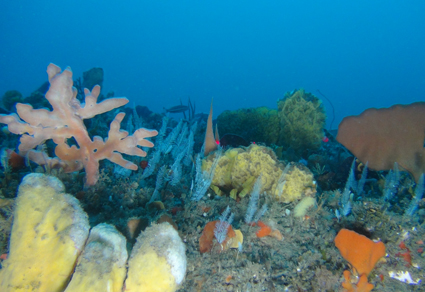
The marine environment of the Amathole region, located in the central part of South Africa’s Eastern Cape Province near East London on the southeast coast, is characterized by a narrow continental shelf and strong currents. Due to these challenging sea conditions, the area remains relatively unexplored from a marine biodiversity perspective. Four hundred and fifty-seven specimens of heteroscleromorph demosponges were sampled using an epibenthic dredge from 48 sites at depths between 3–229 m in 2016. An additional 11 specimens were similarly collected in 2015, while a further six specimens from three additional sites were collected by SCUBA in 1999. Underwater visual surveys were undertaken onboard the R/V Phakisa using a Remotely Operated Vehicle during two expeditions in 2017, with in situ images used for species accounts. This study presents formal descriptions of 23 heteroscleromorph Demospongiae from the Amathole region, including several new records, with fifteen species new to South Africa. The dominant orders were Poecilosclerida and Tetractinellida, and the dominant families were Geodiidae, Isodictyidae, and Latrunculiidae. Although sponge assemblages changed with depth, and taxa-specific depth restrictions were observed, the peak in species richness in the mesophotic zone likely reflects collection effort. The fauna shows strong affinities with southern Africa, especially that of the Agulhas and southern Benguela ecoregions, as well as the Western Indian Ocean.
References
- Acuña, F.H. & Griffiths, C.L. (2004) Species richness, endemicity and distribution patterns of South African sea anemones (Cnidaria: Actiniaria & Corallimorpharia). African Zoology, 39 (2), 193–200. https://doi.org/10.1080/15627020.2004.11657216
- Adams, L.A., Maneveldt, G.W., Green, A., Karenyi, N., Parker, D., Samaai, T. & Kerwath, S. (2020) Rhodolith bed discovered off the South African coast. Diversity, 12 (4), 125. https://doi.org/10.3390/d12040125
- Alvarez, B., Frings, P.J., Clymans, W., Fontorbe, G. & Conley, D.J. (2017) Assessing the potential of sponges (Porifera) as indicators of ocean dissolved Si concentrations. Frontiers in Marine Science, 4, 373. https://doi.org/10.3389/fmars.2017.00373
- Alvarez, B. & Van Soest, R.W.M. (2002) Family Bubaridae Topsent, 1894. In: Hooper, J.N.A. & Van Soest, R.W.M. (Eds.), Systema Porifera. A Guide to the Classification of Sponges. Vol. 1. Kluwer Academic/Plenum Publishers, New York, Boston, Dordrecht, London and Moscow, pp. 748–754. https://doi.org/10.1007/978-1-4615-0747-5_81
- Annandale, N. (1915) Some sponges parasitic on Clionidae with further notes on that family. Records of the Indian Museum, 11 (6), 457–478. https://doi.org/10.26515/rzsi/v11/i6/1915/163050
- Awad, A.A., Griffiths, C.L. & Turpie, J.K. (2002) Distribution of South African marine benthic invertebrates applied to the selection of priority conservation areas. Diversity and Distributions, 8 (3), 129–145. https://doi.org/10.1046/j.1472-4642.2002.00132.x
- Baer, L. (1906) Silicispongien von Sansibar, Kapstadt und Papeete. (Inaugural Dissertation: Berlin). Archiv für Naturgeschichte, 72 (1 & 1), 1–32.
- van der Bank, M.G., Adams, R., Raimondo, D.C., Sink, K.J., van der Colff, D., Makhado, A., Kock, A., Porter, S., Seakamela, S.M., Louw, S., Mann, B.Q. & Bürgener, M. (2019) Chapter 9: The state of indigenous species. In: Sink, K.J., van der Bank, M.G., Majiedt, P.A., Harris, L.R., Atkinson, L.J., Kirkman, S.P. & Karenyi, N. (Eds.), South African National Biodiversity Assessment 2018 Technical Report. Vol. 4. Marine Realm. South African National Biodiversity Institute, Pretoria, pp. 326–395.
- Beckley, L.E. & van Ballegooyen, R.C. (1992) Oceanographic conditions during three ichthyoplankton surveys of the Agulhas Current in 1990/91. South African Journal of Marine Science, 12 (1), 83–93. https://doi.org/10.2989/02577619209504693
- Bolton, J.J. & Stegenga, H. (1987) The marine algae of Hluleka (Transkei) and the warm temperate/sub-tropical transition on the east coast of southern Africa. Helgoländer Meeresuntersuchungen, 41 (2), 165–183. https://doi.org/10.1007/BF02364698
- Bolton, J.J. & Stegenga, H. (2002) Seaweed species diversity in South Africa. South African Journal of Marine Science, 24 (1), 9–18. https://doi.org/10.2989/025776102784528402
- Bolton, J.J., Leliaert, F., De Clerck, O., Anderson, R.J., Stegenga, H., Engledow, H.E. & Coppejans, E. (2004) Where is the western limit of the tropical Indian Ocean seaweed flora? An analysis of intertidal seaweed biogeography on the east coast of South Africa. Marine biology, 144 (1), 51–59. https://doi.org/10.1007/s00227-003-1182-9
- Boonzaaier, M.K. (2017) Diversity and zoogeography of South African Bryozoa. PhD Thesis, University of the Western Cape, Cape Town, 315 pp.
- Boury-Esnault, N. (1973) Résultats Scientifiques des Campagnes de la “Calypso”: Campagne de la “Calypso” au large des côtes atlantiques de l’Amérique du Sud (1961–1962). I. 29. Spongiaires. Annales de l’Institut océanographique, 49 (Supplément 10), 263–295.
- Boury-Esnault, N. & van Beveren, M. (1982) Les démosponges du plateau continental de Kerguelen-Heard. Comité national français des recherches antarctiques, 52, 1–175.
- Boury-Esnault, N. & Rützler, K. (1997) Thesaurus of sponge morphology. Smithsonian Contributions to Zoology, 596, 1–55. https://doi.org/10.5479/si.00810282.596
- Boury-Esnault, N. & Solé-Cava, A.M. (2004) Recent contribution of genetics to the study of sponge systematics and biology. Bollettino dei Musei e degli Istituti Biologici dell‘Università di Genova, 68, 3–18.
- Bowerbank, J.S. (1858) On the anatomy and physiology of the Spongiadae. Part I. On the spicula. Philosophical Transactions of the Royal Society, 148 (2), 279–332. https://doi.org/10.1098/rstl.1858.0016
- Bowerbank, J.S. (1864) A Monograph of the British Spongiadae. Vol. 1. Ray Society, London, 290 pp. https://doi.org/10.5962/bhl.title.56119
- Bowerbank, J.S. (1866) A Monograph of the British Spongiadae. Vol. 2. Ray Society, London, 388 pp.
- Burton, M. (1926) Descriptions of South African sponges collected in the South African Marine Survey. Part I. Myxospongia and Astrotetraxonida. Fisheries Bulletin. Fisheries and Marine Biological Survey Division, Union of South Africa, Report 4 (Special Report 9), 1–29.
- Burton, M. (1928) Report on some deep-sea sponges from the Indian Museum collected by R.I.M.S. “Investigator”. Part II. Tetraxonida (concluded) and Euceratosa. Records of the Indian Museum, 30 (1), 109–138. https://doi.org/10.26515/rzsi/v30/i1/1928/163204
- Burton, M. (1929a) Descriptions of South African sponges collected in the South African Marine Survey. Part II. The “Lithistidae”, with critical survey of the desma-forming sponges. Fisheries and Marine Biological Survey Division, Union of South Africa, Report 7 (Special Report 1), 1–12.
- Burton, M. (1929b) Porifera. Part II. Antarctic sponges. In: British Antarctic (“Terra Nova”) Expedition, 1910. Natural History Report. Zoology. 6 (4). British Museum (Natural History), London, pp. 393–458.
- Burton, M. (1931) On a collection of marine sponges mostly from the Natal coast. Annals of the Natal Museum, 6 (3), 337–358.
- Burton, M. (1932) Sponges. Discovery Reports, 6, 237–392. https://doi.org/10.5962/bhl.part.24379
- Burton, M. (1933a) Four new marine sponges from Natal. Annals of the Natal Museum, 7 (2), 249–254.
- Burton, M. (1933b) Report on a small collection of sponges from Stil Bay, S. Africa. Annals and Magazine of Natural History, Series 10, 11 (62), 235–244. https://doi.org/10.1080/00222933308673651
- Burton, M. (1936) Notes on sponges from South Africa, with descriptions of new species. Annals and Magazine of Natural History, Series 10, 17 (97), 141–147. https://doi.org/10.1080/03745481.1936.10801394
- Burton, M. (1959) Sponges. In: Scientific Reports. John Murray Expedition 1933–34. 10 (5). British Museum (Natural History), London, pp. 151–281.
- Button, R.E. (2018) Remotely Operated Vehicle exploring ichthyofauna association with habitat from shore-shelf, in an endemism hotspot in South Africa. MSc Thesis, University of Cape Town, Cape Town, 62 pp.
- Calcinai, B., Bavestrello, G., Cerrano, C. & Sarà, M. (2001) Boring sponges living into precious corals from the Pacific Ocean. Italian Journal of Zoology, 68 (2), 153–160. https://doi.org/10.1080/11250000109356400
- Carballo, J.L., Cruz-Barraza, J.A., Vega, C., Nava, H. & del Carmen Chávez-Fuentes, M. (2019) Sponge diversity in Eastern Tropical Pacific coral reefs: an interoceanic comparison. Scientific Reports, 9, 9409. https://doi.org/10.1038/s41598-019-45834-4
- Carballo, J.L. & Uriz, M.J. (1998) Guitarra flamenca sp. nov. (Porifera: Poecilosclerida) with a SEM revision of the spiny isochelae and placochelae in the genus. Journal of the Marine Biological Association of the United Kingdom, 78 (3), 807–819. https://doi.org/10.1017/S0025315400044799
- Cárdenas, P., Pérez, T. & Boury-Esnault, N. (2012) Sponge systematics facing new challenges. Advances in Marine Biology, 61, 79–209. https://doi.org/10.1016/B978-0-12-387787-1.00010-6
- Cárdenas, P., Xavier, J.R., Reveillaud, J., Schander, C. & Rapp, H.T. (2011) Molecular phylogeny of the Astrophorida (Porifera, Demospongiaep) reveals an unexpected high level of spicule homoplasy. PLoS ONE, 6 (4), e18318. https://doi.org/10.1371/journal.pone.0018318
- Carter, H.J. (1869) On Grayella cyathophora, a new genus and species of sponges. Annals and Magazine of Natural History, Series 4, 4 (21), 189–197. https://doi.org/10.1080/00222936908696028
- Carter, H.J. (1871) Description and illustrations of a new species of Tethya, with observations on the nomenclature of the Tethyadae. Annals and Magazine of Natural History, Series 4, 8 (44), 99–105. https://doi.org/10.1080/00222937108696442
- Carter, H.J. (1874) Descriptions and figures of deep-sea sponges and their spicules from the Atlantic Ocean, dredged up on board H.M.S.“Porcupine”, chiefly in 1869; with figures and descriptions of some remarkable spicules from the Agulhas Shoal and Colon, Panama. Annals and Magazine of Natural History, Series 4, 14 (79), 207–221 + 245–257. https://doi.org/10.1080/00222937408680956
- Carter, H.J. (1875a) Notes introductory to the study and classification of the Spongida. Part II. Proposed classification of the Spongida. Annals and Magazine of Natural History, Series 4, 16 (92), 126–145. https://doi.org/10.1080/00222937508681142
- Carter, H.J. (1875b) Notes introductory to the study and classification of the Spongida. Annals and Magazine of Natural History, Series 4, 16 (93), 177–200. https://doi.org/10.1080/00222937508681152
- Carter, H.J. (1876) Descriptions and figures of deep-sea sponges and their spicules from the Atlantic Ocean, dredged up on board H.M.S.“Porcupine”, chiefly in 1869 (concluded). Annals and Magazine of Natural History, Series 4, 18 (105, 106, 107 & 108), 226–240, 307–324, 388–410 & 458–479. https://doi.org/10.1080/00222937608682078
- Carter, H.J. (1879) Contributions to our knowledge of the Spongida. Annals and Magazine of Natural History, Series 5, 3 (17), 284–304 + 343–360. https://doi.org/10.1080/00222937908694101
- Carter, H.J. (1881) Contributions to our knowledge of the Spongida. Annals and Magazine of Natural History, Series 5, 8 (46), 101–112 + 118–120 + 241–259.
- https://doi.org/10.1080/00222938109487454
- Carter, H.J. (1882a) Contributions to our knowledge of the Spongida. Order II. Ceratina. Annals and Magazine of Natural History, Series 5, 8 (44), 101–120.
- https://doi.org/10.1080/00222938109487423
- Carter, H.J. (1882b) New sponges, observations on old ones, and a proposed new group. Annals and Magazine of Natural History, Series 5, 10 (55), 106–125.
- https://doi.org/10.1080/00222938209459681
- Carter, H.J. (1882c) Some sponges from the West Indies and Acapulco in the Liverpool Free Museum described, with general and classificatory remarks. Annals and Magazine of Natural History, Series 5, 9 (52), 266–301 + 346–368. https://doi.org/10.1080/00222938209459039
- Carter, H.J. (1883) Contributions to our knowledge of the Spongida. Annals and Magazine of Natural History, Series 5, 12 (71), 308–329. https://doi.org/10.1080/00222938309459636
- Carter, H.J. (1885) Descriptions of sponges from the neighbourhood of Port Phillip Heads, South Australia. Annals and Magazine of Natural History, Series 5, 16 (94), 277–294 + 347–368. https://doi.org/10.1080/00222938509459892
- Castello-Branco, C. & Hajdu, E. (2018) Two new Hamacantha (Vomerula) from the Rio Grande Rise (SW Atlantic) (Hamacanthidae, Porifera). Zootaxa, 4466 (1), 69–77. https://doi.org/10.11646/zootaxa.4466.1.8
- Castelnau, F.L. (1861) Mémoire sur les poissons de l’Afrique australe. J.-B. Baillière et fils, Paris, 78 pp. https://doi.org/10.5962/bhl.title.3819
- Chombard, C. & Boury-Esnault, N. (1999) Good congruence between morphology and molecular phylogeny of Hadromerida, or how to bother sponge taxonomists. Memoirs of the Queensland Museum, 44, 100.
- Costello, M.J., Coll, M., Danovaro, R., Halpin, P., Ojaveer, H. & Miloslavich, P. (2010) A census of marine biodiversity knowledge, resources, and future challenges. PLoS ONE, 5 (8), e12110. https://doi.org/10.1371/journal.pone.0012110
- Davies-Coleman, M.T., Antunes, E.M., Beukes, D.R. & Samaai, T. (2019) Colourful chemistry of South African latrunculid sponges. South African Journal of Science, 115 (5–6), 1–7. https://doi.org/10.17159/sajs.2019/5534
- Day, J.A. (2000) Marine and estuarine studies in South Africa: an historical perspective. Transactions of the Royal Society of South Africa, 55 (2), 101–105. https://doi.org/10.1080/00359190009520436
- Dendy, A. (1905) Report on the sponges collected by Professor Herdman, at Ceylon, in 1902. In: Herdman, W.A. (Ed.), Report to the Government of Ceylon on the Pearl Oyster Fisheries of the Gulf of Manaar. Part III. Supplementary Reports 18. Royal Society, London, pp. 57–246.
- Dendy, A. (1916) Report on the non-calcareous sponges collected by Mr. James Hornell at Okhamandal in Kattiawar in 1905–6. Report to the Government of Baroda on the Marine Zoology of Okhamandal in Kattiawar, 2, 93–146.
- Dendy, A. (1922) Report on the Sigmatotetraxonida collected by H.M.S. “Sealark” in the Indian Ocean. In: Reports of the Percy Sladen Trust Expedition to the Indian Ocean in 1905. Vol. 7. Transactions of the Linnean Society of London, London, 18 (1), pp. 1–164. https://doi.org/10.1111/j.1096-3642.1922.tb00547.x
- Dendy, A. (1924) Porifera. Part I. Non-Antarctic sponges. Natural History Report. British Antarctic (“Terra Nova”) Expedition, 1910, Zoology, 6 (3), 269–392.
- Dendy, A. & Ridley, S.O. (1886) On Proteleia sollasi, a new genus and species of Monaxonid sponges allied to Polymastia. Annals and Magazine of Natural History, 5, 18 (104), 152–159. https://doi.org/10.1080/00222938609459948
- Desqueyroux-Faúndez, R. & Van Soest, R.W.M. (1996) A review of Iophonidae, Myxillidae and Tedaniidae occurring in the South East Pacific (Porifera: Poecilosclerida). Revue suisse de Zoologie, 103 (1), 3–79. https://doi.org/10.5962/bhl.part.79938
- Dingle, R.V. & Robson, S. (1985) Slumps, canyons and related features on the continental margin off East London, SE Africa (SW Indian Ocean). Marine Geology, 67 (1–2), 37–54. https://doi.org/10.1016/0025-3227(85)90147-1
- Dlamini, N. (2017) Marine geology of the East London continental shelf. MSc Thesis, University of KwaZulu-Natal, Durban, 102 pp.
- Downey, R.V., Griffiths, H.J., Linse, K. & Janussen, D. (2012) Diversity and distribution patterns in high southern latitude sponges. PLoS ONE, 7 (7), e41672. https://doi.org/10.1371/journal.pone.0041672
- Ehlers, E. (1870) Die Esper’schen Spongien in der zoologischen Sammlung der K. Universität Erlangen. E.Th. Jacob, Erlangen, 36 pp.
- Ellis, J. & Solander, D. (1786) The Natural History of many curious and uncommon Zoophytes, collected from various parts of the Globe. Systematically arranged and described by the late Daniel Solander. Vol. 4. Benjamin White & Son, London, 206 pp. https://doi.org/10.5962/bhl.title.2145
- Emanuel, B.P., Bustamante, R.H., Branch, G.M., Eekhout, S. & Odendaal, F.J. (1992) A zoogeographic and functional approach to the selection of marine reserves on the west coast of South Africa. South African Journal of Marine Science, 12 (1), 341–354. https://doi.org/10.2989/02577619209504710
- Esper, E.J.C. (1797) Fortsetzungen der Pflanzenthiere in Abbildungen nach der Natur mit Farben erleuchtet nebst Beschreibungen. Erster Theil. Raspe, Nürnberg, 230 pp.
- Fortunato, H.F.M., de Paula, T.S., Esteves, E.L., Muricy, G. & Lôbo-Hajdu, G. (2020) Biodiversity and structure of marine sponge assemblages around a subtropical island. Hydrobiologia, 847 (5), 1281–1299. https://doi.org/10.1007/s10750-020-04183-4
- Francini-Filho, R.B., Asp, N.E., Siegle, E., Hocevar, J., Lowyck, K., D’Avila, N., Vasconcelos, A.A., Baitelo, R., Rezende, C.E., Omachi, C.Y., Thompson, C.C. & Thompson, F.L. (2018) Perspectives on the Great Amazon Reef: extension, biodiversity, and threats. Frontiers in Marine Science, 5, 142. https://doi.org/10.3389/fmars.2018.00142
- Fromont, J., Vanderklift, M.A. & Kendrick, G.A. (2006) Marine sponges of the Dampier Archipelago, Western Australia: patterns of species distributions, abundance and diversity. Biodiversity and Conservation, 15, 3731–3750. https://doi.org/10.1007/s10531-004-1871-9
- Gibbons, M.J., Abiahy, B.B., Angel, M., Assuncao, C.M.L., Bartsch, I., Best, P., Biseswar, R., Bouillon, J., Bradford-Grieve, J.M., Branch, W., Burreson, E., Cannon, L., Casanova, J.-P., Channing, A., Child, C.A., Compagno, L., Cornelius, P.F.S., Dadon, J.R., David, J.H.M., Day, J., Della Croce, N., Emschermann, P., Erseus, C., Esnal, G., Gibson, R., Griffiths, C.L., Hayward, P.J., Heard, R., Heemstra, P., Herbert, D., Hessler, R., Higgins, R., Hiller, N., Hirano, Y.M., Kensley, B., Kilburn, R., Kornicker, L., Lambshead, J., Manning, R., Marshall, D., Mianzan, H., Monniot, C. & F., Newman, W., Nielsen, C., Patterson, G., Pugh, P., Roeleveld, M., Ross, A., Ryan, P., Ryland, J.S., Samaai, T., Schleyer, M., Schockaert, E., Seapy, R., Shiel, R., Sluys, R., Southward, E.C., Sulaiman, A., Thandar, A., van der Spoel, S., Van Soest, R., van der Land, J., Vetter, E., Vinogradov, G., Williams, G. & Wooldridge, T. (1999) The taxonomic richness of South Africa’s marine fauna: a crisis at hand. South African Journal of Science, 95 (1), 8–12.
- Goschen, W.S. & Schumann, E.H. (2011) The physical oceanographic processes of Algoa Bay, with emphasis on the western coastal region. South African Environmental Observation Network (SAEON), Stellenbosch and Institute for Maritime Technology (IMT), Simon’s Town, 82 pp.
- Goschen, W.S., Schumann, E.H., Bernard, K.S., Bailey, S.E. & Deyzel, S.H.P. (2012) Upwelling and ocean structures off Algoa Bay and the south-east coast of South Africa. African Journal of Marine Science, 34 (4), 525–536. https://doi.org/10.2989/1814232X.2012.749810
- Grant, R.E. (1836) Animal Kingdom. In: Todd, R.B. (Ed.), The Cyclopaedia of Anatomy and Physiology. Vol. 1. Sherwood, Gilbert and Piper, London, pp. 107–118.
- Gray, J.E. (1867) Notes on the arrangement of sponges, with the descriptions of some new genera. Proceedings of the Zoological Society of London, 1867 (2), 492–558.
- Gray, J.E. (1872) Notes on the classification of the sponges. Annals and Magazine of Natural History, 4, 9 (54), 442–461. https://doi.org/10.1080/00222937208696616
- Griffiths, C.L. (2005) Coastal marine biodiversity in East Africa. Indian Journal of Marine Sciences, 34 (1), 35–41.
- Griffiths, C.L. & Robinson, T.B. (2016) Use and usefulness of measures of marine endemicity in South Africa. South African Journal of Science, 112 (3/4), 1–7. https://doi.org/10.17159/sajs.2016/20150249
- Griffiths, C.L., Robinson, T.B., Lange, L. & Mead, A. (2010) Marine biodiversity in South Africa: an evaluation of current states of knowledge. PLoS ONE, 5 (8), e12008. https://doi.org/10.1371/journal.pone.0012008
- Grube, A.E. (1863) Beschreibung neuer oder wenig bekannter Anneliden. Sechster Beitrag. Archiv für Naturgeschichte, Berlin, 29, 37–69. https://doi.org/10.5962/bhl.part.9306
- Hajdu, E. (2002) Family Hamacanthidae Gray, 1872. In: Hooper, J.N.A. & Van Soest, R.W.M. (Eds.), Systema Porifera. A Guide to the Classification of Sponges. Vol. 1. Kluwer Academic/Plenum Publishers, New York, Boston, Dordrecht, London and Moscow, pp. 665–668. https://doi.org/10.1007/978-1-4615-0747-5_72
- Hajdu, E. & Desqueyroux-Faúndez, R. (2008) A reassessment of the phylogeny and biogeography of Rhabderemia Topsent, 1890 (Rhabderemiidae, Poecilosclerida, Demospongiae). Revue Suisse de Zoologie, 115 (2), 377–395.
- Hajdu, E. & Lerner, C. (2002) Family Guitarridae Dendy, 1924. In: Hooper, J.N.A. & Van Soest, R.W.M. (Eds.), Systema Porifera. A Guide to the Classification of Sponges. Vol. 1. Kluwer Academic/Plenum Publishers, New York, Boston, Dordrecht, London and Moscow, pp. 651–655. https://doi.org/10.1007/978-1-4615-0747-5_70
- Hajdu, E. & Lôbo-Hajdu, G. (2002) Family Isodictyidae Dendy, 1924. In: Hooper, J.N.A. & Van Soest, R.W.M. (Eds.), Systema Porifera. A Guide to the Classification of Sponges. Vol. 1. Kluwer Academic/Plenum Publishers, New York, Boston, Dordrecht, London and Moscow, pp. 703–706. https://doi.org/10.1007/978-1-4615-0747-5_76
- Hajdu, E. & Van Soest, R.W.M. (2002) Family Desmacellidae Ridley & Dendy, 1886. In: Hooper, J.N.A. & Van Soest, R.W.M. (Eds.), Systema Porifera. A Guide to the Classification of Sponges. Vol. 1. Kluwer Academic/Plenum Publishers, New York, Boston, Dordrecht, London and Moscow, pp. 642–650. https://doi.org/10.1007/978-1-4615-0747-5_69
- Hentschel, E. (1912) Kiesel- und Hornschwämme der Aru- und Kei-Inseln. Abhandlungen herausgegeben von der Senckenbergischen naturforschenden Gesellschaft, 34 (3), 293–448. https://doi.org/10.5962/bhl.title.85325
- Hentschel, E. (1914) Monaxone Kieselschwämme und Hornschwämme der Deutschen Südpolar Expedition 1901–1903. Deutsche Südpolar-Expedition, 15 (1), 35–141.
- Hentschel, E. (1923) Erste Unterabteilung der Metazoa: Parazoa, Porifera-Schwämme. In: Kükenthal, W. & Krumbach, T. (Eds.), Handbuch der Zoologie. Eine Naturgeschichteder Stämme des Tierreiches. Vol. 1. Protozoa, Porifera, Coelenterata, Mesozoa. Walter de Gruyter & Co., Berlin, Leipzig, pp. 307–418.
- Hewitt, J.E., Thrush, S.F. & Dayton, P.D. (2008) Habitat variation, species diversity and ecological functioning in a marine system. Journal of Experimental Marine Biology and Ecology, 366 (1–2), 116–122. https://doi.org/10.1016/j.jembe.2008.07.016
- Hooper, J.N.A. (1990) A new species of Rhabderemia Topsent (Porifera: Demospongiae) from the Great Barrier Reef. The Beagle, Records of the Northern Territory Museum of Arts and Sciences, 7 (1), 65–78. https://doi.org/10.5962/p.262793
- Hooper, J.N.A. (1996) Revision of Microcionidae (Porifera: Poecilosclerida: Demospongiae), with description of Australian species. Memoirs of the Queensland Museum, 40, 1–626.
- Hooper, J.N.A. (2002a) Family Acarnidae Dendy, 1922. In: Hooper, J.N.A. & Van Soest, R.W.M. (Eds.), Systema Porifera. A Guide to the Classification of Sponges. Vol. 1. Kluwer Academic/Plenum Publishers, New York, Boston, Dordrecht, London and Moscow, pp. 412–431. https://doi.org/10.1007/978-1-4615-0747-5_51
- Hooper, J.N.A. (2002b) Family Raspailiidae Hentschel, 1923. In: Hooper, J.N.A. & Van Soest, R.W.M. (Eds.), Systema Porifera. A Guide to the Classification of Sponges. Vol. 1. Kluwer Academic/Plenum Publishers, New York, Boston, Dordrecht, London and Moscow, pp. 469–510. https://doi.org/10.1007/978-1-4615-0747-5_53
- Hooper, J.N.A. (2002c) Family Rhabderemiidae Topsent, 1928. In: Hooper, J.N.A. & Van Soest, R.W.M. (Eds.), Systema Porifera. A Guide to the Classification of Sponges. Vol. 1. Kluwer Academic/Plenum Publishers, New York, Boston, Dordrecht, London and Moscow, pp. 511–513. https://doi.org/10.1007/978-1-4615-0747-5_54
- Hooper, J.N.A., Kelly, M. & Kennedy, J.A. (2000) A new Clathria (Porifera: Demospongiae: Microcionidae) from the Western Indian Ocean. Memoirs of the Queensland Museum, 45 (2), 427–444.
- Hooper, J.N.A. & Kennedy, J.A. (2002) Small-scale patterns of sponge biodiversity (Porifera) from the Sunshine Coast reefs, eastern Australia. Invertebrate Systematics, 16 (4), 637–653. https://doi.org/10.1071/IS02015
- Hooper, J.N.A., Kennedy, J.A. & Quinn, R.J. (2002) Biodiversity “hotspots”, patterns of richness and endemism, and taxonomic affinities of tropical Australian sponges (Porifera). Biodiversity and Conservation, 11 (5), 851–885. https://doi.org/10.1023/A:1015370312077
- Hooper, J.N.A. & Van Soest, R.W.M. (2002) Systema Porifera. A Guide to the Classification of Sponges. Vols. 1 & 2. Kluwer Academic/Plenum Publishers, New York, Boston, Dordrecht, London and Moscow, 1708 pp. https://doi.org/10.1007/978-1-4615-0747-5_1
- Howell, K.-L., Piechaud, N., Downie, A.-L. & Kenny, A. (2016) The distribution of deep-sea sponge aggregations in the North Atlantic and implications for their effective spatial management. Deep Sea Research, Part I, Oceanographic Research Papers, 115, 309–320. https://doi.org/10.1016/j.dsr.2016.07.005
- Huang, Z., Brooke, B. & Li, J. (2011) Performance of predictive models in marine benthic environments based on predictions of sponge distribution on the Australian continental shelf. Ecological Informatics, 6 (3–4), 205–216. https://doi.org/10.1016/j.ecoinf.2011.01.001
- Idan, T., Shefer, S., Feldstein, T., Yahel, R., Huchon, D. & Ilan, M. (2018) Shedding light on an East-Mediterranean mesophotic sponge ground community and the regional sponge fauna. Mediterranean Marine Science, 19 (1), 84–106. https://doi.org/10.12681/mms.13853
- Ilan, M., Gugel, J. & Van Soest, R.W.M. (2004) Taxonomy, reproduction and ecology of new and known Red Sea sponges. Sarsia, 89, 388–410. https://doi.org/10.1080/00364820410002659
- Johnston, G. (1842) A history of British sponges and lithophytes. W.H. Lizars, Edinburgh, 264 pp. https://doi.org/10.5962/bhl.title.51495
- Kelly, M. (2011) Phylum Porifera. Sponges. In: Richmond, M.D. (Ed.), A Field Guide to the Seashores of Eastern Africa and the Western Indian Ocean Islands. Sida/WIOMSA, Zanzibar City, pp. 116–127.
- Kelly, M. & Sim-Smith, C. (2012) A review of Ancorina, Stryphnus, and Ecionemia (Demospongiae, Astrophorida, Ancorinidae), with descriptions of new species from New Zealand waters. Zootaxa, 3480 (1), 1–47. https://doi.org/10.11646/zootaxa.3480.1.1
- Kirkpatrick, R. (1901) Description of a new hexactinellid sponge from South Africa. Annals and Magazine of Natural History, Series 7, 7 (41), 457–460. https://doi.org/10.1080/00222930108678498
- Kirkpatrick, R. (1902) Descriptions of South African sponges. Part I. Marine Investigations in South Africa, 1, 219–232. https://doi.org/10.5962/p.366552
- Kirkpatrick, R. (1903a) Descriptions of South African sponges. Part II. Marine Investigations in South Africa, 2 (14), 171–180. https://doi.org/10.5962/p.366557
- Kirkpatrick, R. (1903b) Descriptions of South African sponges. Part III. Marine Investigations in South Africa, 2 (14), 233–264. https://doi.org/10.5962/p.366550
- Kirkpatrick, R. (1913) Note on the occurrence of the euplectellid sponge Regadrella phoenix O. Schmidt, off the South African coast. Annals of the South African Museum, 13, 63–64.
- Klautau, M., Russo, C.A.M., Lazoski, C., Boury‐Esnault, N., Thorpe, J.P. & Solé‐Cava, A.M. (1999) Does cosmopolitanism result from overconservative systematics? A case study using the marine sponge Chondrilla nucula. Evolution, 53 (5), 1414–1422. https://doi.org/10.2307/2640888
- Koltun, V.M. (1964) Sponges of the Antarctic. Part 1. Tetraxonida and Cornacuspongida. In: Pavlovskii, E.P., Andriyashev, A.P. & Ushakov, P.V. (Eds.), Biological Reports of the Soviet Antarctic Expedition (1955–1958). Vol. 2 (10). Academy of Sciences of the USSR, Nauka and Moscow-Leningrad, pp. 6–133 + 443–448.
- Laird, M.C. (2013) Taxonomy, systematics and biogeography of South African Actiniaria and Corallimorpharia. PhD Thesis, University of Cape Town, Cape Town, 334 pp.
- Lamouroux, J.V.F. (1813) Essai sur les genres de la famille des thalassiophytes non articulées. Annales du Muséum National d’Histoire Naturelle, Paris, 20, 21–47 + 115–139 + 267–293.
- de Laubenfels, M.W. (1936) A discussion of the sponge fauna of the Dry Tortugas in particular and the West Indies in general, with material for a revision of the families and orders of the Porifera. Carnegie Institute of Washington Publication, 467 (Tortugas Laboratory Paper 30), 1–225.
- Lendenfeld, R. Von (1907) Die Tetraxonia. Wissenschaftliche Ergebnisse der Deutschen Tiefsee-Expedition auf der Dampfer Valdivia 1898–1899, 11 (1–2), i–iv + 59–374.
- Lesser, M.P., Slattery, M. & Mobley, C.D. (2018) Biodiversity and functional ecology of mesophotic coral reefs. Annual Review of Ecology, Evolution, and Systematics, 49 (1), 49–71. https://doi.org/10.1146/annurev-ecolsys-110617-062423
- Lévi, C. (1953) Sur une nouvelle classification des démosponges. Comptes rendus hebdomadaires des séances de l’Académie des Sciences, 236 (8), 853–855.
- Lévi, C. (1956) Éponges littorales des Îles Kerguelen récoltées par M. Angot. Mémoires de l’Institut Scientifique de Madagascar, A, 10, 25–34.
- Lévi, C. (1958) Résultats scientifiques des Campagnes de la “Calypso”. Campagne 1951–1952 en Mer Rouge (suite). 11. Spongiaires de Mer Rouge recueillis par la “Calypso” (1951–1952). Annales de l’Institut océanographique, 34 (3), 3–46.
- Lévi, C. (1960) Les spongiaires à desmes astéroïdes. Bulletin de l’Institut océanographique de Monaco, 1179, 1–8.
- Lévi, C. (1961) Résultats scientifiques des Campagnes de la “Calypso”. Campagne 1954 dans l’Océan Indien (suite). 2. Les spongiaires de l’Ile Aldabra. Annales de l’Institut océanographique, 39 (1), 1–32.
- Lévi, C. (1963) Spongiaires d’Afrique du Sud. (1) Poecilosclérides. Transactions of the Royal Society of South Africa, 37 (1), 1–72. https://doi.org/10.1080/00359196309519054
- Lévi, C. (1964a) Spongiaires des zones bathyale, abyssale et hadale. Galathea Report. Scientific Results of The Danish Deep-Sea Expedition Round the World, 1950–52, 7, 63–112.
- Lévi, C. (1964b) Spongiaires du canal de Mozambique. Bulletin du Muséum National d’Histoire Naturelle, Paris, 2, 36 (3), 384–395.
- Lévi, C. (1967) Spongiaires d’Afrique du Sud. (3) Tétractinellides. Transactions of the Royal Society of South Africa, 37, 227–256. https://doi.org/10.1080/00359196709519067
- Lévi, C. (1969) Spongiaires du Vema Seamount (Atlantique Sud). Bulletin du Muséum National d’Histoire Naturelle, 2, 41 (4), 952–973.
- Lévi, C. (Ed.) (1998) Sponges of the New Caledonian Lagoon. Collection Faune et Flore Tropicales. No. 33. Éditions de l’Orstom, Paris, 214 pp.
- Lévi, C. & Lévi, P. (1983) Eponges Tétractinellides et Lithistides bathyales de Nouvelle-Calédonie. Bulletin du Muséum National d’Histoire Naturelle, 4, 5 (1), 101–168. https://doi.org/10.5962/p.285993
- Lévi, C. & Lévi, P. (1989) Spongiaires (MUSORSTOM 1 & 2). In: Forest, J. (Ed.), Résultats des Campagnes MUSORSTOM 4. Mémoires du Muséum National d’Histoire Naturelle, A (Zoologie), 143, pp. 25–103.
- Lieberkühn, N. (1859) Neue Beiträge zur Anatomie der Spongien. Archiv für Anatomie und Physiologie, 30 (3), 353–382 + 515–529.
- Longo, C., Cardone, F., Pierri, C., Mercurio, M., Mucciolo, S., Nonnis Marzano, C. & Corriero, G. (2018) Sponges associated with coralligenous formations along the Apulian coasts. Marine Biodiversity, 48 (4), 2151–2163. https://doi.org/10.1007/s12526-017-0744-x
- Lutjeharms, J.R.E. (2006a) The ocean environment off southeastern Africa: a review. South African Journal of Science, 102 (9), 419–426.
- Lutjeharms, J.R. (2006b) The agulhas current. Springer, Berlin and Heidelberg, XIII + 329 pp.
- Lutjeharms, J.R.E. (2007) Three decades of research on the greater Agulhas Current. Ocean Science, 3 (1), 129–147. https://doi.org/10.5194/os-3-129-2007
- Lutjeharms, J.R.E., Cooper, J. & Roberts, M. (2000) Upwelling at the inshore edge of the Agulhas Current. Continental Shelf Research, 20 (7), 737–761. https://doi.org/10.1016/S0278-4343(99)00092-8
- Maduray, S. (2013) Studies on the diversity and spatial distribution of deep-water sponges along the west and south coasts of South Africa. MSc Thesis, University of the Western Cape, Cape Town, 132 pp.
- Maldonado, M. (2006) The ecology of the sponge larva. Canadian Journal of Zoology, 84 (2), 175–194. https://doi.org/10.1139/z05-177
- Maldonado, M. & Young, C.M. (1996) Bathymetric patterns of sponge distribution on the Bahamian slope. Deep Sea Research, Part I, Oceanographic Research Papers, 43 (6), 897–915. https://doi.org/10.1016/0967-0637(96)00042-8
- Marshall, W. (1876) Ideen über die Verwandtschaftsverhältnisse der Hexactinelliden. Zeitschrift für wissenschaftliche Zoologie, 27 (1), 113–136.
- Massie, V., Clark, B., Hutchings, K., Dawson, J., Brown, E., Wright, A. & Laird, M. (2019) Proposed Sea-based Aquaculture Development Zone in Algoa Bay, Eastern Cape – Draft Basic Assessment Report in Terms of the National Environmental Management Act (107 of 1998). Report prepared for the Department of Agriculture, Forestry and Fisheries by Anchor Research and Monitoring (Pty) Ltd, Cape Town, 196 pp.
- Meyer, I., Reinecke, J., Roberts, M. & van Niekerk, J.L. (2013) Assessment of the Ocean Energy Resources off the South African Coast. Centre for Renewable and Sustainable Energy Studies, Faculty of Engineering, Stellenbosch University, Stellenbosch, 65 pp.
- Morrow, C.C. & Cárdenas, P. (2015) Proposal for a revised classification of the Demospongiae (Porifera). Frontiers in Zoology, 12 (7), 1–27. https://doi.org/10.1186/s12983-015-0099-8
- Morrow, C.C., Cárdenas, P., Boury-Esnault, N., Picton, B., McCormack, G., Van Soest, R.W.M., Collins, A., Redmond, N., Maggs, C., Sigwart, J. & Allcock, L.A. (2019) Integrating morphological and molecular taxonomy with the revised concept of Stelligeridae (Porifera: Demospongiae). Zoological Journal of the Linnean Society, 187 (1), 31–81. https://doi.org/10.1093/zoolinnean/zlz017
- Morrow, C.C., Picton, B.E., Erpenbeck, D., Boury-Esnault, N., Maggs, C.A. & Allcock, A.L. (2012) Congruence between nuclear and mitochondrial genes in Demospongiae: a new hypothesis for relationships within the G4 clade (Porifera: Demospongiae). Molecular Phylogenetics and Evolution, 62 (1), 174–190. https://doi.org/10.1016/j.ympev.2011.09.016
- Morrow, C.C., Redmond, N.E., Picton, B.E., Thacker, R.W., Collins, A.G., Maggs, C.A., Sigwart, J.D. & Allcock, A.L. (2013) Molecular phylogenies support homoplasy of multiple morphological characters used in the taxonomy of Heteroscleromorpha (Porifera: Demospongiae). Integrative and Comparative Biology, 53 (3), 428–446. https://doi.org/10.1093/icb/ict065
- Moura, R.L., Amado-Filho, G.M., Moraes, F.C., Brasileiro, P.S., Salomon, P.S., Mahiques, M.M., Bastos, A.C., Almeida, M.G., Silva, J.M. Jr., Araujo, B.F., Brito, F.P., Rangel, T.P., Oliveira, B.C.V., Bahia, R.G., Paranhos, R.P., Dias, R.J.S., Siegle, E., Figueiredo, A.G.Jr., Pereira, R.C., Leal, C.V., Hajdu, E., Asp, N.E., Gregoracci, G.B., Neumann-Leitão, S., Yager, P.L., Francini-Filho, R.B., Fróes, A., Campeão, M., Silva, B.S., Moreira, A.P.B., Oliveira, L., Soares, A.C., Araujo, L., Oliveira, N.L., Teixeira, J.B., Valle, R.A.B., Thompson, C.C., Rezende, C.E. & Thompson, F.L. (2016) An extensive reef system at the Amazon River mouth. Science Advances, 2 (4), e1501252. https://doi.org/10.1126/sciadv.1501252
- Nardo, G.D. (1833) Auszug aus einem neuen System der Spongiarien, wonach bereits die Aufstellung in der Universitäts-Sammlung zu Padua gemacht ist. In: Isis, oder Encyclopädische Zeitung Coll. Oken, Jena, pp. 519–523.
- Ngwakum, B.B., Payne, R.P., Teske, P.R., Janson, L., Kerwath, S.E. & Samaai, T. (2021) Hundreds of new DNA barcodes for South African sponges. Systematics and Biodiversity, 19 (7), 747–769. https://doi.org/10.1080/14772000.2021.1915896
- Parker, D., Sink, K. & Kerwath, S. (2017) Dredging the depths of the Amathole to find sponges, corals and shipwrecks. Maritime Review Africa, 2017, 6–7.
- Pereira, P. & Raghunathan, C. (2018) Diversity of sponges in Marine Protected Areas of North Andaman, India. Thalassas: An International Journal of Marine Sciences, 34 (2), 361–372. https://doi.org/10.1007/s41208-018-0073-2
- Plotkin, A. & Boury-Esnault, N. (2004) Alleged cosmopolitanism in sponges: the example of a common Arctic Polymastia (Porifera, Demospongiae, Hadromerida). Zoosystema, 26 (1), 13–20.
- Pomponi, S.A., Diaz, M.C., Van Soest, R.W.M., Bell, L.J., Busutil, L., Gochfeld, D.J., Kelly, M. & Slattery, M. (2019) Sponges. In: Loya, Y., Puglise, K.A. & Bridge, T.C.L. (Eds.), Mesophotic Coral Ecosystems. Coral Reefs of the World. Vol. 12. Springer, Cham, pp. 563–588. https://doi.org/10.1007/978-3-319-92735-0_32
- Procheş, Ş. & Marshall, D.J. (2002) Diversity and biogeography of southern African intertidal Acari. Journal of Biogeography, 29 (9), 1201–1215. https://doi.org/10.1046/j.1365-2699.2002.00772.x
- Przeslawski, R., Alvarez, B., Kool, J., Bridge, T., Caley, M.J. & Nichol, S. (2015) Implications of sponge biodiversity patterns for the management of a marine reserve in Northern Australia. PLoS ONE, 10 (11), e0141813. https://doi.org/10.1371/journal.pone.0141813
- Pulitzer-Finali, G. (1993) A collection of marine sponges from East Africa. Annali del Museo Civico di Storia Naturale Giacomo Doria, 89, 247–350.
- Regan, C.T. (1908) A collection of fishes from the coasts of Natal, Zululand, and Cape Colony. Annals of the Natal Museum, 1 (3), 241–255.
- Ridley, S.O. (1881) XI. Spongida. Horny and siliceous sponges of Magellan Straits, S.W. Chili, and Atlantic off S.W. Brazil. In: Gunther, A. (Ed.), Account of the Zoological Collections made during the Survey of H.M.S. “Alert” in the Straits of Magellan and on the Coast of Patagonia. Zoological Society, London, pp. 107–137 + 140–141.
- Ridley, S.O. & Dendy, A. (1886) Preliminary report on the Monaxonida collected by H.M.S. “Challenger”. Annals and Magazine of Natural History, Series 5, 18 (107), 325–351 + 470–493. https://doi.org/10.1080/00222938609459982
- Ridley, S.O. & Dendy, A. (1887) Report on the Monaxonida collected by H.M.S. “Challenger” during the years 1873–1876. Report on the Scientific Results of the Voyage of H.M.S. “Challenger”, 1873–1876, Zoology, 20 (59), 1–275.
- Robinson, T.B., Peters, K. & Brooker, B. (2020) Chapter 9. Coastal invasions: the South African context. In: van Wilgen, B., Measey, J., Richardson, D.M., Wilson, J.R. & Zengeya, T.A. (Eds.), Biological Invasions in South Africa. Invading Nature - Springer Series in Invasion Ecology. Vol. 14. Springer, Cham, pp. 229–247. https://doi.org/10.1007/978-3-030-32394-3_9
- Russo, C.S., Lamont, T., Tutt, G.C.O., van den Berg, M.A. & Barlow, R.G. (2019) Hydrography of a shelf ecosystem inshore of a major western boundary current. Estuarine, Coastal and Shelf Science, 228, 106363. https://doi.org/10.1016/j.ecss.2019.106363
- Samaai, T. (1998) Systematics, phylogeny, and biogeography of a selection of poecilosclerid sponges from Ouderkraal, on the west coast of South Africa. MSc Thesis, Imperial College & Natural History Museum, London. [unknown pagination]
- Samaai, T. (2002) Systematics of the family Latrunculiidae Topsent (Porifera: Demospongiae) and consideration of the diversity and biogeography of shallow-water sponges of western South Africa. PhD Thesis, University of the Western Cape, Bellville. [unknown pagination] https://doi.org/10.1007/978-1-4615-0747-5_78
- Samaai, T. (2006) Biodiversity “hotspots”, patterns of richness and endemism, and distribution of marine sponges in South Africa based on actual and interpolation data: a comparative approach. Zootaxa, 1358 (1), 1–37. https://doi.org/10.11646/zootaxa.1358.1.1
- Samaai, T. & Gibbons, M.J. (2005) Demospongiae taxonomy and biodiversity of the Benguela region on the west coast of South Africa. African Natural History, 1 (1), 1–96.
- Samaai, T., Gibbons, M.J. & Kelly, M. (1999) Morphological phylogenetic considerations on the relationships of Isodictya Bowerbank,1865. Memoirs of the Queensland Museum, 44, 517–523.
- Samaai, T., Gibbons, M.J. & Kelly, M. (2006) Revision of the genus Latrunculia du Bocage, 1869 (Porifera: Demospongiae: Latrunculiidae) with descriptions of new species from New Caledonia and the northeastern Pacific. Zootaxa, 1127 (1), 1–71. https://doi.org/10.11646/zootaxa.1127.1.1
- Samaai, T., Gibbons, M.J. & Kelly, M. (2009a) A revision of the genus Strongylodesma Lévi (Porifera: Demospongiae: Latrunculiidae) with descriptions of four new species. Journal of the Marine Biological Association of the United Kingdom, 89 (8), 1689–1702. https://doi.org/10.1017/S0025315409000101
- Samaai, T., Gibbons, M.J., Kelly, M. & Davies‐Coleman, M. (2003) South African Latrunculiidae (Porifera: Demospongiae: Poecilosclerida): descriptions of new species of Latrunculia du Bocage, Strongylodesma Lévi, and Tsitsikamma Samaai & Kelly. Zootaxa, 371 (1), 1–26. https://doi.org/10.11646/zootaxa.371.1.1
- Samaai, T., Gibbons, M.J., Kerwath, S., Yemane, D. & Sink, K. (2010) Sponge richness along a bathymetric gradient within the iSimangaliso Wetland Park, South Africa. Marine Biodiversity, 40 (3), 205–217. https://doi.org/10.1007/s12526-010-0046-z
- Samaai, T., Gibbons, M.J. & Muricy, G. (2017a) Validation of Tethya samaaii Ribeiro & Muricy, 2011, replacement name for the sponge Tethya rubra Samaai & Gibbons, 2005 (Demospongiae, Tethyida, Tethyidae). Zootaxa, 4347 (3), 592–594. https://doi.org/10.11646/zootaxa.4347.3.11
- Samaai, T., Govender, V. & Kelly, M. (2004a) Cyclacanthia n.g. (Demospongiae: Poecilosclerida: Latrunculiidae incertea sedis), a new genus of marine sponges from South African waters, and description of two new species. Zootaxa, 725 (1), 1–18. https://doi.org/10.11646/zootaxa.725.1.1
- Samaai, T., Janson, L. & Kelly, M. (2012) New species of Latrunculia from the Agulhas shelf, South Africa, with designation of a type species for subgenus Biannulata (Demospongiae, Poecilosclerida, Latrunculiidae). Zootaxa, 3395 (1), 33–45. https://doi.org/10.11646/zootaxa.3395.1.3
- Samaai, T. & Kelly, M. (2002) Family Latrunculiidae Topsent, 1922. In: Hooper, J.N.A. & Van Soest, R.W.M. (Eds.), Systema Porifera. A Guide to the Classification of Sponges. Vol. 1. Kluwer Academic/Plenum Publishers, New York, Boston, Dordrecht, London and Moscow, pp. 708–719. https://doi.org/10.1007/978-1-4615-0747-5_78
- Samaai, T., Kelly, M., Ngwakum, B., Payne, R., Teske, P.R., Janson, L., Kerwath, S., Parker, D. & Gibbons, M.J. (2020a) New Latrunculiidae (Demospongiae, Poecilosclerida) from the Agulhas ecoregion of temperate southern Africa. Zootaxa, 4896 (3), 409–442. https://doi.org/10.11646/zootaxa.4896.3.4
- Samaai, T., Keyzers, R. & Davies-Coleman, M. (2004b) A new species of Strongylodesma Lévi, 1969 (Porifera; Demospongiae; Poecilosclerida; Latrunculiidae) from Aliwal Shoal on the east coast of South Africa. Zootaxa, 584 (1), 1–11. https://doi.org/10.11646/zootaxa.584.1.1
- Samaai, T., Maduray, S., Janson, L., Gibbons, M.J., Ngwakum, B. & Teske, P.R. (2017b) A new species of habitat–forming Suberites (Porifera, Demospongiae, Suberitida) in the Benguela upwelling region (South Africa). Zootaxa, 4254 (1), 49–81. https://doi.org/10.11646/zootaxa.4254.1.3
- Samaai, T., Payne, R.P., Maduray, S. & Janson, L. (2018) Phylum Porifera. In: Atkinson, L.J. & Sink, K.J. (Eds.), Field Guide to the Offshore Marine Invertebrates of South Africa. Malachite Marketing and Media, Pretoria, pp. 37–64.
- Samaai, T., Pillay, R. & Janson, L. (2019) Shallow-water Demospongiae (Porifera) from Sodwana Bay, iSimangaliso Wetland Park, South Africa. Zootaxa, 4587 (1), 1–85. https://doi.org/10.11646/zootaxa.4587.1.1
- Samaai, T., Pillay, R. & Janson, L. (2020b) Suggestion of Spongia (Heterofibria) peddemorsi as replacement name for Spongia (Heterofibria) cooki Samaai, Pillay & Janson, 2019. Zootaxa, 4728 (1), 149. https://doi.org/10.11646/zootaxa.4728.1.9
- Samaai, T., Pillay, R. & Kelly, M. (2009b) Cymbastela sodwaniensis sp. nov. (Halichondrida: Axinellidae): a first record of this sponge genus in South Africa. Journal of the Marine Biological Association of the United Kingdom, 89 (8), 1679–1687. https://doi.org/10.1017/S002531540900006X
- Schlacher, T.A., Schlacher-Hoenlinger, M.A., Williams, A., Althaus, F., Hooper, J.N.A. & Kloser, R. (2007) Richness and distribution of sponge megabenthos in continental margin canyons off southeastern Australia. Marine Ecology Progress Series, 340, 73–88. https://doi.org/10.3354/meps340073
- Schmidt, O. (1862) Die Spongien des Adriatischen Meeres. Wilhelm Engelmann, Leipzig, 88 pp.
- Schmidt, O. (1870) Grundzüge einer Spongien-Fauna des Atlantischen Gebietes. Wilhelm Engelmann, Leipzig, 88 pp.
- Schmidt, O. (1880) Die Spongien des Meerbusen von Mexico (Und des caraibischen Meeres). Heft II. Abtheilung II. Hexactinelliden. Abtheilung III. Tetractinelliden. Monactinelliden und Anhang. Nachträge zu Abtheilung I (Lithistiden). In: Reports on the dredging under the supervision of Alexander Agassiz, in the Gulf of Mexico, by the USCSS “Blake”. Gustav Fischer, Jena, pp. 33–90.
- Schumann, E.H., Ross, G.J.B. & Goschen, W.S. (1988) Cold water events in Algoa Bay and along the Cape south coast, South Africa, in March/April 1987. South African Journal of Science, 84 (7), 579–584.
- Sim-Smith, C. & Kelly, M. (2019) Review of the sponge genus Penares (Demospongiae, Tetractinellida, Astrophorina) in the New Zealand EEZ, with descriptions of new species. Zootaxa, 4638 (1), 1–56. https://doi.org/10.11646/zootaxa.4638.1.1
- Sink, K.J., Harris, L.R., van der Bank, M.G., Franken, M., Skowno, A., Driver, A., Atkinson, L.J., Fairweather, T.P., Kerwath, S., Majiedt, P.A., Robinson, T., Pfaff, M., Rikhotso, W., Smith, C. & van Niekerk, L. (2019a) Chapter 11: Key findings, priority actions and knowledge gaps. In: Sink, K.J., van der Bank, M.G., Majiedt, P.A., Harris, L.R., Atkinson, L.J., Kirkman, S.P. & Karenyi, N. (Eds.), South African National Biodiversity Assessment 2018 Technical Report. Vol. 4. Marine Realm. South African National Biodiversity Institute, Pretoria, pp. 407–455.
- Sink, K.J., Harris, L.R., Skowno, A.L., Livingstone, T., Franken, M., Porter, S., Atkinson, L.J., Bernard, A., Cawthra, H., Currie, J., Dayaram, A., de Wet, W., Dunga, L. V, Filander, Z., Green, A., Herbert, D., Karenyi, N., Palmer, R., Pfaff, M., Makwela, M., Mackay, F., van Niekerk, L., van Zyl, W., Bessinger, M., Holness, S., Kirkman, S.P., Lamberth, S. & Lück-Vogel, M. (2019b) Chapter 3: Marine ecosystem classification and mapping. In: Sink, K.J., van der Bank, M.G., Majiedt, P.A., Harris, L.R., Atkinson, L.J., Kirkman, S.P. & Karenyi, N. (Eds.), South African National Biodiversity Assessment 2018 Technical Report. Vol. 4. Marine Realm. South African National Biodiversity Institute, Pretoria, pp. 49–109.
- Sink, K.J., Holness, S., Skowno, A.L., Franken, M., Majiedt, P.A., Atkinson, L.J., Bernard, A., Dunga, L.V., Harris, L.R., Kirkman, S.P., Oosthuizen, A., Porter, S., Smit, K. & Shannon, L. (2019c) Chapter 7: Ecosystem threat status. In: Sink, K.J., van der Bank, M.G., Majiedt, P.A., Harris, L.R., Atkinson, L.J., Kirkman, S.P. & Karenyi, N. (Eds.), South African National Biodiversity Assessment 2018 Technical Report. Vol. 4. Marine Realm. South African National Biodiversity Institute, Pretoria, pp. 249–282.
- Sink, K.J., Sibanda, S.M., Fielding, P., Skowno, A.L., Franken, M., Harris, L.R., Adams, R. & Baleta, T. (2019d) Chapter 8: Ecosystem protection level. In: Sink, K.J., van der Bank, M.G., Majiedt, P.A., Harris, L.R., Atkinson, L.J., Kirkman, S.P. & Karenyi, N. (Eds.), South African National Biodiversity Assessment 2018 Technical Report. Vol. 4. Marine Realm. South African National Biodiversity Institute, Pretoria, pp. 283–325.
- Sink, K.J., Skowno, A.L., Green, A., Landschoff, J., Lamont, T. & Franken, M. (2019e) Chapter 1: Introduction and approach. In: Sink, K.J., van der Bank, M.G., Majiedt, P.A., Harris, L.R., Atkinson, L.J., Kirkman, S.P. & Karenyi, N. (Eds.), South African National Biodiversity Assessment 2018 Technical Report. Vol. 4. Marine Realm. South African National Biodiversity Institute, Pretoria, pp. 1–25.
- Smith, J.L.B. (1939) A living fish of Mesozoic type. Nature, 143 (3620), 455–456. https://doi.org/10.1038/143455a0
- Sollas, W.J. (1885) A classification of the sponges. Annals and Magazine of Natural History, Series 5, 16 (95), 395. https://doi.org/10.1080/00222938509459901
- Sollas, W.J. (1886) Preliminary account of the tetractinellid sponges dredged by H.M.S. “Challenger’’ 1872–76. Part I. The Choristida. Scientific Proceedings of the Royal Dublin Society, New Series, 5, 177–199.
- Sollas, W.J. (1887) Sponges. In: Black, A. & Black, C. (Eds.), Encyclopaedia Britannica. Vol. 22. Adam and Charles Black, Edinburgh, pp. 412–429.
- Sollas, W.J. (1888) Report on the Tetractinellida collected by H.M.S. “Challenger” during the years 1873–1876. Report on the Scientific Results of the Voyage of H.M.S. “Challenger”, 1873–1876, Zoology, 25 (63), 1–458.
- Spalding, M.D., Fox, H.E., Allen, G.R., Davidson, N., Ferdaña, Z.A., Finlayson, M., Halpern, B.S., Jorge, M.A., Lombana, A., Lourie, S.A., Martin, K.D., McManus, E., Molnar, J., Recchia, C.A. & Robertson, J. (2007) Marine ecoregions of the world: a bioregionalization of coastal and shelf areas. BioScience, 57 (7), 573–583. https://doi.org/10.1641/B570707
- Stephens, J. (1915) Atlantic sponges collected by the Scottish National Antarctic Expedition. Transactions of The Royal Society of Edinburgh, 50 (2), 423–467. https://doi.org/10.1017/S0080456800036012
- Strand, E. (1928) Miscellaniea nomen-clatorica zoologica et palaeontologica. Archiv für Naturgeschichte, 92 (8), 30–75.
- Teske, P.R., von der Heyden, S., McQuaid, C.D. & Barker, N.P. (2011) A review of marine phylogeography in southern Africa. South African Journal of Science, 107 (5/6), 514. https://doi.org/10.4102/sajs.v107i5/6.514
- Thiele, J. (1898) Studien über pazifische Spongien. I. Japanische Demospongien. Zoologica. Original—Abhandlungen aus dem Gesamtgebiete der Zoologie, Stuttgart, 24 (1), 1–72. https://doi.org/10.5962/bhl.title.106767
- Thiele, J. (1900) Kieselschwämme von Ternate. I. Abhandlungen herausgegeben von der Senckenbergischen Naturforschenden Gesellschaft. Frankfurt, 25, 19–80.
- Thiele, J. (1905) Die Kiesel- und Hornschwämme der Sammlung Plate. Zoologische Jahrbücher, Supplement 6 (Fauna Chilensis III), 407–496.
- Thomas, P.A. (1968) Studies on Indian sponges—I. Two new species of silicious sponges belonging to the genera Echinodictyum Ridley and Rhadberemia Topsent (Class: Demospongiae Sollas, Order: Poecilosclerida Topsent). Journal of the Marine Biological Association of India, 10 (2), 245–249.
- Thomas, P.A. (1973) Marine Demospongiae of Mahe Island in the Seychelles Bank (Indian Ocean). Annales du Musée royal de l’Afrique centrale. Sciences zoologiques, 203, 1–96.
- Thomas, P.A. (1979) Studies on sponges of the Mozambique Channel. I. Sponges of the Inhaca Island. II. Sponges of Mambone and Paradise Islands. Annales du Musée royal de l’Afrique centrale, Tervuren. Sciences zoologiques, 8, 227, 1–73.
- Thomas, P.A. (1981) A second collection of marine Demospongiae from Mahe Island in the Seychelles Bank (Indian Ocean). Annales du Musée royal de l’Afrique centrale, Tervuren. Sciences zoologiques, 233, 1–63.
- Thomas, P.A. (1985) Demospongiae of the Gulf of Mannar and Palk Bay. In: James, P.S.B.R. (Ed.), Recent Advances in Marine Biology. Today & Tomorrow’s Printers and Publishers, New Delhi, pp. 205–365.
- Topsent, E. (1890) Notice préliminaire sur les spongiaires recueillis durant les campagnes de l’Hirondelle. Bulletin de la Société zoologique de France, 15, 26–32 + 65–71. https://doi.org/10.5962/bhl.part.18721
- Topsent, E. (1892) Diagnoses d’éponges nouvelles de la Méditerranée et plus particulièrement de Banyuls. Archives de Zoologie expérimentale et générale, Series 2, 10 (Notes et Revue 6), xvii–xxviii.
- Topsent, E. (1893) Nouvelle série de diagnoses d’éponges de Roscoff et de Banyuls. Archives de Zoologie expérimentale et générale, Series 3, 1 (Notes et Revue 10), xxxiii–xliii.
- Topsent, E. (1894) Une réforme dans la classification des Halichondrina. Mémoires de la Société zoologique de France, 7, 5–26.
- Topsent, E. (1901) Spongiaires. Résultats du voyage du S.Y. “Belgica’’ en 1897–99 sous le commandement de A. de Gerlache de Gomery. Expédition antarctique belge, Zoologie, 4, pp. 1–54.
- Topsent, E. (1905) Étude sur les Dendroceratida. Archives de Zoologie expérimentale et générale, 4, 3 (8), 171–192.
- Topsent, E. (1907) Poecilosclérides nouvelles recueillies par le Français dans l’Antarctique. Bulletin du Muséum National d’Histoire Naturelle, Paris, 13, 69–76. https://doi.org/10.5962/bhl.part.4486
- Topsent, E. (1913) Spongiaires de l’Expédition Antarctique Nationale Ecossaise. Transactions of the Royal Society of Edinburgh, 49 (3), 579–643. https://doi.org/10.1017/S0080456800013119
- Topsent, E. (1916) Diagnoses d’éponges recueillies dans l’Antarctique par le Pourquoi-Pas? Bulletin du Muséum National d’Histoire Naturelle, Paris, Series 1, 22 (3), 163–172.
- Topsent, E. (1922) Les mégasclères polytylotes des Monaxonides et la parenté des Latrunculiines. Bulletin de l’Institut océanographique de Monaco, 415, 1–8.
- Topsent, E. (1928) Spongiaires de l’Atlantique et de la Méditerranée provenant des croisières du Prince Albert ler de Monaco. Résultats des campagnes scientifiques accomplies par le Prince Albert I. Monaco, 74, 1–376.
- Topsent, E. (1931 [1930]) Éponges de Lamarck conservées au Muséum de Paris. Archives du Muséum National d’Histoire Naturelle, Paris, 6 (5), pp. 1–56.
- Uriz, M.J. (1987) Sponges from the south-west of Africa: description of species. In: Jones, W.C. (Ed.), European Contributions to the Taxonomy of Sponges. Sherkin Island Marine Station, Sherkin Island, County Cork, pp. 54–73.
- Uriz, M.J. (1988) Deep-water sponges from the continental shelf and slope off Namibia (Southwest Africa): classes Hexactinellida and Demospongia. Monografías de Zoología Marina, 3, 9–157.
- Uriz, M.J. (2002) Family Ancorinidae Schmidt, 1870. In: Hooper, J.N.A. & Van Soest, R.W.M. (Eds.), Systema Porifera. A Guide to the Classification of Sponges. Vol. 1. Kluwer Academic/Plenum Publishers, New York, Boston, Dordrecht, London and Moscow, pp. 108–126. https://doi.org/10.1007/978-1-4615-0747-5_12
- Uriz, M.J. & Carballo, J.L. (2001) Phylogenetic relationships of sponges with placochelae or related spicules (Poecilosclerida, Guitarridae) with a systematic revision. Zoological Journal of the Linnean Society, 132, 411–428. https://doi.org/10.1111/j.1096-3642.2001.tb02468.x
- Vacelet, J. (1979) Descriptions et affinités d’une éponge sphinctozoaire actuelle. In: Lévi, C. & Boury-Esnault, N. (Eds.), Biologie des Spongiaires. Sponge Biology. Colloques Internationaux du Centre National de la Recherché Scientifique, Paris, 291, pp. 483–493.
- Vacelet, J. & Vasseur, P. (1971) Éponges des récifs coralliens de Tuléar (Madagascar). Téthys Supplément, 1, 51–126.
- Van Soest, R.W.M. (1980) Marine sponges from Curaçao and other Caribbean localities. Part II. Haplosclerida. Studies on the Fauna of Curaçao and other Caribbean Islands, 62 (191), 1–173.
- Van Soest, R.W.M. (1993) Distribution of sponges on the Mauritanian continental shelf. Hydrobiologia, 258 (1–3), 95–106. https://doi.org/10.1007/BF00006189
- Van Soest, R.W.M. (2002a) Family Coelosphaeridae Dendy, 1922. In: Hooper, J.N.A. & Van Soest, R.W.M. (Eds.), Systema Porifera. A Guide to the Classification of Sponges. Vol. 1. Kluwer Academic/Plenum Publishers, New York, Boston, Dordrecht, London and Moscow, pp. 528–546. https://doi.org/10.1007/978-1-4615-0747-5_57
- Van Soest, R.W.M. (2002b) Family Crellidae Dendy, 1922. In: Hooper, J.N.A. & Van Soest, R.W.M. (Eds.), Systema Porifera. A Guide to the Classification of Sponges. Vol. 1. Kluwer Academic/Plenum Publishers, New York, Boston, Dordrecht, London and Moscow, pp. 556–566. https://doi.org/10.1007/978-1-4615-0747-5_59
- Van Soest, R.W.M. (2002c) Family Myxillidae Dendy, 1922. In: Hooper, J.N.A. & Van Soest, R.W.M. (Eds.), Systema Porifera. A Guide to the Classification of Sponges. Vol. 1. Kluwer Academic/Plenum Publishers, New York, Boston, Dordrecht, London and Moscow, pp. 602–620. https://doi.org/10.1007/978-1-4615-0747-5_64
- Van Soest, R.W.M. (2002d) Family Suberitidae Schmidt, 1870. In: Hooper, J.N.A. & Van Soest, R.W.M. (Eds.), Systema Porifera. A Guide to the Classification of Sponges. Vol. 1. Kluwer Academic/Plenum Publishers, New York, Boston, Dordrecht, London and Moscow, pp. 227–244. https://doi.org/10.1007/978-1-4615-0747-5_25
- Van Soest, R.W.M., Boury-Esnault, N., Vacelet, J., Dohrmann, M., Erpenbeck, D., de Voogd, N.J., Santodomingo, N., Vanhoorne, B., Kelly, M. & Hooper, J.N.A. (2012) Global diversity of sponges (Porifera). PLoS ONE, 7 (4), e35105. https://doi.org/10.1371/journal.pone.0035105
- Van Soest, R.W.M., Cleary, D.F.R., de Kluijver, M.J., Lavaleye, M.S.S., Maier, C. & van Duyl, F.C. (2007) Sponge diversity and community composition in Irish bathyal coral reefs. Contributions to Zoology, 76 (2), 121–142. https://doi.org/10.1163/18759866-07602005
- Van Soest, R.W.M. & Hajdu, E. (2002) Family Esperiopsidae Hentschel, 1923. In: Hooper, J.N.A. & Van Soest, R.W.M. (Eds.), Systema Porifera. A Guide to the Classification of Sponges. Vol. 1. Kluwer Academic/Plenum Publishers, New York, Boston, Dordrecht, London and Moscow, pp. 656–664. https://doi.org/10.1007/978-1-4615-0747-5_71
- Van Soest, R.W.M. & Hooper, J.N.A. (1993) Taxonomy, phylogeny and biogeography of the marine sponge genus Rhabderemia Topsent, 1890 (Demospongiae, Poecilosclerida). Scientia Marina, 57 (4), 319–351.
- Van Soest, R.W.M., Hooper, J.N.A. & Butler, P.J. (2020) Every sponge its own name: removing Porifera homonyms. Zootaxa, 4745 (1), 1–93. https://doi.org/10.11646/zootaxa.4745.1.1
- Van Soest, R.W.M., Hooper, J.N.A. & Hiemstra, F. (1991) Taxonomy, phylogeny and biogeography of the marine sponge genus Acarnus (Porifera: Poecilosclerida). Beaufortia, 42 (3), 49–88.
- Van Soest, R.W.M. & Lavaleye, M.S.S. (2005) Diversity and abundance of sponges in bathyal coral reefs of Rockall Bank, NE Atlantic, from boxcore samples. Marine Biology Research, 1 (5), 338–349. https://doi.org/10.1080/17451000500380322
- Van Soest, R.W.M. & de Voogd, N.J. (2018) Calcareous sponges of the Western Indian Ocean and Red Sea. Zootaxa, 4426 (1), 1–160. https://doi.org/10.11646/zootaxa.4426.1.1
- de Voogd, N.J., Becking, L.E. & Cleary, D.F.R. (2009) Sponge community composition in the Derawan Islands, NE Kalimantan, Indonesia. Marine Ecology Progress Series, 396, 169–180. https://doi.org/10.3354/meps08349
- de Voogd, N.J., Alvarez, B., Boury-Esnault, N., Cárdenas, P.; Díaz, M.-C., Dohrmann, M., Downey, R., Goodwin, C., Hajdu, E., Hooper, J.N.A., Kelly, M., Klautau, M., Lim, S.C., Manconi, R., Morrow, C., Pinheiro, U., Pisera, A.B., Ríos, P., Rützler, K., Schönberg, C., Turner, T., Vacelet, J., Van Soest, R.W.M. & Xavier, J. (2024) World Porifera Database. Available from: https://www.marinespecies.org/porifera/porifera.php/porifera.php?p=taxdetails&id=167992 (accessed 29 December 2025)
- Vosmaer, G.C.J. (1880) The sponges of the Leyden Museum. 1. The family of the Desmacidinae. Notes from the Leyden Museum, 2, 99–164.
- de Wet, W.M. (2013) Bathymetry of the South African continental shelf. MSc Thesis, University of Cape Town, Cape Town, 306 pp.
- Wilkinson, C.R. & Cheshire, A.C. (1989) Patterns in the distribution of sponge populations across the central Great Barrier Reef. Coral Reefs, 8 (3), 127–134. https://doi.org/10.1007/BF00338268
- Wörheide, G. & Erpenbeck, D. (2007) DNA taxonomy of sponges—progress and perspectives. Journal of the Marine Biological Association of the United Kingdom, 87 (6), 1629–1633. https://doi.org/10.1017/S0025315407058274