

Abstract
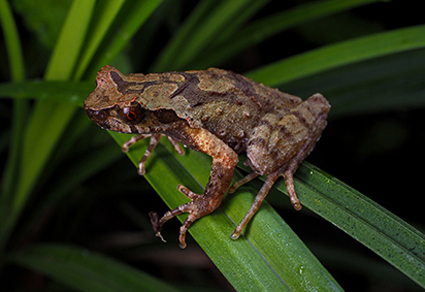
A new species of the genus Jingophrys is described from Xizang, China based on the morphological comparisons and phylogenetic reconstruction. Morphologically, this new species Jingophrys zhaoermii sp. nov. can be distinguished from other known congeners by a combination of diagnostic characteristics: (1) body size small, SVL 34.5–35.4 mm in adult males and SVL 39.6–43.1 mm in adult females; (2) tympanum distinct, upper margin slightly concealed by supratympanic fold; (3) presence of weak vomerine ridge, absence of vomerine teeth; (4) tongue notch absent; (5) hindlimbs slender, heels meeting when thighs flexed at right angles to the axis of body and tibiotarsal articulation reaching anterior corner of eye or tip of the snout when leg stretched alongside body; (6) fingers with lateral fringes, subarticular tubercles absent; (7) toes with rudimentary webbing at bases and lateral fringes; (8) dorsal skin relatively smooth (lack granules), strong discontinuous X-shaped ridge on center of dorsum, discontinuous dorsolateral ridges absent or weak; (9) sparse large tubercles on flanks, no granules between tubercles; (10) adult males lack nuptial pads. Phylogenetically, it differs from its congeners by uncorrected p-distances of >3.7% for the 16S gene fragment and uncorrected p-distances of >10.1% for the COI gene fragment. Additionally, we provide a new identification key to the genus Jingophrys.
References
- AmphibiaWeb (2025) AmphibiaWeb: information on amphibian biology and conservation. University of California, Berkeley, California. Available from: http://amphibiaweb.org/ (accessed 31 July 2025)
- Che, J., Jiang, K., Yan, F. & Zhang, Y.P. (2020) Amphibians and Reptiles in Tibet-Diversity and Evolution. Science Press, Beijing, 803 pp. [in Chinese]
- Chen, J.M., Zhou, W.W., Poyarkov, N.A., Stuart, B.L., Brown, R.M., Lathrop, A., Wang, Y.Y., Yuan, Z.Y., Jiang, K., Hou, M., Chen, H.M., Suwannapoom, C., Nguyen, S.N., Duong, T.V., Papenfuss, T.J., Murphy, R.W., Zhang, Y.P. & Che, J. (2017) A novel multilocus phylogenetic estimation reveals unrecognized diversity in Asian horned toads, genus Megophrys sensu lato (Anura: Megophryidae). Molecular Phylogenetics and Evolution, 106, 28–43. thttps://doi.org/10.1016/j.ympev.2016.09.004
- Delorme, M., Dubois, A., Grosjean, S. & Ohler, A. (2006) Une nouvelle ergotaxinomie des Megophryidae (Amphibia, Anura). Alytes, 24, 6–21.
- Deuti, K., Grosjean, S., Nicolas, V., Vasudevan, K. & Ohler, A. (2017) Nomenclatural puzzle in early Xenophrys nomina (Anura, Megophryidae) solved with description of two new species from India (Darjeeling hills and Sikkim). Alytes, 34, 20–48.
- Dubois, A., Ohler, A. & Pyron, R.A. (2021) New concepts and methods for phylogenetic taxonomy and nomenclature in zoology, exemplified by a new ranked cladonomy of recent amphibians (Lissamphibia). Megataxa, 5 (1), 1–738. thttps://doi.org/10.11646/megataxa.5.1.1
- Frost, D.R. (2025) Amphibian Species of the World: an online reference. Version 6.2. American Museum of Natural History, New York. Available from: https://amphibiansoftheworld.amnh.org/ (accessed 31 July 2025)
- Fei, L., Hu, S.Q., Ye, C.Y. & Huang, Y.Z. (2009) Fauna Sinica. Amphibia. Vol. 2. Anura. Science Press, Beijing, 503 pp. [in Chinese]
- Fei, L. & Ye, C.Y. (2016) Amphibians of China. Vol. 1. Science Press, Beijing, 1040 pp.
- Huang, Y.Z. & Fei, L. (1981) Two new species of amphibians from Xizang. Acta Zootaxonomica Sinica/Dong Wu Fen Lei Xue Bao, 6, 211–215.
- Jiang, K., Rao, D.Q., Yuan, S.Q., Wang, J.S., Li, P.P., Hou, M., Che, M. & Che, J. (2012) A new species of the genus Scutiger (Anura: Megophryidae) from southeastern Tibet, China. Zootaxa, 3388 (1), 29–40. thttps://doi.org/10.11646/zootaxa.3388.1.3
- Kumar, S., Stecher, G. & Tamura, K. (2016) MEGA7: Molecular Evolutionary Genetics Analysis Version 7.0 for Bigger Datasets. Molecular Biology and Evolution, 33 (7), 1870–1874. thttps://doi.org/10.1093/molbev/msw054
- Lanfear, R., Frandsen, P.B., Wright, A.M., Senfeld, T. & Calcott, B. (2017) PartitionFinder 2: New Methods for Selecting Partitioned Models of Evolution for Molecular and Morphological Phylogenetic Analyses. Molecular Biology and Evolution, 34 (3), 772–773. thttps://doi.org/10.1093/molbev/msw260
- Liu, Z.Y., Chen, G.L., Zhu, T.Q., Zeng, Z.C., Lyu, Z.T., Wang, J., Messenger, K., Greenberg, A.J., Guo, Z.X., Yang, Z.H., Shi, S.H. & Wang, Y.Y. (2018) Prevalence of cryptic species in morphologically uniform taxa—Fast speciation and evolutionary radiation in Asian frogs. Molecular Phylogenetics and Evolution, 127, 723–731. thttps://doi.org/10.1016/j.ympev.2018.06.020
- Lyu, Z.T., Qi, S., Wang, J., Zhang, S.Y., Zhao, J., Zeng, Z.C., Wan, H., Yang, J.H., Mo, Y.M. & Wang, Y.Y. (2023) generic classification of Asian horned Toads (Anura: Megophryidae: Megophryinae) and monograph of Chinese species. Zoological Research, 44 (2), 380–450. thttps://doi.org/10.24272/j.issn.2095-8137.2022.372
- Mahony, S., Foley, N.M., Biju, S.D. & Teeling, E.C. (2017) Evolutionary history of the Asian Horned Frogs (Megophryinae): integrative approaches to timetree dating in the absence of a fossil record. Molecular Biology and Evolution, 34, 744–771. thttps://doi.org/10.1093/molbev/msw267
- Mahony, S., Teeling, E.C. & Biju, S.D. (2013) Three new species of horned frogs, Megophrys (Amphibia: Megophryidae), from northeast India, with a resolution to the identity of Megophrys boettgeri populations reported from the region. Zootaxa, 3722 (2), 143–169. thttps://doi.org/10.11646/zootaxa.3722.2.2
- Ronquist, F., Teslenko, M., van der Mark, P., Ayres, D.L., Darling, A., Höhna, S., Larget, B., Liu, L., Suchard, M.A. & Huelsenbeck, J.P. (2012) MrBayes 3.2: Efficient Bayesian Phylogenetic Inference and Model Choice Across a Large Model Space. Systematic Biology, 61 (3), 539–542. thttps://doi.org/10.1093/sysbio/sys029
- Shi, S.C., Zhang, M.H., Xie, F., Jiang, J.P., Liu, W.L., Ding, L., Luan, L. & Wang, B. (2020) Multiple data revealed two new species of the Asian horned toad Megophrys Kuhl & Van Hasselt, 1822 (Anura: Megophryidae) from the eastern corner of the Himalayas. ZooKeys, 977, 101–161. thttps://doi.org/10.3897/zookeys.977.55693
- Stamatakis, A. (2014) RAxML version 8: a tool for phylogenetic analysis and post-analysis of large phylogenies. Bioinformatics, 30, 1312–1313. thttps://doi.org/10.1093/bioinformatics/btu033
- Weng, S.Y., Liu, X.L., Li, J.C., Yu, G.H. & Huang, J.K. (2025) A new species of Rhacophorus (Anura, Rhacophoridae) from Xizang, China, with a revision of the distribution of R. bipunctatus. Zoosystematics and Evolution, 101, 437–447. thttps://doi.org/10.3897/zse.101.142297
- Yang, J.H., Wang, J. & Wang, Y.Y. (2018) A new species of the genus Megophrys (Anura: Megophryidae) from Yunnan Province, China. Zootaxa, 4413 (2), 325–338. thttps://doi.org/10.11646/zootaxa.4413.2.5