

Abstract
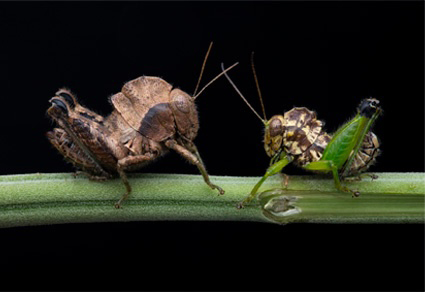
In this study, we describe five taxa of Melanoplinae from southwestern Mexico: Stegotettix cristata gen. nov. sp. nov., and three species of the genus Oaxaca Fontana, Buzzetti & Mariño-Pérez, 2011, O. pyromaculata sp. nov., O. tecuani sp. nov. and O. turquesa sp. nov. The taxonomic descriptions were based on morphological analyses of a minimum of 64 specimens collected over the last five years from at least eight localities per species. Taxonomic keys in tabular form are provided, along with information on the probable host plants, habitat, phenology, and occurrence records from iNaturalist. We discuss morphological similarities between the described taxa, as well as the morphological singularity of grasshoppers of genus Stegotettix cristata gen. nov. sp. nov. among other melanoplines. This work increases the known diversity of Melanoplinae in southwestern Mexico and highlights the region as an important center of endemism for the subfamily.
References
- Aguilar-Roldán, C.A., Gómez-Tapia, J.D., Mariño-Pérez, R., Song, H., Vázquez-Reyes, L.D. & Sanabria-Urbán, S. (2024) Studies in Mexican grasshoppers: four new species of the genus Oaxaca Fontana, Buzzetti & Mariño-Pérez, 2011 with the erection of the subgenus Paraoaxaca (Caelifera: Acrididae: Melanoplinae). Zootaxa, 5486 (4), 499–538. https://doi.org/10.11646/zootaxa.5486.4.3
- BugGuide.Net (2025) BugGuide: identification, images, and information for insects, spiders and their kin. Available from: https://bugguide.net/node/view/243292 (accessed 12 December 2025)
- Cigliano, M.M., Braun, H., Eades, D.C. & Otte, D. (2025) Orthoptera Species File. Version 5.0/5.0. Available from: http://orthoptera.speciesfile.org/ (accessed December 2025)
- Fontana, P., Buzzetti, F.M. & Mariño-Pérez, R. (2011) New Acrididae from Oaxaca State, Mexico (Orthoptera: Caelifera: Acrididae: Ommatolampinae, Melanoplinae). Zootaxa, 2862 (1), 39–55. https://doi.org/10.11646/zootaxa.2862.1.2
- Fontana, P., Mariño-Pérez, R., Sanabria-Urbán, S. & Woller, D.A. (2017) Studies in Mexican grasshoppers: three new species of Dactylotini (Acrididae: Melanoplinae) from Mexico and a review of existing conspecifics with comments on their geographical distributions. Zootaxa, 4337 (3), 301–343. https://doi.org/10.11646/zootaxa.4337.3.1
- González-Serna, M.J., Cordero, P.J. & Ortego, J. (2018) Using high-throughput sequencing to investigate the factors structuring genomic variation of a Mediterranean grasshopper of great conservation concern. Scientific Reports, 8, 13436. https://doi.org/10.1038/s41598-018-31775-x
- Hochkirch, A., Dey, L.-S. & Husemann, M. (2023) Phylogeography of the grasshopper genus Oedipoda (Acrididae: Oedipodinae) in the Mediterranean: classic refugia and cryptic lineages. Biological Journal of the Linnean Society, 140 (1), 85–95. https://doi.org/10.1093/biolinnean/blad044
- Honma, A., Oku, S. & Nishida, T. (2006) Adaptive significance of death-feigning posture as a specialized inducible defence against gape-limited predators. Proceedings of the Royal Society B, 273 (1594), 1631–1636. https://doi.org/10.1098/rspb.2006.3501
- Hubbell, T.H. (1932) A revision of the Puer group of the North American genus Melanoplus, with remarks on the taxonomic value of the concealed male genitalia in the Cyrtacanthacridinae (Orthoptera: Acrididae). Miscellaneous Publications, Museum of Zoology, University of Michigan, 23, 1–64.
- Koleff, P., Soberón, J., Arita, H.T., Dávila, P., Flores-Villela, O., Golubov, J. & Rodríguez, P. (2008) Patrones de diversidad espacial en grupos selectos de especies. In: Sarukhán, J. (Ed.), Capital natural de México. Vol. 1. CONABIO, Mexico City, pp. 323–364.
- Luna-Vega, I., Espinoza, D. & Contreras-Medina, R. (Eds.) (2016) Biodiversidad de la Sierra Madre del Sur: una síntesis preliminar. Universidad Nacional Autónoma de México, Mexico City, 528 pp.
- Morrone, J.J. (2017) Biogeographic regionalization of the Sierra Madre del Sur province, Mexico. Revista Mexicana de Biodiversidad, 88 (3), 710–714. https://doi.org/10.1016/j.rmb.2017.07.012
- Otte, D. (2014) Revision of the Mexican genus Philocleon (Orthoptera: Acrididae: Melanoplinae). Transactions of the American Entomological Society, 140, 209–236. https://doi.org/10.3157/061.140.0113
- Otte, D. & Cohn, T.J. (2002) Review of the genus Sinaloa (Acrididae: Melanoplinae): syntopy and allopatry in the lowlands of western Mexico. Journal of Orthoptera Research, 11 (2), 135–155. https://doi.org/10.1665/1082-6467(2002)011[0135:ROTGSA]2.0.CO;2
- Pfadt, R.E. (1994) Field guide to common western grasshoppers. 2nd edition. Wyoming Agricultural Experiment Station, Bulletin 912, Laramie, Wyoming.
- Rebrina, F., Brigić, A., Kasalo, N. & Skejo, J. (2025) The pronotum shape of scelimenine grasshoppers (Orthoptera: Tetrigidae) likely represents an exaptation for heterogeneous niche colonization. Current Zoology, 71 (1), 89–98. https://doi.org/10.1093/cz/zoae027
- Sanabria-Urbán, S., Song, H., Oyama, K., González-Rodríguez, A. & Cueva del Castillo, R. (2017) Integrative taxonomy reveals cryptic diversity in Neotropical grasshoppers: taxonomy, phylogenetics, and evolution of the genus Sphenarium Charpentier, 1842 (Orthoptera: Pyrgomorphidae). Zootaxa, 4274 (1), 1–86. https://doi.org/10.11646/zootaxa.4274.1.1
- Skejo, J., Gupta, S.K., Chandra, K., Panhwar, W.A. & Franjević, D. (2019) Oriental macropterous leaf-mimic pygmy grasshoppers, genera Oxyphyllum and Paraphyllum (Orthoptera: Tetrigidae), and their taxonomic assignment. Zootaxa, 4590 (5), 546–560. https://doi.org/10.11646/zootaxa.4590.5.3
- Wood, T.K. (1993) Diversity in the New World Membracidae. Annual Review of Entomology, 38, 409–433. https://doi.org/10.1146/annurev.en.38.010193.002205
- Woller, D.A., Fontana, P., Mariño-Pérez, R. & Song, H. (2014) Studies in Mexican grasshoppers: Liladownsia fraile, a new genus and species of Dactylotini (Acrididae: Melanoplinae), and an updated molecular phylogeny of Melanoplinae. Zootaxa, 3793 (4), 475–495. https://doi.org/10.11646/zootaxa.3793.4.6