

Abstract
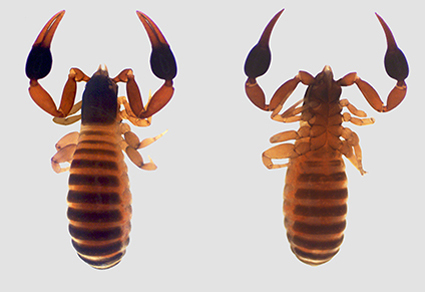
Despite its broad distribution across arid and semi-arid regions of Africa, Asia, southern Europe, and Australia, the pseudoscorpion genus Olpium L. Koch, 1873 (Pseudoscorpiones: Olpiidae) remains taxonomically neglected in Iran and only two species (O. omanense Mahnert, 1991 and O. lindbergi Beier, 1959) have been recorded from this country to date. Following detailed morphological study of extensive field collections in Iran, we describe two new species, O. tenebris sp. nov. and O. lacustre sp. nov., that are widely distributed across the country. Comprehensive descriptions, illustrations, and comparisons with closely related species are provided. To facilitate standardized identification and character evaluation, we present an updated species-level key for the genus Olpium, constructed using DELTA software.
References
- Ansari, A., Ghorbanpour, M., Kazemi, A. & Kariman, K. (2023) Ecological assessment of Iran’s terrestrial biomes for wildlife conservation. Scientific Reports, 13 (1), 17761. https://doi.org/10.1038/s41598-023-45120-4
- Beier, M. (1931) Neue Pseudoscorpione der UO Neobisiinea. Mitteilungen aus dem Zoologischen Museum in Berlin, 17, 299–318.
- Beier, M. (1932) Pseudoscorpionidea 1: Subord. Chthoniinea et Neobisiinea. Das Tierreich, 57, 1–258. https://doi.org/10.1515/9783111435107
- Beier, M. (1952) The 3rd Danish Expedition to Central Asia. Zoological Results 7. Pseudoscorpionidea (Chelicerata) aus Afghanistan. Videnskabelige Meddelelser fra Dansk Naturhistorisk Forening i Kjøbenhavn, 114, 245–250.
- Beier, M. (1959) Zur Kenntnis der Pseudoscorpioniden-Fauna Afghanistans. Zoologische Jahrbücher, Abteilung für Systematik, Ökologie und Geographie der Tiere, 87, 257–282.
- Beier, M. (1964) Über Pseudoskorpione von den Kanaren. Annalen des Naturhistorischen Museums in Wien, 67, 375–381.
- Beier, M. (1967a) Pseudoscorpione vom kontinentalen Südost-Asien. Pacific Insects, 9 (2), 341–369.
- Beier, M. (1967b) Die Pseudoscorpione der Noona Dan Expedition nach den Philippinen und Bismarck Inseln. Entomologiske Meddelelser, 35, 315–324.
- Beier, M. (1969) Neue Pseudoskorpione aus Australien. Annalen des Naturhistorischen Museums in Wien, 73, 171–187.
- Bedoya-Roqueme, E. & Tizo-Pedroso, E. (2020) Techniques for collection and sampling of pseudoscorpions (Arthropoda: Arachnida). In: Measuring Arthropod Biodiversity: A Handbook of Sampling Methods. Springer International Publishing, Cham, pp. 341–363. https://doi.org/10.1007/978-3-030-53226-0_14
- Chamberlin, J.C. (1931) The arachnid order Chelonethida. Biological Sciences, 7 (1), 1–284.
- Dallwitz, M.J., Paine, T. & Zurcher, E. (2006) User’s Guide to the DELTA System: A General System for Processing Taxonomic Descriptions, CSIRO Division of Entomology, Canberra. Available from: https://www.delta-intkey.com/www/uguide.pdf (accessed 15 Jul 2021)
- Dashdamirov, S. & Schawaller, W. (1993) Pseudoscorpions from Middle Asia, Part 2 (Arachnida: Pseudoscorpiones). Stuttgarter Beiträge zur Naturkunde, (A) 496, 1–14.
- Harvey, M.S. (1992) The phylogeny and classification of the Pseudoscorpionida (Chelicerata: Arachnida). Invertebrate Systematics, 6 (6), 1373–1435. https://doi.org/10.1071/IT9921373
- Harvey, M.S. & Edward, K.L. (2007) A review of the pseudoscorpion genus Ideoblothrus (Pseudoscorpiones, Syarinidae) from western and northern Australia. Journal of Natural History, 41 (5–8), 445–472. https://doi.org/10.1080/00222930701219123
- Harvey, M.S., Ratnaweera, P.B., Udagama, P.V. & Wijesinghe, M.R. (2012) A new species of the pseudoscorpion genus Megachernes (Pseudoscorpiones: Chernetidae) associated with a threatened Sri Lankan rainforest rodent, with a review of host associations of Megachernes. Journal of Natural History, 46 (41–42), 2519–2535. https://doi.org/10.1080/00222933.2012.707251
- Heurtault, J. (1979) Complément à la description de Olpium pallipes Lucas, 1845, type de la famille Olpiidae (Arachnides, Pseudoscorpions). Revue Suisse de Zoologie, 86, 925–931. https://doi.org/10.5962/bhl.part.82349
- Judson, M.L.I. (2007) A new and endangered species of the pseudoscorpion genus Lagynochthonius from a cave in Vietnam, with notes on chelal morphology and the composition of the Tyrannochthoniini (Arachnida, Chelonethi, Chthoniidae). Zootaxa, 1627 (1), 53–68. https://doi.org/10.11646/zootaxa.1627.1.4
- Latifi, Z., Nassirkhani, M. & Mirshamsi, O. (2020) A new epigean pseudoscorpion species (Pseudoscorpiones: Neobisiidae) from northeast of Iran, with an identification key to the species of the family Neobisiidae from Iran. Turkish Journal of Zoology, 44 (3), 230–237. https://doi.org/10.3906/zoo-1912-23
- Latifi, Z. & Mirshamsi, O. (2024) Withius hispanus (L. Koch, 1873) new to the fauna of Iran: with an identification key of Withius Kew, 1911 in the Palaearctic (Pseudoscorpione; Withiidae). Iranian Journal of Animal Biosystematics, 20 (2), 89–100.
- Mahnert, V. (1881) Taxonomische Irrwege: Olpium savignyi Simon, O. kochi Simon, O. bicolor Simon (Pseudoscorpiones). Bulletin de la Societe Zoologique de France, 6, 13–14.
- Mahnert, V. (1982) Die Pseudoskorpione (Arachnida) Kenyas: 3. Olpiidae. Monitore Zoologico Italiano, Supplemento, 16 (1), 263–304. https://doi.org/10.1080/00269786.1982.11758556
- Mahnert, V. (1991) Pseudoscorpions (Arachnida) from the Arabian Peninsula. Fauna of Saudi Arabia, 12, 171–199.
- Mahnert, V. (2007) Pseudoscorpions (Arachnida: Pseudoscorpiones) of the Socotra Archipelago, Yemen. Fauna of Arabia, 23, 271–307.
- Murthy, V.A. & Ananthakrishnan, T.N. (1977) Indian Chelonethi. Oriental Insects Monograph, 4, 1–210.
- Nassirkhani, M. (2015) Notes on Olpiidae (Arachnida: Pseudoscorpiones) from Iran: description of Cardiolpium bisetosum sp. nov. and redescription of Olpium omanense. Arachnologische Mitteilungen, 50, 1–10. https://doi.org/10.5431/aramit5001
- Nassirkhani, M. & Shoushtari, R.V. (2017) Key to the species of Megachernes Beier (Pseudoscorpiones: Chernetidae), with notes on M. afghanicus and M. pavlovskyi. Turkish Journal of Zoology, 41 (3), 568–575. https://doi.org/10.3906/zoo-1511-54
- Nassirkhani, M. & Zamani, A. (2018) Description of a new pseudoscorpion, Parolpium litoreum sp.n. (Pseudoscorpiones: Olpiidae) from southern islands of Iran. Arthropoda Selecta, 27, 325–329. https://doi.org/10.15298/arthsel.27.4.07
- Nassirkhani, M. (2022) First record of Neobisium (Neobisium) kobachidzei Beier (Pseudoscorpiones: Neobisiidae) from Iran, with a list of Iranian pseudoscorpion species. Arachnology, 19 (1), 7–14. https://doi.org/10.13156/arac.2022.19.1.7
- Noori, S., Zahiri, R., Yusefi, G.H., Rajabizadeh, M., Hawlitschek, O., Rakhshani, E., Husemann, M. & Rajaei, H. (2024) Patterns of zoological diversity in Iran—a review. Diversity, 16 (10), 621. https://doi.org/10.3390/d16100621
- Ohira, H., Kaneko, S., Faulks, L. & Tsutsumi, T. (2018) Unexpected species diversity within Japanese Mundochthonius pseudoscorpions (Pseudoscorpiones: Chthoniidae) and the necessity for improved species diagnosis revealed by molecular and morphological examination. Invertebrate Systematics, 32 (2), 259–277. https://doi.org/10.1071/IS17036
- Romero-Ortiz, C., Flórez, D.E. & Sarmiento, C.E. (2020) Assessment of morphometric characters to delimit species of Apolpium Chamberlin, 1930 (Pseudoscorpiones, Olpiidae). Journal of Natural History, 54 (15–16), 1025–1043. https://doi.org/10.1080/00222933.2020.1781273
- Turienzo, P., Di Iorio, O. & Mahnert, V. (2010) Global checklist of pseudoscorpions (Arachnida) found in birds’ nests. Revue Suisse de Zoologie, 117 (4), 557–598.
- Vachon, M. (1966) Olpium minnizioides nouvelle Espèce de Pseudoscorpions Olpiidae habitant l’île Hasikaya (Sud de L’arabie). Annals and Magazine of Natural History, Series 13, 9 (100–102), 183–188. https://doi.org/10.1080/00222936608656043
- World Pseudoscorpiones Catalog (2025) World Pseudoscorpiones Catalog. Natural History Museum Bern, Bern. Available from: https://wac.nmbe.ch/order/pseudoscorpiones (accessed 21 September 2025)
- Zamani, M., Shoushtari, R.V., Kahrarian, M. & Nassirkhani, M. (2019) New pseudoscorpion records (Arachnida: Pseudoscorpiones) from Lorestan province, western Iran, with redescriptions of Olpium lindbergi (Olpiidae) and Geogarypus shulovi (Geogarypidae). Arachnologische Mitteilungen, 57 (1), 77–83. https://doi.org/10.30963/aramit5714