

Abstract
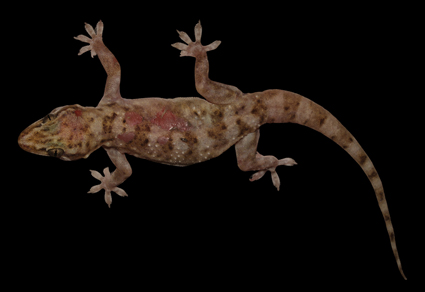
We describe a new species of leaf-toed gecko of the genus Hemidactylus from the southern Aravalli Hills in Gujarat, India. The new species is a member of the H. persicus complex and has previously been reported as conspecific with H. persicus. In light of the recent revision of H. persicus, we reassessed the status of the population reported from Gujarat, India. The population was found to be genetically and morphologically distinct and is here described as a new species. The new species is diagnosable by the following suite of characters: a medium-size (adult snout-vent length up to 65 mm); dorsal scalation on trunk granular, intermixed with slightly enlarged, regularly arranged transverse rows of 14 oval, feebly keeled or sub-trihedral tubercles; original tail lacks any enlarged tubercles; males with 3–8 precloacal pores. The new species, Hemidactylus aravalliensis sp. nov. is the third endemic species of gecko described from the Aravalli Hills and highlights the rich and unique diversity of this ancient yet understudied land mass.
References
- Agarwal, I. & Ramakrishnan, U. (2017) A phylogeny of open‐habitat lizards (Squamata: Lacertidae: Ophisops) supports the antiquity of Indian grassy biomes. Journal of Biogeography, 44 (9), 2021–2032. https://doi.org/10.1111/jbi.12999
- Agarwal, I., Bauer, A.M., Giri, V.B. & Khandekar, A. (2019) An expanded ND2 phylogeny of the brookii and prashadi groups with the description of three new Indian Hemidactylus Oken (Squamata: Gekkonidae). Zootaxa, 4619 (3), 431–458. https://doi.org/10.11646/zootaxa.4619.3.2
- Agarwal, I., Goyal, S.P. & Qureshi, Q. (2015) Lizards of the Thar Desert–Resource partitioning and community composition. Journal of Arid Environments, 118, 58–64. https://doi.org/10.1016/j.jaridenv.2015.03.003
- Agarwal, I., Thackeray, T., Pal, S. & Khandekar, A. (2020) Granite boulders act as deep-time climate refugia: A Miocene divergent clade of rupicolous Cnemaspis Strauch, 1887 (Squamata: Gekkonidae) from the Mysore Plateau, India, with descriptions of three new species. Journal of Zoological Systematics and Evolutionary Research, 58 (4), 1234–1261. https://doi.org/10.1111/jzs.12391
- Anderson, J. (1872) On some Persian, Himalayan, and other reptiles. Proceedings of the Zoological Society of London, 1872, 371–404.
- Anderson, S.C. (1999) The Lizards of Iran. Society for the Study of Amphibians and Reptiles, Oxford, Ohio, 442 pp., 25 pls.
- Bansal, R. & Karanth, K.P. (2010) Molecular phylogeny of Hemidactylus geckos (Squamata: Gekkonidae) of the Indian subcontinent reveals a unique Indian radiation and an Indian origin of Asian house geckos. Molecular Phylogenetics and Evolution, 57, 459–465. https://doi.org/10.1016/j.ympev.2010.06.008
- Bauer, A.M., de Silva, A., Greenbaum, E. & Jackman, T. (2007) A new species of day gecko from high elevation in Sri Lanka, with a preliminary phylogeny of Sri Lankan Cnemaspis (Reptilia, Squamata, Gekkonidae). Zoosystematics and Evolution, 83 (S1), 22–32. https://doi.org/10.1002/mmnz.200600022
- Bauer, A.M., Jackman, T.R., Greenbaum, E., Giri, V. & De Silva, A. (2010) South Asia supports a major endemic radiation of Hemidactylus geckos. Molecular Phylogenetics and Evolution, 57, 343–352. https://doi.org/10.1016/j.ympev.2010.06.014
- Bauer, A.M., Vyas, R., Jackman, T.R., Lajmi, A. & Giri, V.B. (2012) Hemidactylus porbandarensis Sharma, 1981 is a synonym of Hemidactylus robustus Heyden, 1827. Hamadryad, 36, 46–51.
- Blyth, E. (1853) Notices and descriptions of various reptiles, new or little known. Journal of the Asiatic Society of Bengal, 22, 639–655.
- Boruah, B., Narayanan, S., Aravind, N.A., Lalronunga, S., Deepak, V. & Das, A. (2024) Description of six new species of Cyrtodactylus Gray (Squamata: Gekkonidae) from northeastern India. Vertebrate Zoology, 74, 453–486. https://doi.org/10.3897/vz.74.e124752
- Carranza, S. & Arnold, E.N. (2006) Systematics, biogeography, and evolution of Hemidactylus geckos (Reptilia: Gekkonidae) elucidated using mitochondrial DNA sequences. Molecular Phylogenetics and Evolution, 38, 531–545. https://doi.org/10.1016/j.ympev.2005.07.012
- Carranza, S. & Arnold, E.N. (2012) A review of the geckos of the genus Hemidactylus (Squamata: Gekkonidae) from Oman based on morphology, mitochondrial and nuclear data, with descriptions of eight new species. Zootaxa, 3378, 1–95. https://doi.org/10.11646/zootaxa.3378.1.1
- Champion, H.G. & Seth, S.K. (1968) A Revised Survey of the Forest Types of India. Government of India, Delhi, 404 pp.
- Duméril, A.M.C. & Bibron, G. (1836) Erpetologie Générale ou Histoire Naturelle Complete des Reptiles. Vol. 3. Libr. Encyclopédique Roret, Paris, iv + 517 + [1] pp., 2 folding table, pls. 25–28 + 33 + 35 + 43–48.
- Goldfuss, G.A. (1820) Handbuch der Zoologie. Zweite Abtheilung. Johann Leonhard Schrag, Nuremberg, 510 pp.
- Günther, A. (1864) The Reptiles of British India. Taylor and Francis, London, xxvii + 452 pp., 26 pls. https://doi.org/10.5962/bhl.title.5012
- Harlan, R. (1825) Description of a new species of Agama. Journal of the Academy of Natural Sciences of Philadelphia, 4, 296–305, pl. xix.
- Heyden, C.H.G. von (1827) Reptilien. In: Rüppell, E. (Ed.), Atlas zu Reise im nördlichen Afrika. l. Zoologie. H. L. Brönner, Frankfurt am Main, pp. 24, 6 pls.
- Khandekar, A., Gaikwad, S.M., Thackeray, T., Gangalmale, S. & Agarwal, I. (2024a) A preliminary taxonomic revision of the girii clade of South Asian Cnemaspis Strauch, 1887 (Squamata: Gekkonidae) with the description of four new species from southern Maharashtra, India. Zootaxa, 5429 (1), 001–114. https://doi.org/10.11646/zootaxa.5429.1.1
- Khandekar, A., Thackeray, T. & Agarwal, I. (2024b) Two new nocturnal species of South Asian Cnemaspis Strauch, 1887 (Squamata, Gekkonidae) of the wynadensis clade from the southern Western Ghats. Zootaxa, 5443 (3), 353–386. https://doi.org/10.11646/zootaxa.5443.3.3
- Khandekar, A., Thackeray, T., Mariappan, R., Gangalmale, S., Waghe, V., Pawar, S. & Agarwal, I. (2023) A remarkable new species of gecko (Squamata: Gekkonidae: Hemidactylus) from scrublands at the southern tip of India. Vertebrate Zoology, 73, 433–450. https://doi.org/10.3897/vz.73.e101871
- Kumar, S., Stecher, G., Li, M., Knyaz, C. & Tamura, K. (2018) MEGA X: Molecular Evolutionary Genetics Analysis across computing platforms. Molecular Biology and Evolution, 35, 1547–1549. https://doi.org/10.1093/molbev/msy096
- Lajmi, A., Bansal, R., Giri, V. & Karanth, P. (2018) Phylogeny and biogeography of the endemic Hemidactylus geckos of the Indian subregion suggest multiple dispersals from Peninsular India to Sri Lanka, Zoological Journal of the Linnean Society, 186 (10), 286–301. https://doi.org/10.1093/zoolinnean/zly047
- Lajmi, A., Giri, V.B. & Karanth, K.P. (2016) Molecular data in conjunction with morphology help resolve the Hemidactylus brookii complex (Squamata: Gekkonidae). Organisms Diversity & Evolution, 16 (3), 659–677. https://doi.org/10.1007/s13127-016-0271-9
- Leary, S., Underwood, W., Anthony, R. & Cartner, S. (2013) AVMA Guidelines for the Euthanasia of Animals. 2013 Edition. AVMA, Schaumburg, 98 pp.
- Linnaeus, C. (1758) Systema Naturæ per Regna tria Naturæ, secundum Classes, Ordines, Genera, Species, cum Characteribus, Differentiis, Synonymis, Locis. Tomus I. Editio Decima, Reformata. Laurentii Salvii, Holmiae, 824 pp. https://doi.org/10.5962/bhl.title.542
- Minton, S.A. (1966) A contribution to the herpetology of West Pakistan. Bulletin of the American Museum of Natural History, 134, 27–184, pls. 9–36.
- Mirza, Z.A. (2024) A Further taxonomic reassessment of Cyrtodactylus madarensis Sharma, 1980 (Squamata: Gekkonidae) now in the genus Eublephairs Gray, 1827 (Squamata: Eublephariade). Taprobanica, 13, 9–15. https://doi.org/10.47605/tapro.v13i1.318
- Mirza, Z.A., Bhosale, H., Thackeray, T., Phansalkar, P., Sawant, M., Gowande, G. & Patel, H. (2022) A new species of bent-toed geckos of the genus Cyrtodactylus Gray, 1827 from western Arunachal Pradesh, India. Herpetozoa, 35, 65–76. https://doi.org/10.3897/herpetozoa.35.e80610
- Mirza, Z.A., Gowande, G.G., Patil, R., Ambekar, M. & Patel, H. (2018) First appearance deceives many: disentangling the Hemidactylus triedrus species complex using an integrated approach. PeerJ, 6, e5341. https://doi.org/10.7717/peerj.5341
- Mohapatra, P.P., Ray, S., Sarkar, S., Deuti, K., Palot, M.J., Sethy, P.G.S. & Bahuguna, A. (2024) Checklist of Fauna of India: Chordata: Reptilia. Online Version 1.0. Available from: https://zsi.gov.in/uploads/documents/checklist/english/119_REPTILIA.pdf (accessed 31 December 2025) https://doi.org/10.26515/Fauna/1/2023/Chordata:Reptilia
- Murray, J.A. (1884) The Vertebrate Zoology of Sind. A Systematic Account with Descriptions of all the Known Species of Mammals, Birds, and Reptiles Inhabiting the Province; Observations on Their Habits, &c; Tables of Their Geographic Distribution in Persia, Beloochistan, and Afghanistan; Punjab, North-West Provinces, and the peninsula of India Generally, with Woodcuts, Lithographs, and Coloured Illustrations. Richardson & Co., London, xvi + 424 pp., XIII pls. https://doi.org/10.5962/bhl.title.57275
- Nasrabadi, R., Rastegar-Pouyani, N., Rastegar-Pouyani, E. & Gharzi, A. (2017) A revised key to the lizards of Iran (Reptilia: Squamata: Lacertilia). Zootaxa, 4227 (3), 431–443. https://doi.org/10.11646/zootaxa.4227.3.9
- Pal, S., Mirza, Z.A., Dsouza, P. & Shanker, K. (2021) Diversifying on the Ark: Multiple new endemic lineages of dwarf geckos from the Western Ghats provide insights into the systematics and biogeography of South Asian Cnemaspis (Reptilia: Squamata). Zoological Research, 42 (6), 675–691. https://doi.org/10.24272/j.issn.2095-8137.2021.074
- Patel, H. & Vyas, R. (2019) Reptiles of Gujarat, India: updated checklist, distribution, and conservation status. Herpetology Notes, 12, 765–777.
- Patel, H. (2022) Revisiting the type of Cyrtopodion aravallense (Gill, 1997): redescription of the species with comments on the genus. Zootaxa, 5175 (4), 453–462. https://doi.org/10.11646/zootaxa.5175.4.3
- Patel, H., Thackeray, T., Mirza, Z.A. & Vyas, R. (2023) A new species of naked-toed gecko Cyrtopodion sensu lato (Squamata: Sauria: Gekkonidae) from Gujarat, India. Zootaxa, 5254 (3), 398–412. https://doi.org/10.11646/zootaxa.5254.3.6
- Rüppell, E. (1835) Neue Wirbelthiere zu der Fauna von Abyssinien gehörig, entdeckt und beschrieben. Säugethiere, Vögel, Amphibien & Fische. S. Schmerber, Frankfurt am Main, 40 pp., 14 pls., 116 pp., 42 pls, 18 pp., 6 pls. & 148 pp., 33 pls.
- Sayyed, A., Khot, R. & Purkayastha, J. (2025) A new tuberculate house gecko species (Squamata: Gekkonidae: Hemidactylus) from the northern Western Ghats of Maharashtra, India. Zootaxa, 5583 (2), 293–308. https://doi.org/10.11646/zootaxa.5583.2.4
- Schneider, J.G. (1801) Historiae Amphibiorum Naturalis et Literariae. Fasciculus secundus continens Crocodilos, Scincos, Chamaesauras, Boas. Pseudoboas, Elapes, Angues. Amphisbaenas et Caecilias. Frommanni, Jena, vi + 374 pp., 2 pls.
- Šmíd, J., Carranza, S., Kratochvíl, L., Gvoždík, V., Nasher, A.K. & Moravec, J. (2013) Out of Arabia: A complex biogeographic history of multiple vicariance and dispersal events in the gecko genus Hemidactylus (Reptilia: Gekkonidae). PLoS ONE, 8 (5), e64018. https://doi.org/10.1371/journal.pone.0064018
- Smith, M.A. (1935) The Fauna of British India, including Ceylon and Burma. Reptiles and Amphibia, Vol. II. Sauria. Taylor and Francis, London, xiii + 440 + [1] pp., 1 pl., 1 folding map.
- Thompson, J., Higgins, D. & Gibson, T. (1994) ClustalW: improving the sensitivity of progressive multiple sequence alignment through sequence weighting, position-specific gap penalties and weight matrix choice. Nucleic Acids Research, 22 (22), 4673–4680. https://doi.org/10.1093/nar/22.22.4673
- Uetz, P., Freed, P., Aguilar, R., Reyes, F., Kudera, J. & Hošek, J. (2025) The Reptile Database. Available from: http://www.reptile-database.org (accessed 20 April 2025)
- Vyas, R. (2011) Preliminary survey on reptiles of Jassore Wildlife Sanctuary, Gujarat State, India. Russian Journal of Herpetology, 18 (3), 210–214.
- Vyas, R., Giri, V. & Bauer, A. (2006) First records of Hemidactylus persicus Anderson, 1872 (Squamata: Sauria: Gekkonidae) from the republic of India, with notes on its distribution. Hamadryad, 30 (1 & 2), 209–211.
- Werner, F. (1896) Über eine Sammlung von Reptilien aus Persien, Mesopotamien und Arabien. Verhandlungen der Zoologisch-Botanischen Gesellschaft in Wien, 45, 13–22. https://doi.org/10.5962/bhl.part.26910