
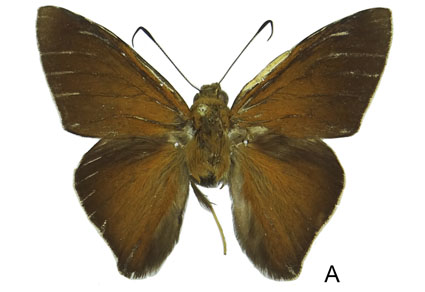

Abstract
One striking feature of Porphyrogenes Watson, 1893 species (Lepidoptera: Hesperiidae, Eudaminae, Phocidini) is the pronounced sexual dimorphism which challenges taxonomists in associating males and females. In this paper, using DNA barcoding, one female collected in Maranhão (Brazil) is associated with a previously described species only known from Rondônia (Brazil), Porphyrogenes spadix Austin & Mielke, 2008. The phenotype of the female collected in Maranhão matches one of the unassociated females described previously.
References
- Austin, G.T., Brock, J.P. & Mielke, O.H.H. (1993) Ants, birds, and skippers. Tropical Lepidoptera Research, 4 (2), 1–11.
- Austin, G.T. & Mielke, O.H.H. (2008) Hesperiidae of Rondônia, Brazil: Porphyrogenes Watson (Lepidoptera: Pyrginae: Eudamini), with descriptions of new species from Central and South America. Insecta Mundi, 44, 1–56.
- Beccaloni, G.W., Viloria, A.L., Hall, S.K. & Robinson, G.S. (2008) Catalogue of the hostplants of the Neotropical butterflies/ Catálogo de las plantas huésped de las mariposas neotropicales. Monogragias Tercer Milenio, Vol. 8, Zaragoza.
- Burns, J.M., Janzen, D.H. & Hallwachs, W. (2010) Of many similar species in the Neotropical genus Porphyrogenes (Lepidoptera: Hesperiidae), a new one, repeatedly reared in Costa Rica, is relatively distinct. Proceedings of Entomological Society of Washington, 112 (1), 32–42. https://doi.org/10.4289/0013-8797-112.1.32
- Carneiro, E., Mielke, O.H.H. & Casagrande, M.M. (2013) Thorax and abdome morphology of some Neotropical Hesperiidae (Lepidoptera). Insecta Mundi, 327, 1–47.
- Filardi, F. L. R. & Lima, H. C. (2014) The Diversity of Machaerium (Leguminosae: Papilionoideae) in the Atlantic Forest: Three New Species, Nomenclatural Updates, and a Revised Key. Systematic Botany, 39 (1), 145–159. https://doi.org/10.1600/036364414X678026
- Katoh, K. & Standley, D.M. (2013) MAFFT Multiple sequence alignment software version 7: improvements in performance and usability. Molecular Biology and Evolution, 30 (4), 772–780. https://doi.org/10.1093/molbev/mst010
- Kimura, M. (1980) A simple method for estimating evolutionary rates of base substitutions through comparative studies of nucleotide sequences. Journal of Molecular Evolution, 16, 111–120. https://doi.org/10.1007/BF01731581
- Kumar, S., Stecher, G., Suleski, M., Sanderford, M., Sharma, S. & Tamura, K. (2024) Molecular Evolutionary Genetics Analysis Version 12 for adaptive and green computing. Molecular Biology and Evolution, 41 (12), 1–9. https://doi.org/10.1093/molbev/msae263
- Lavin, M. (1988) Systematics of Coursetia (Leguminosae-Papilionoideae). Systematics Botany Monographs, 21, 1–167. https://doi.org/10.2307/25027701
- Li, W., Cong, Q., Shen, J., Hallwachs, W., Janzen, D.H. & Grishin, N.V. (2019) Genomes of skipper butterflies reveal extensive convergence of wing patterns. Proceedings of the National Academy of Sciences of the United States of America, 116 (13), 6232–6237. https://doi.org/10.1073/pnas.1821304116
- Maas, P.J.M., Westra, L.Y.Th., Chatrou, L.W., Verspagen, N., Rainder, H., Zamora, N.A. & Erkens, R.H.J. (2019) Twelve new and exciting Annonaceae from the Neotropics. PhytoKeys, 126, 25–69. https://doi.org/10.3897/phytokeys.126.33913
- Magalhães, I.L.F., Martins, P.H., Nogueira, A.A. & Santos, A.J. (2017) Finding host singles: matching males to females in dimorphic spiders (Araneidae: Micrathena) using phylogenetic placement and DNA barcoding. Invertebrate Systematics, 31 (1), 8–36. https://doi.org/10.1071/IS15062
- Martins, A.L., Muniz, D.B. & Domahovski, A.C. (2024) Descriptions of the male Gonatopus pinhalensis (Dryinidae, Gonatopodinae) supported by DNA barcoding and new host records. Insect Systematic & Evolution, 56 (2), 111–124. https://doi.org/10.1163/1876312x-bja10067
- Mielke, O.H.H. (2025) Catalogue of the American Hesperioidea: Hesperiidae (Lepidoptera). Vol. 7. Hesperiinae. Part 3. Hesperiini. Part 3. Moncina, Thymelicina, Megathymini, Pericharini. Version 20 December 2025. Available from: https://sites.google.com/site/lablepneo/publica%C3%A7%C3%B5es/livros (accessed 20 December 2025)
- Moss, A.M. (1949) Biological notes on some Hesperiidae of Para and the Amazon. Acta Zoologica Lilloana, 6, 27–29.
- Prance, G.T. (2022) A synopsis of Neotropical Dichapetalaceae. Kew Bulletin, 77, 147–187. https://doi.org/10.1007/s12225-021-09993-w
- Saitou, N. & Nei, M. (1987) The neighbor-joining method: a new method for reconstructing phylogenetic trees. Molecular Biology and Evolution, 4 (4), 406–425. https://doi.org/10.1093/oxfordjournals.molbev.a040454
- Snak, C., Vatanparast, M., Silva, C., Lewis, G.P., Lavin, M., Kajita, T. & Queiroz, L.P. (2016) A dated phylogeny of the papilionoid legume genus Canavalia reveals recent diversification by a pantropical liana lineage. Molecular Phylogenetics and Evolution, 98, 133–146. https://doi.org/10.1016/j.ympev.2016.02.001
- Toledo, C.A.P., Lucas, E.J., Forero, E., Falcão, M.J.A., Shimizu, G.H. & Souza, V.C. (2024) A taxonomic revision of Neotropical Connarus (Connaraceae). Taxon, 73 (1), 13–123. https://doi.org/10.1002/tax.13109
- Xue, G., Ikari, E., Inayoshi, Y. & Li, M. (2019) Hasora mavis Evans, 1934 syn. n. is confirmed to be the female of H. leucospila leucospila (Mabille, 1891) (Hesperiidae, Coeliadinae) by DNA barcoding. Zootaxa, 4965 (4), 391–393. https://doi.org/10.11646/zootaxa.4695.4.7
- Xue, G., Qu, P., Li, M., Chiba, H. & Li, W. (2022) Molecular and morphological evidences confirm the statuses of Ancistroides othonias (Hewitson, 1878) and the subspecies of A. nigrita (Latreille, [1824]), sensu Evans 1949 (Lepidoptera, Hesperiidae). Zootaxa, 5205 (5), 481–490. https://doi.org/10.11646/zootaxa.5205.5.5
- Xue, G., Inayoshi, Y., Li, M. & Zou, E. (2024) Some taxonomic notes on Capila translucida (Leech, 1894) and C. hainana Crowley, 1900 (Hesperiidae, Pyrginae). Zootaxa, 5410 (3), 384–391. https://doi.org/10.11646/zootaxa.5410.3.5
- Zhang, J., Cong, Q., Shen, J. & Grishin, N.V. (2022) Taxonomic changes suggested by the genomic analysis of Hesperiidae (Lepidoptera). Insecta Mundi, 921, 1–135.