

Abstract
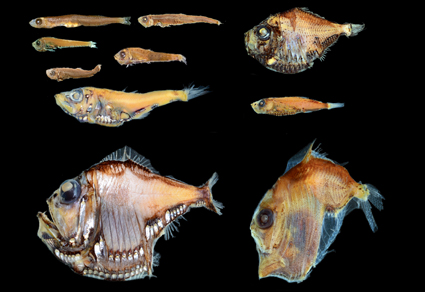
The dragonfishes and allies (Stomiiformes) are among the most species rich and ecologically important clades of deep-sea fishes. Within the Stomiiformes, the marine hatchetfishes (Sternoptychidae) are the second largest family with 10 genera and 79 species. Sternoptychids are well known for their highly reflective bodies and bioluminescent photophores that are hypothesized to aid camouflage and allow communication with conspecifics in the deep sea. While sternoptychids in Argyropelecus, Polyipnus, and Sternoptyx have anteriorly deep and posteriorly shallow bodies that resemble a hatchet or an ax in lateral view, the seven other sternoptychid genera have a more uniform, slender body; these differences have been used to separate these clades into two subfamilies. Despite their ecological importance and captivating life history, the phylogeny of this group has not been studied as extensively as other deep-sea fish groups. To date, phylogenetic studies have primarily used morphological characters to examine sternoptychid evolutionary relationships, and, perhaps surprisingly, prior molecular studies with sufficient genus-level sampling have never recovered the family as monophyletic. Herein, we investigate the evolutionary relationships of the Sternoptychidae using 415 mitochondrial and nuclear loci (including ultraconserved elements [UCEs]) and 149 morphological characters. We present the results of concatenated and species-tree molecular analyses and combined phylogenetic analysis. Based on these results, we provide a revised monophyletic classification that recognizes a monophyletic Sternoptychidae without any subfamilies because our results recovered a paraphyletic Sternoptychinae and a polyphyletic Maurolicinae. Specifically, our combined analyses revealed that the slender-bodied species in Maurolicus were nested within the traditionally recognized deeper-bodied sternoptychines (Argyropelecus, Polyipnus, and Sternoptyx). This four-genus clade was found sister to a slender-bodied clade composed of Araiophos, Argyripnus, Danaphos, Sonoda, Thorophos, and Valenciennellus. Unlike previous molecular analyses, all genera that included more than one species in our analyses were recovered as monophyletic. Our revised sternoptychid phylogeny provides a comprehensive framework for subsequent researchers interested in exploring evolutionary scenarios for the marine hatchetfishes.
References
- Ahlstrom, E.H. (1974) The diverse patterns of metamorphosis in gonostomatid fishes - an aid to classification. In: Blaxter, J.H.S. (Ed.), The Early Life History of Fish. Springer-Verlag, Berlin, pp. 659–674. https://doi.org/10.1007/978-3-642-65852-5_52
- Ahlstrom, E.H., Richards, W.J. & Weitzman, S.H. (1984) Families Gonostomatidae, Sternoptychidae, and associated stomiiform groups: development and relationships. In: Moser, H.G., Richards, W.J., Cohen, D.M., Fahay, M.P., Kendall Jr., A.W. & Richardson, S.L. (Eds.), Ontogeny and Systematics of Fishes. American Society of Ichthyologists and Herpetologists, Special Publication No. 1. American Society of Ichthyologists and Herpetologists, Lawrence, Kansas, pp. 184–198.
- Alves Gomes, A.A., Sidlauskas, B.L., Machado, F.A., Caires, R.A. & de Melo, M.R.S. (2024) Body-shape evolution among the dragonfishes and their allies (Teleostei: Stomiiformes). Ichthyology & Herpetology, 112 (3), 473–488. https://doi.org/10.1643/i2023068
- Arrondo, N.V., Gomes-Dos-Santos, A., Román Marcote, E., Pérez, M., Froufe, E. & Castro, L.F.C. (2020) A new gene order in the mitochondrial genome of the deep-sea diaphanous hatchet fish Sternoptyx diaphana Hermann, 1781 (Stomiiformes: Sternoptychidae). Mitochondrial DNA, Part B, 5 (3), 2850–2852. https://doi.org/10.1080/23802359.2020.1790325
- Baird, R.C. (1971) Systematics, distribution, and zoogeography of the marine hatchetfish (Family Sternoptychidae). Bulletin of the Museum of Comparative Zoology, 142 (1), 1–128.
- Baird, R.C. & Eckardt, M.J. (1972) Divergence and relationship in deep-sea hatchetfishes (Sternoptychidae). Systematic Zoology, 21 (1), 80–90. https://doi.org/10.2307/2412260
- Baird, R.C. (1986) Tribe Sternoptychini. In: Smith, M.M. & Heemstra, P.C. (Eds.), Smith’s Sea Fishes. Macmillan South Africa, Johannesburg, pp. 255–259.
- Betancur-R., R., Broughton, R.E., Wiley, E.O., Carpenter, K., López, J.A., Li, C., Holcroft, N.I., Arcila, D., Sanciangco, M., Cureton, II, J.C., Zhang, F., Buser, T., Campbell, M.A., Ballesteros, J.A., Roa-Varon, A., Willis, S., Borden, W.C., Rowley, T., Reneau, P.C., Hough, D.J., Lu, G., Grande, T., Arratia, G. & Ortí, G. (2013) The tree of life and a new classification of bony fishes. PLoS Currents Tree of Life, 5, ecurrents.tol.53ba26640df0ccaee75bb165c8c26288. https://doi.org/10.1371/currents.tol.53ba26640df0ccaee75bb165c8c26288
- Brauer, A. (1906) Die Tiefsee-Fische. I. Systematischer Teil. In: Chun, C. (Ed.), Wissenschaftl. Ergebnisse der deutschen Tiefsee-Expedition “Valdivia,” 1898–99. Jena.1898–1899. Vol. 15. Verlag von Gustav Fescher, Jena, pp. 1–432.
- Brauer, A. (1908) Die Tiefsee-Fische. II. Systematischer Teil. In: Chun, C. (Ed,), Wissenschaftl. Ergebnisse der deutschen Tiefsee-Expedition “Valdivia,” 1898–99. Jena.1898–1899. Vol. 15. Verlag von Gustav Fescher, Jena, pp. 1–266.
- Chakrabarty, P., Davis, M.P., Smith, W.L., Baldwin, Z.H. & Sparks, J.S. (2011) Is sexual selection driving diversification of the bioluminescent ponyfishes (Teleostei: Leiognathidae)? Molecular Ecology, 20, 2818–2834. https://doi.org/10.1111/j.1365-294X.2011.05112.x
- Chen, W.-J., Lavoué, S. & Mayden, R.L. (2013) Evolutionary origin and early biogeography of otophysan fishes (Ostariophysi: Teleostei). Evolution, 67 (8), 2218–2239. https://doi.org/10.1111/evo.12104
- Chen, W.-J., Santini, F., Carnevale, G., Chen, J.-N., Liu, S.-H., Lavoué, S. & Mayden, R.L. (2014) New insights on early evolution of spiny-rayed fishes (Teleostei: Acanthomorpha). Frontiers in Marine Science, 1 (53), 1–17. https://doi.org/10.3389/fmars.2014.00053
- Chernomor, O., von Haeseler, A. & Minh, B.Q. (2016) Terrace aware data structure for phylogenomic inference from supermatrices. Systematic Biology, 65 (6), 997–1008. https://doi.org/10.1093/sysbio/syw037
- Davis, M.P. (2010) Evolutionary relationships of the Aulopiformes (Euteleostei: Cyclosquamata): a molecular and total evidence approach. In: Nelson, J.S., Schultze, H.-P. & Wilson, M.V.H. (Eds.), Origin and Phylogenetic Interrelationships of Teleosts. Verlag Dr. F. Pfeil, München, pp. 431–470.
- Davis, M.P., Holcroft, N.I., Wiley, E.O., Sparks, J.S. & Smith, W.L. (2014) Species-specific bioluminescence facilitates speciation in the deep-sea. Marine Biology, 161, 1139–1148. https://doi.org/10.1007/s00227-014-2406-x
- Davis, M.P., Sparks, J.S. & Smith, W.L. (2016) Repeated and widespread evolution of bioluminescence in marine fishes. PLoS ONE, 11 (6), 1–11. https://doi.org/10.1371/journal.pone.0155154
- Eduardo, N.L., Bertrand, A., Mincarone, M.M., Santos, L.V., Frédou, T., Assunção, R.V., Silva, A., Ménard, F., Schwamborn, R. & Le Loc’h, Lucena-Frédou, F. (2020) Hatchetfishes (Stomiiformes: Sternoptychidae) biodiversity, trophic ecology, vertical niche partitioning and functional roles in the western Tropical Atlantic. Progress in Oceanography, 187, 122389. https://doi.org/10.1016/j.pocean.2020.102389
- Ellis, E.A. & Oakley, T.H. (2016) High rates of species accumulation in animals with bioluminescent courtship displays. Current Biology, 26 (14), 1916–1921. https://doi.org/10.1016/j.cub.2016.05.043
- Faircloth, B.C. (2016) PHYLUCE is a software package for the analysis of conserved genomic loci. Bioinformatics, 32 (5), 786–788. https://doi.org/10.1093/bioinformatics/btv646
- Faircloth, B.C., Sorenson, L., Santini, F. & Alfaro, M.E. (2013) A phylogenomic perspective on the radiation of ray-finned fishes based upon targeted sequencing of ultraconserved elements (UCEs). PLoS ONE, 8, e65923. https://doi.org/10.1371/journal.pone.0065923
- Fink, W.L. (1984) Stomiiformes: relationships. In: Moser, H.G., Richards, W.J., Cohen, D.M., Fahay, M.P., Kendall, Jr., A.W. & Richardson, S.L. (Eds.), Ontogeny and Systematics of Fishes. American Society of Ichthyologists and Herpetologists Special Publication No. 1. American Society of Ichthyologists and Herpetologists, Lawrence, Kansas, pp. 181–184.
- Fink, W.L. & Weitzman, S.H. (1982) Relationships of the stomiiform fishes (Teleostei), with a description of Diplophos. Bulletin of the Museum of Comparative Zoology, 150 (2), 31–93.
- Fricke, R., Eschmeyer, W.N. & van der Laan, R. (2025) Eschmeyer’s Catalog of Fishes: genera, species, references. Available from: https://researcharchive.calacademy.org/research/ichthyology/catalog/fishcatmain.asp (accessed June 2025)
- Girard, M.G., Davis, M.P. & Smith, W.L. (2020) The phylogeny of carangiform fishes: morphological and genomic investigations of a new fish clade. Copeia, 108 (2), 265–298. https://doi.org/10.1643/ci-19-320
- Grande, T., Borden, W.C. & Smith, W.L. (2013) Limits and relationships of Paracanthopterygii: a molecular framework for evaluating past morphological hypotheses. In: Arratia, G., Schultze, H.-P. & Wilson, M.V.H. (Eds.), Mesozoic Fishes 5–Global Diversity and Evolution. Verlag Dr. Friedrich Pfeil, München, pp. 385–418.
- Grey, M. (1959) Three new genera and one new species of the family Gonostomatidae. Bulletin of the Museum of Comparative Zoology, 121, 167–184.
- Grey, M. (1960) A preliminary review of the family Gonostomatidae, with a key to the genera and the description of a new species from the tropical Pacific. Bulletin of the Museum of Comparative Zoology, 122, 57–125.
- Haddock, S.H.D., Moline, M.A. & Case, J.F. (2010) Bioluminescence in the sea. Annual Review of Marine Science, 2, 443–493. https://doi.org/10.1146/annurev-marine-120308-081028
- Harold, A.S. (1993) Phylogenetic relationships of the sternoptychid Argyropelecus (Teleostei: Stomiiformes). Copeia, 1993 (1), 123–133. https://doi.org/10.2307/1446303
- Harold, A.S. (1994) A taxonomic revision of the sternoptychid genus Polyipnus (Teleostei: Stomiiformes), with an analysis of phylogenetic relationships. Bulletin of Marine Science, 54 (2), 428–534.
- Harold, A.S. (1998) Phylogenetic relationships of the Gonostomatidae (Teleostei: Stomiiformes). Bulletin of Marine Science, 62 (3), 715–741.
- Harold, A.S. & Weitzman, S.H. (1996) Interrelationships of stomiiform fishes. In: Stiassny, M.L.J., Parenti, L.R. & Johnson, G.D. (Eds.), Interrelationship of Fishes. 2nd Edition. Academic Press, San Diego, pp. 333–353. https://doi.org/10.1016/B978-012670950-6/50014-X
- Harvey, E.N. (1952) Bioluminescence. Academic Press Inc., New York, New York, 649 pp.
- Helfman, G.S., Collette, B.B., Facey, D.E. & Bowen, B.W. (2009) The Diversity of Fishes: Biology, Evolution, and Ecology, 2nd Edition. Wiley-Blackwell, Hoboken, New Jersey, 720 pp.
- Herring, P.J. & Morin, J.G. (1978) Bioluminescence in fishes. In: Herring, P.J. (Ed.), Bioluminescence in Action. Academic Press, London, pp. 273–329.
- Hughes, L.C., Ortí, G., Huang, Y., Sun, Y., Baldwin, C.C., Thompson, A.W., Arcila, D., Betancur-R, R., Li, C., Becker, L., Bellora, N., Zhao, X., Li, X., Wang, M., Fang, C., Xie, B., Zhoug, Z., Huang, H., Chen, S., Venkatesh, B. & Shi, Q. (2018) Comprehensive phylogeny of ray-finned fishes (Actinopterygii) based on transcriptomic and genomic data. Proceedings of the National Academy of Sciences of the United States of America, 115 (24), 6249–6254. https://doi.org/10.1073/pnas.1719358115
- Ilves, K.L. & Taylor, E.B. (2009) Molecular resolution of the systematics of a problematic group of fishes (Teleostei: Osmeridae) and evidence for morphological homoplasy. Molecular Phylogenetics and Evolution, 50, 163–178. https://doi.org/10.1016/j.ympev.2008.10.021
- Katoh, K. & Standley, D.M. (2013) MAFFT multiple-sequence-alignment software version 7: improvements in performance and usability. Molecular Biology and Evolution, 30 (4), 772–780. https://doi.org/10.1093/molbev/mst010
- Kearse, M., Moir, R., Wilson, A., Stones-Havas, S., Cheung, M., Sturrock, S., Buxton, S., Cooper, A., Markowitz, S., Duran, C., Thierer, T., Ashton, B., Meintjes, P. & Drummond, A. (2012) Geneious Basic: an integrated and extendable desktop software platform for the organization and analysis of sequence data. Bioinformatics, 28 (12), 1647–1649. https://doi.org/10.1093/bioinformatics/bts199
- Kenaley, C.P., DeVaney, S.C. & Fjeran, T.T. (2014) The complex evolutionary history of seeing red: molecular phylogeny and the evolution of an adaptive visual system in deep-sea dragonfishes (Stomiiformes: Stomiidae). Evolution, 68 (4), 996–1013. https://doi.org/10.1111/evo.12322
- Kinzer, J. & Schulz, K. (1988) Vertical distribution and feeding patterns of midwater fish in the central equatorial Atlantic II. Sternoptychidae. Marine Biology, 99 (2), 261–269. https://doi.org/10.1007/BF00391989
- Lanfear, R., Calcott, B., Ho, S.Y.W. & Guindon, S. (2012) PartitionFinder: combined selection of partitioning schemes and substitution models for phylogenetic analyses. Molecular Biology and Evolution, 29 (6), 1695–1701. https://doi.org/10.1093/molbev/mss020
- Lewis, P.O. (2001) A likelihood approach to estimating phylogeny from discrete morphological character data. Systematic Biology, 50 (6), 913–925. https://doi.org/10.1080/106351501753462876
- Maddison, W.P. & Maddison, D.R. (2018) Mesquite: a modular system for evolutionary analysis. Version. 3.8.1 Available from: https://mesquiteproject.org (accessed May 2025)
- Maile, A.J., Smith, W.L. & Davis, M.P. (2025) A total-evidence phylogenetic approach to understanding the evolution, depth transitions, and body-shape changes in the anglerfishes and allies (Acanthuriformes: Lophioidei). PLoS ONE, 20 (5), e0322369. https://doi.org/10.1371/journal.pone.0322369
- Martin, R.P., Davis, M.P. & Smith, W.L. (2022) The impact of evolutionary trade-offs among bioluminescent organs and body shape in the deep sea: a case study on lanternfishes. Deep-sea Research I, 184, 103769. https://doi.org/10.1016/j.dsr.2022.103769
- Martin, R.P., Olson, E.E., Girard, M.G., Smith, W.L. & Davis, M.P. (2018) Light in the darkness: new perspectives on lanternfish relationships and classification using genomic and morphological data. Molecular Phylogenetics and Evolution, 121, 71–85. https://doi.org/10.1016/j.ympev.2017.12.029
- Martinez, C.M., Friedman, S.T., Corn, K.A., Larouche, O., Price, S.A. & Wainwight, P.C. (2021) The deep sea is a hot spot of fish body shape evolution. Ecology Letters, 24 (9), 1788–1799. https://doi.org/10.1111/ele.13785
- May, Z.A. (2019) Evolutionary relationships and evolution of body shape of the deep-sea hatchetfishes (Stomiiformes: Sternoptychidae). M.S. Thesis, St. Cloud State University, St. Cloud, Minnesota, 76 pp.
- Mensinger, A.F. & Case, J.F. (1990) Luminescent properties of deep sea fish. Journal of Experimental Marine Biology and Ecology, 144 (1), 1–15. https://doi.org/10.1016/0022-0981(90)90015-5
- Minh, B.Q., Schmidt, H.A., Chernomor, O., Schrempf, D., Woodhams, M.D., von Haeseler, A. & Lanfear, R. (2020) IQ-TREE 2: new models and efficient methods for phylogenetic inference in the genomic era. Molecular Biology and Evolution, 37 (5), 1530–1534. https://doi.org/10.1093/molbev/msaa015
- Mirande, J.M. (2017) Combined phylogeny of ray-finned fishes (Actinopterygii) and the use of morphological characters in large-scale analyses. Cladistics, 33 (4), 333–350. https://doi.org/10.1111/cla.12171
- Miya, M. & Nishida, M. (1998) Molecular phylogeny and evolution of the deep-sea fish genus Sternoptyx. Molecular Phylogenetics and Evolution, 10 (1), 11–22. https://doi.org/10.1006/mpev.1997.0479
- Miya, M. & Nishida, M. (2000) Molecular systematics of the deep-sea fish genus Gonostoma (Stomiiformes: Gonostomatidae): two paraphyletic clades and resurrection of Sigmops. Copeia, 2000 (2), 378–389. https://doi.org/10.1643/0045-8511(2000)000[0378:MSOTDS]2.0.CO;2
- Near, T.J., Dornburg, A., Eytan, R.I., Keck, B.P., Smith, W.L., Kuhn, K.L., Moore, J.A., Price, S.A., Burbrink, F.T., Friedman, M. & Wainwright, P.C. (2013) Phylogeny and tempo of diversification in the superradiation of spiny-rayed fishes. Proceedings of the National Academy of Sciences of the United States of America, 110 (31), 12738–12743. https://doi.org/10.1073/pnas.1304661110
- Near, T.J., Eytan, R.I., Dornburg, A., Kuhn, K.L., Moore, J.A., Davis, M.P., Wainwright, P.C., Friedman, M. & Smith, W.L. (2012) Resolution of ray-finned fish phylogeny and timing of diversification. Proceedings of the National Academy of Sciences of the United States of America, 109 (34), 13698–13703. https://doi.org/10.1073/pnas.1206625109
- Nelson, J.S., Grande, T.C. & Wilson, M.V.H. (2016) Fishes of the World. 5th edition. John Wiley & Sons, Hoboken, New Jersey, 752 pp.
- Norman, J.R. (1930) Oceanic fishes and flatfishes collected in 1925–1927. Discovery Reports, 2, 261–369.
- Parin, N.V. & Kobyliansky, S.G. (1996) Diagnoses and distribution of fifteen species recognized in genu Maurolicus Cocco (Sternoptychidae, Stomiiformes) with a key to their Identification. Cybium, 20 (2), 185–195.
- Poulsen, J.Y. (2015) A new species of pencil smelt Nansenia boreacrassicauda (Microstomatidae, Argentiniformes) from the North Atlantic Ocean. Zootaxa, 4020 (3), 517–532. https://doi.org/10.11646/zootaxa.4020.3.6
- Priede, I.G. (2017) Deep-Sea Fishes: Biology, Diversity, Ecology and Fisheries. Cambridge University Press, Cambridge, 492 pp. https://doi.org/10.1017/9781316018330
- Rabosky, D.L., Chang, J., Title, P.O., Cowman, P.F., Sallan, L., Friedman, M., Kaschner, K., Garilao, C., Near, T.J., Coll, M. & Alfaro, M.E. (2018) An inverse latitudinal gradient in speciation rate for marine fishes. Nature, 559, 392–395. https://doi.org/10.1038/s41586-018-0273-1
- Randall, D.J. & Farrell, A.P. (1997) Deep-sea Fishes. Academic Press, San Diego, 388 pp.
- Ratnasingham, S., Wei, C., Chan, D., Agda, J., Agda, J., Ballesteros-Mejia, L., Ait Boutou, H., El Bastami, Z.M., Ma, E., Manjunath, R., Rea, D., Ho, C., Telfer, A., McKeowan, J., Rahulan, M., Steinke, C., Dorsheimer, J., Milton, M. & Hebert, P.D.N. (2024) BOLD v4: A centralized bioinformatics platform for DNA-based biodiversity data. In: DNA Barcoding: Methods and Protocols. Springer US, New York, New York, pp. 403–441. https://doi.org/10.1007/978-1-0716-3581-0_26
- Rees, D.J., Byrkjedal, I. & Sutton, T.T. (2017) Pruning the pearlsides: reconciling morphology and molecules in mesopelagic fishes (Maurolicus; Sternoptychidae). Deep-Sea Research, Part II: Topical Studies in Oceanography, 137, 246–257. https://doi.org/10.1016/j.dsr2.2016.04.024
- Rees, D.J., Poulsen, J.Y., Sutton, T.T., Costa, P.A.S. & Landaeta, M.F. (2020) Global phylogeography suggests extensive eucosmopolitanism in mesopelagic fishes (Maurolicus; Sternoptychidae). Scientific Reports, 10, 20544. https://doi.org/10.1038/s41598-020-77528-7
- Regan, C.T. (1923) LXIX.—The classification of the stomiatoid fishes. Annals and Magazine of Natural History, Series 9, 11, 612–614. https://doi.org/10.1080/00222932308632899
- Sabaj, M.H. (2020) Codes for natural history collections in ichthyology and herpetology. Copeia, 108 (3), 593–669. https://doi.org/10.1643/ASIHCODONS2020
- Schultz, L.P. (1938) Review of the fishes of the genera Polyipnus and Argyropelecus (Family Sternoptychidae), with descriptions of three new species. Proceedings of the United States National Museum, 86 (3047), 135–155. https://doi.org/10.5479/si.00963801.86-3047.135
- Schultz, L.P. (1961) Revision of the marine silver hatchetfishes (family Sternoptychidae). Proceedings of the United States National Museum, 112 (3449), 587–649. https://doi.org/10.5479/si.00963801.112-3449.587
- Smith, W.L., Ghedotti, M.J., Domínguez‑Domínguez, O., McMahan, C.D., Espinoza, E., Martin, R.P., Girard, M.G. & Davis, M.P. (2022) Investigations into the ancestry of the Grape‑eye Seabass (Hemilutjanus macrophthalmos) reveal novel limits and relationships for the Acropomatiformes (Teleostei: Percomorpha). Neotropical Ichthyology, 20 (3), e210160. https://doi.org/10.1590/1982-0224-2021-0160
- Smith, W.L., Girard, M.G., Walker, Jr., H.J. & Davis, M.P. (2024) The phylogeny of bristlemouths, lightfishes, and portholefishes with a revised family-level classification of the dragonfishes (Teleostei: Stomiiformes). National Oceanic and Atmospheric Administration Professional Papers National Marine Fisheries Service, 24 (13), 167–184. https://doi.org/10.7755/PP.24.13
- Smith, W.L., Stern, J.H., Girard, M.G. & Davis, M.P. (2016) Evolution of venomous cartilaginous and ray-finned fishes. Integrative and Comparative Biology, 56 (5), 950–961. https://doi.org/10.1093/icb/icw070
- Sparks, J.S., Schelly, R.C., Smith, W.L., Davis, M.P., Tchernov, D., Pieribone, V.A. & Gruber, D.F. (2014) The covert world of fish biofluorescence: a phylogenetically widespread and phenotypically variable phenomenon. PLoS ONE, 9 (1), e83259. https://doi.org/10.1371/journal.pone.0083259
- Stamatakis, A. (2014) RAxML version 8: a tool for phylogenetic analysis and post-analysis of large phylogenies. Bioinformatics, 30 (9), 1312–1313. https://doi.org/10.1093/bioinformatics/btu033
- Tagliacollo, V.A. & Lanfear, R. (2018) Estimating improved partitioning schemes for ultraconserved elements. Molecular Biology and Evolution, 35 (7), 1798–1811. https://doi.org/10.1093/molbev/msy069
- Teramura, A., Koeda, K., Matsuo, A., Sato, M.P., Senou, H., Ho, H.-C., Suyama, Y., Kikuchi, K. & Hirase, S. (2022) Assessing the effectiveness of DNA barcoding for exploring hidden genetic diversity in deep‑sea fishes. Marine Ecology Progress Series, 701, 83–98. https://doi.org/10.3354/meps14193
- Vourey, E., Dupoux, C. & Harold, A.S. (2017) A new species of Polyipnus (Stomiiformes: Sternoptychidae) from the western South Pacific. Zootaxa, 4263 (3), 567–577. https://doi.org/10.11646/zootaxa.4263.3.8
- Wainwright, P.C. & Longo, S.J. (2017) Functional innovations and the conquest of the oceans by acanthomorph fishes. Current Biology, 27 (11), PR550–PR557. https://doi.org/10.1016/j.cub.2017.03.044
- Weitzman, S.H. (1967) The origin of stomiatoid fishes with comments on the classification of salmoniform fishes. Copeia, 1967 (3), 507–540. https://doi.org/10.2307/1442231
- Weitzman, S.H. (1974) Osteology and evolutionary relationships of the Sternoptychidae, with a new classification of stomiatoid families. Bulletin of the American Museum of Natural History, 153 (3), 329–478.
- Widder, E.A. (2010) Bioluminescence in the ocean: origins of biological, chemical, and ecological diversity. Science, 328 (5979), 704–708. https://doi.org/10.1126/science.1174269
- Zhang, C., Rabiee, M., Sayyari, E. & Mirarab, S. (2018) ASTRAL‑III: polynomial time species tree reconstruction from partially resolved gene trees. BMC Bioinformatics, 19 (Supplement 6), 153. https://doi.org/10.1186/s12859-018-2129-y