
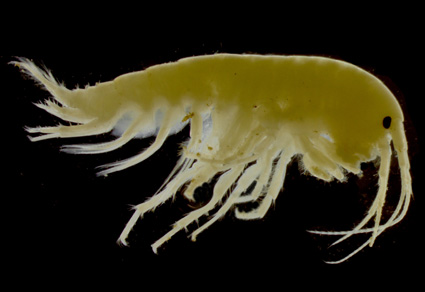

Abstract
This study describes morphologically and molecularly a new species, Gammarus ariegiensis sp. nov. from the Pyrenean Mountains in southern France. The new species is characterized by the lack of calceoli on the second antenna, the presence of long setae on anterior margin of merus and carpus of pereopod 5–7, endopodite of uropod 3 between 0.4 and 0.5 times the exopodite. A full description of the new species and information about its distribution is given in this paper together with molecular data (COI and 28S genes) corroborating the morphological delimitation of the new species.
References
- Ayati, K., Hupało, K., Dhaouadi, S., Rewicz, T., Grabowski, M. & Piscart, C. (2023) Conservation of freshwater biodiversity in Tunisia in a climate change context: combining amphipod distribution data and molecular analyses to improve priorities. Biodiversity and Conservation, 32 (7), 2539–2559. https://doi.org/10.1007/s10531-023-02617-8
- Barnard, J.L. & Barnard, C.M. (1983) Freshwater Amphipoda of the world. I. Evolutionary Patterns. II. Handbook and Bibliography. Hayfield Associates, Mount Vernon, Virginia, xix + 830 pp.
- Baytaşoğlu, H., Aksu, İ. & Özbek, M. (2024) Gammarus sezgini sp. nov. (Arthropoda, Amphipoda, Gammaridae), a new amphipod species from the Eastern Black Sea region of Türkiye. Zoosystematics and Evolution, 100 (3), 989–1004. https://doi.org/10.3897/zse.100.121692
- Castresana, J. (2000) Selection of conserved blocks from multiple alignments for their use in phylogenetic analysis. Molecular Biology and Evolution, 17 (4), 540–552. https://doi.org/10.1093/oxfordjournals.molbev.a026334
- Darriba, D., Taboada, G.L., Doallo, R. & Posada, D. (2012) jModelTest 2: more models, new heuristics and parallel computing. Nature Methods, 9 (8), 772–772. https://doi.org/10.1038/nmeth.2109
- Edgar, R.C. (2004) MUSCLE: multiple sequence alignment with high accuracy and high throughput. Nucleic Acids Research, 32 (5), 1792–1797. https://doi.org/10.1093/nar/gkh340
- Felsenstein, J. (1985) Confidence limits on phylogenies: An approach using the bootstrap. Evolution, 39 (4), 783–791. https://doi.org/10.2307/2408678
- Folmer, O., Black, M., Hoeh, W., Lutz, R. & Vrijenhoek, R. (1994) DNA primers for amplification of mitochondrial cytochrome c oxidase subunit I from diverse metazoan invertebrates. Molecular Marine Biology and Biotechnology, 3 (5), 294–299.
- Goedmakers, A. (1974) Les Gammaridae (Crustaces, Amphipodes) du Massif Central. Bulletin Zoologisch Museum, 3 (23), 211–219.
- Gouy, M., Guindon, S. & Gascuel, O. (2010) SeaView version 4: A multiplatform graphical user interface for sequence alignment and phylogenetic tree building. Molecular Biology and Evolution, 27 (2), 221–224. https://doi.org/10.1093/molbev/msp259
- Guindon, S., Dufayard, J.-F., Lefort, V., Anisimova, M., Hordijk, W. & Gascuel, O. (2010) New Algorithms and Methods to Estimate Maximum-Likelihood Phylogenies: Assessing the Performance of PhyML 3.0. Systematic Biology, 59 (3), 307–321. https://doi.org/10.1093/sysbio/syq010
- Hebert, P.D.N., Cywinska, A., Ball, S.L. & deWaard, J.R. (2003) Biological identifications through DNA barcodes. Proceedings Biological Sciences, 270 (1512), 313–321. https://doi.org/10.1098/rspb.2002.2218
- Hou, Z., Sket, B., Fišer, C. & Li, S. (2011) Eocene habitat shift from saline to freshwater promoted Tethyan amphipod diversification. Proceedings of the National Academy of Sciences, 108 (35), 14533–14538. https://doi.org/10.1073/pnas.1104636108
- Karaman, G. & Pinkster, S. (1977) Freshwater Gammarus species from Europe, North-Africa and adjacent regions of Asia (Crustacea—Amphipoda). Part 1. Gammarus pulex-group and related species. Bijdragen Tot De Dierkunde, 47 (1), 1–97. https://doi.org/10.1163/26660644-04701001
- Lefébure, T., Douady, C.J., Gouy, M. & Gibert, J. (2006) Relationship between morphological taxonomy and molecular divergence within Crustacea: Proposal of a molecular threshold to help species delimitation. Molecular Phylogenetics and Evolution, 40 (2), 435–447. https://doi.org/10.1016/j.ympev.2006.03.014
- Leigh, J.W. & Bryant, D. (2015) Popart: Full-feature software for haplotype network construction. Methods in Ecology and Evolution, 6, 1110–1116. https://doi.org/10.1111/2041-210X.12410
- Pinkster, S. (1972) On members of the Gammarus pulex-group (Crustacea—Amphipoda) from western Europe. Bijdragen tot de Dierkunde, 42 (2), 164–188. https://doi.org/10.1163/26660644-04202005
- Pinkster, S. (1983) The value of morphological characters in the taxonomy of Gammarus. Beaufortia, 33 (2), 15–28.
- Pinkster, S. (1988) Problems in the taxonomy of the freshwater Gammarids with special emphasis on the genus Echinogammarus in Italy. In: Studies on Amphipoda. Brill, Leiden, pp. 245–255. https://doi.org/10.1163/9789004629417_018
- Pinkster, S. & Scholl, A. (1984) Gammarus orinos sp. nov. from the Massif Central (France): its genetic and morphological distinction from Gammarus ibericus Margalef, 1951 (Crustacea, Amphipoda). Bijdragen tot de dierkunde, 54 (1), 139–145. https://doi.org/10.1163/26660644-05401010
- Piscart, C. & Bollache, L. (2012) Crustacés amphipodes de surface (Gammare d’eau douce). Association Française de Limnologie, Thonon les Bains, 113 pp.
- Puillandre, N., Brouillet, S. & Achaz, G. (2021) ASAP: assemble species by automatic partitioning. Molecular Ecology Resources, 21 (2), 609–620. https://doi.org/10.1111/1755-0998.13281
- Roux, A.-L. (1967) Les gammares du groupe pulex, crustacés amphipodes : essai de systématique biologique. Université Claude Bernard Lyon 1, Lyon, 172 pp.
- Stock, J.H. & Von Vaupel Klein, J.C. (1996) Mounting Media Revisited: The Suitability of Reyne’s Fluid for Small Crustaceans on JSTOR. Crustaceana, 69 (6), 794–798. https://doi.org/10.1163/156854096X00826
- Vences, M., Patmanidis, S., Fedosov, A., Miralles, A. & Puillandre, N. (2024) iTaxoTools 1.0: Improved DNA Barcode Exploration with TaxI2. In: DeSalle, R. (Ed.), DNA Barcoding: Methods and Protocols. Springer US, New York, New York, pp. 281–296. https://doi.org/10.1007/978-1-0716-3581-0_18
- Verovnik, R., Sket, B. & Trontelj, P.P. (2005) The colonization of Europe by the freshwater crustacean Asellus aquaticus (Crustacea: Isopoda) proceeded from ancient refugia and was directed by habitat connectivity. Molecular Ecology, 14 (14), 4355–4369. https://doi.org/10.1111/j.1365-294X.2005.02745.x
- Wattier, R., Mamos, T., Copilaş-Ciocianu, D., Jelić, M., Ollivier, A., Chaumot, A., Danger, M., Felten, V., Piscart, C., Žganec, K., Rewicz, T., Wysocka, A., Rigaud, T. & Grabowski, M. (2020) Continental-scale patterns of hyper-cryptic diversity within the freshwater model taxon Gammarus fossarum (Crustacea, Amphipoda). Scientific Reports, 10 (1), 16536. https://doi.org/10.1038/s41598-020-73739-0
- Zhang, J., Kapli, P., Pavlidis, P. & Stamatakis, A. (2013) A general species delimitation method with applications to phylogenetic placements. Bioinformatics, 29 (22), 2869–2876. https://doi.org/10.1093/bioinformatics/btt499