

Abstract
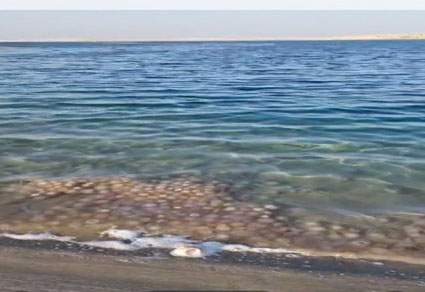
The jellyfish Chrysaora cf. caliparea was recently reported as the first Scyphomedusae record for Qatar based on morphological affinity, though genetic confirmation was lacking. To definitively substantiate its taxonomic identity, we conducted hereby a molecular analysis. Specimens were collected (n=3), subjected to DNA extraction, PCR amplification and sequencing targeting 16S, 28S and COX genes. The Maximum Likelihood phylogenetic analysis advanced that the Qatari specimen likely represents either a previously unidentified species or the genuine Chrysaora cf. caliparea. Considering the morphological and biometric analysis of an adult population (n=94) presented in the current study, in addition to the genetic data, we could attribute the identity of the Chrysaora specimens in the Arabian Gulf to Chrysaora cf. caliparea. Our integrative approach combining morphological and molecular data can serve as a framework for delineating species diversity across challenging taxonomic groups.
References
- Arsiranant, I., Xiao, J., Nakpan, A., Aungtonya, C., Rungraung, P. & Zhang, X. (2022) The genus Chrysaora (Semaeostomeae: Pelagiidae) in coastal waters of the Andaman Sea and the Gulf of Thailand. Phuket Marine Biological Center Research Bulletin, 79, 105–123. https://doi.org/10.14456/pmbcrb.2022.4
- Baniasadi, Z., Sakhaei, N., Doustshenas, B., Archangi, B. & Keshvarz, M. (2019) Identification and study of some ecological indicators of Scyphomedusae from coastal waters of Khuzestan and Hormozgan (the North of Persian Gulf). Iranian Scientific Fisheries Journal, 28, 137–150.
- Bat, L., Satilmis, H.H., Birinci-Ozdemir, Z., Sahin, F. & Ustun, F. (2009) Distribution and population dynamics of Aurelia aurita (Cnidaria; Scyphozoa) in the southern Black Sea. North-Western Journal of Zoology, 5 (2), 225–241.
- Bayha, K.M., Dawson, M.N., Collins, A.G., Barbeitos, M.S. & Haddock, S.H.D. (2010) Evolutionary relationships among scyphozoan jellyfish families based on complete taxon sampling and phylogenetic analyses of 18S and 28S ribosomal DNA. Integrative and Comparative Biology, 50, 436–455. https://doi.org/10.1093/icb/icq074
- Bayha, K.M., Collins, A.G. & Gaffney, P.M. (2017) Multigene phylogeny of the scyphozoan jellyfish family Pelagiidae reveals that the common US Atlantic sea nettle comprises two distinct species (Chrysaora quinquecirrha and C. chesapeakei). PeerJ, 5, e3863. https://doi.org/10.7717/peerj.3863
- Boughattas, S., Albatesh, D., Al-Khater, A., Giraldes, B.W., Althani, A.A. & Benslimane, F.M. (2021) Whole genome sequencing of marine organisms by Oxford Nanopore Technologies: Assessment and optimization of HMW-DNA extraction protocols. Ecology and Evolution, 11 (24), 18505–18513. https://doi.org/10.1002/ece3.8447
- Daly Yahia, M.N., Range, P., Giraldes, B.W. & Morandini, A.C. (2023) First jellyfish records for Qatar and further notes on Scyphomedusae species from the Arabian Gulf (Cnidaria, Scyphozoa). Journal of the Marine Biological Association of the United Kingdom, 103, e17. https://doi.org/10.1017/S002531542300005X
- DeClerck, M.P., Bailey, Y., Craig, D., Lin, M., Auerbach, L.J., Linney, O., Morrison, D.E., Patry, W. & Auerbach, P.S. (2016) Efficacy of topical treatments for Chrysaora chinensis species: A human model in comparison with an in vitro model. Wilderness & Environmental Medicine, 27 (1), 25–38. https://doi.org/10.1016/j.wem.2015.10.008
- Douek, J., Paz, G., Rinkevich, B., Gevili, R. & Galil, B.S. (2020) First record of a non-native pelagiid jellyfish (Scyphozoa: Pelagiidae: Chrysaora) in the easternmost Mediterranean Sea. BioInvasions Records, 9 (3), 482–489. https://doi.org/10.3391/bir.2020.9.3.04
- Ender, A. & Schierwater, B. (2003) Placozoa are not derived cnidarians: evidence from molecular morphology. Molecular Biology and Evolution, 20 (1), 130–134. https://doi.org/10.1093/molbev/msg018
- Farías-Tafolla, B., De la Cruz-Torres, J., Ponce-Rodríguez, A., Gersenowies-Rodríguez, J.R., Martínez-Pérez, J.A. & Chávez-Arteaga, M.M. (2015) Comparison of the allometry coefficient of the length-weight and length-length relationship between Selene brownii, S. vomer and S. setapinnis caught in the Gulf of Mexico. International Journal of Morphology, 33 (4), 1237–1241. https://doi.org/10.4067/S0717-95022015000400007
- Giraldes, B.W., Al-Maslamani, I., Chatting, M. & Smyth, D. (2015) Marine collection in Qatar—basis for biodiversity management. QScience Proceedings, 2015 (5), 21. https://doi.org/10.5339/qproc.2015.qulss2015.21
- Gul, S. & Morandini, A.C. (2013) New records of Scyphomedusae from Pakistan coast: Catostylus perezi and Pelagia cf. noctiluca (Cnidaria: Scyphozoa). Marine Biodiversity Records, 6 (1), 1–6. https://doi.org/10.1017/S1755267213000602
- Haddad Jr, V., Morandini, A.C. & Rodrigues, L.E. (2018) Jellyfish blooms causing mass envenomations in aquatic marathonists: Report of cases in S and SE Brazil (SW Atlantic Ocean). Wilderness & Environmental Medicine, 29, 142–145. https://doi.org/10.1016/j.wem.2017.09.012
- Harris, R.P., Wiebe, P.H., Lenz, J., Skjoldal, H.R. & Huntley, M. (2000) ICES Zooplankton methodology manual. Academic Press, London and San Diego, California, 684 pp.
- Jarms, G. & Morandini, A.C. (2019) World atlas of jellyfish. Dölling & Galitz Verlag, Hamburg, 816 pp.
- Kanagaraj, G., Ezhilarasan, P., Sampathkumar, P., Morandini, A.C. & Sivakumar, V.P. (2011) Field and laboratory observations on predation and prey selectivity of the scyphomedusa Chrysaora cf. caliparea in Southeast Indian waters. Journal of Ocean University of China, 10 (1), 47–54. https://doi.org/10.1007/s11802-011-1700-1
- Kumar, S., Stecher, G., Li, M., Knyaz, C. & Tamura, K. (2018) MEGA X: Molecular evolutionary genetics analysis across computing platforms. Molecular Biology and Evolution, 35, 1547–1549. https://doi.org/10.1093/molbev/msy096
- Kumawat, T., Saravanan, R., Vinod, K., Joshi, K.K., Jaiswar, A.K., Deshmukh, G. & Shenoy, L. (2022) Scyphozoan jellyfish diversity and distribution along the north-eastern Arabian Sea, off Gujarat coast, India. Indian Journal of Fisheries, 69 (3), 126–134. https://doi.org/10.21077/ijf.2022.69.3.110008-15
- Langeneck, J., Crocetta, F., Doumpas, N., Giovos, I., Piraino, S. & Boero, F. (2019) First record of the non-native jellyfish Chrysaora cf. achlyos (Cnidaria: Pelagiidae) in the Mediterranean Sea. BioInvasions Records, 8 (3), 608–613. https://doi.org/10.3391/bir.2019.8.3.17
- Morandini, A.C. & Marques, A.C. (2010) Revision of the genus Chrysaora Péron & Lesueur, 1810 (Cnidaria: Scyphozoa). Zootaxa, 2464 (1), 1–97. https://doi.org/10.11646/zootaxa.2464.1.1
- Mutlu, E., Çağatay, İ.T., Olguner, M.T. & Yılmaz, H.E. (2020) A new sea-nettle from the Eastern Mediterranean Sea: Chrysaora pseudoocellata sp. nov. (Scyphozoa: Pelagiidae). Zootaxa, 4790 (2), 229–244. https://doi.org/10.11646/zootaxa.4790.2.2
- Pitt, K.A., Duarte, C.M., Lucas, C.H., Sutherland, K.R. & Condon, R.H. (2013) Jellyfish body plans provide allometric advantages beyond low carbon content. PLoS ONE, 8 (8), e72683. https://doi.org/10.1371/journal.pone.0072683
- Pourjomeh, F., Shokri, M.R., Rajabi-Maham, H., Rezai, H. & Maghsoudlou, E. (2018) New records of the scyphozoan medusae (Cnidaria: Scyphozoa) in the north of Gulf of Oman, Iran. Marine Biodiversity, 48, 2193–2202. https://doi.org/10.1007/s12526-017-0683-6
- Raghavan, G., Gokulan, N.C., Matilda, M.V. & Narayana, S.V. (2025) Stabilized length-weight relationship and pre-monsoon ascendency of jellyfish, Acromitus maculosus and Acromitus flagellatus in Kochi-Backwaters, India. Thalassas: An International Journal of Marine Sciences, 41, 126. https://doi.org/10.1007/s41208-025-00865-9
- Raj, C.P., Siddique, A., Bhowal, A., Prasad, H. & Purushothaman, J. (2022) Report of Chrysaora caliparea (Reynaud, 1830) swarm from the coastal waters of Odisha, western Bay of Bengal. National Academy Science Letters, 45, 491–495. https://doi.org/10.1007/s40009-022-01140-8
- Ras, V., Neethling, S., Engelbrecht, A., Morandini, A.C., Bayha, K.M., Skrypzeck, H. & Gibbons, M.J. (2020) There are three species of Chrysaora (Scyphozoa: Discomedusae) in the Benguela upwelling ecosystem, not two. Zootaxa, 4778 (3), 401–438. https://doi.org/10.11646/zootaxa.4778.3.1
- Siddique, A., Purushothaman, J., Madhusoodhanan, R. & Raghunathan, C. (2022) The rising swarms of jellyfish in Indian waters: The environmental drivers, ecological, and socio-economic impacts. Journal of Water and Climate Change, 13 (10), 3747–3759. https://doi.org/10.2166/wcc.2022.245
- Syazwan, W.M., Rizman-Idid, M., Low, L.B., Then, A.Y.H. & Chong, V.C. (2020) Assessment of scyphozoan diversity, distribution and blooms: Implications of jellyfish outbreaks to the environment and human welfare in Malaysia. Regional Studies in Marine Science, 39, 101444. https://doi.org/10.1016/j.rsma.2020.101444
- Wang, Y., Wang, N., Sun, S., Wang, J. & Jin, X. (2022) First record of the non-native jellyfish Chrysaora pacifica (Goette, 1886) (Cnidaria, Scyphozoa) in Liaodong Bay, Bohai Sea, China. BioInvasions Records, 11 (1), 206–214. https://doi.org/10.3391/bir.2022.11.1.21