

Abstract
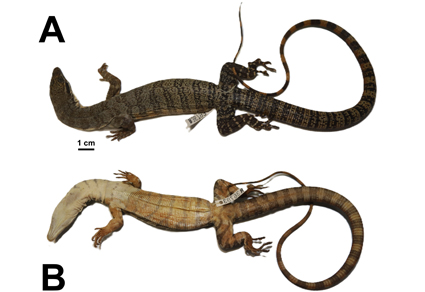
Here we describe a species from the subgenus Odatria that is allied with the Kimberley Rock Goanna, Varanus glauerti. The new species, Varanus fyfei sp. nov., is highly distinct from V. glauerti in nuclear and mitochondrial phylogenetic analyses and can be morphologically diagnosed on dorsal and tail colour patterns. The new species appears to be a short-range endemic restricted primarily to sandstone ranges and isolated hills of the north-western Northern Territory. It is mostly saxicoline inhabiting sheer rock faces in gorges and utilises horizontal crevices fractionally wider than their head depth on the rock face and at least 2m above ground level as night-time refugia. The species forages diurnally for small lizards and insects on vertical rock-faces. We also demonstrate two evolutionary lineages within V. glauerti, from the east and west Kimberley. The lineages can be distinguished in nuclear and mitochondrial phylogenetic analyses and on dorsal and tail colour patterns and body size. One of our west Kimberley samples is a hybrid, but the ranges of both lineages in the central Kimberley need further definition to better understand the degree of gene flow between the two and typotypic material of V. glauerti Mertens needs examination to establish the taxonomic provenance of the type, which is in poor condition.
References
- Anderson, E.C. & Thompson, E.A. (2002) A model-based method for identifying species hybrids using multilocus genetic data. Genetics, 160, 1217–1229. https://doi.org/10.1093/genetics/160.3.1217
- Aplin, K.P., Fitch, A. & King, D.J. (2006) A new species of Varanus Merrem (Squamata: Varanidae) from the Pilbara region of Western Australia, with observations on sexual dimorphism in closely related species. Zootaxa, 1313 (1), 1–38. https://doi.org/10.11646/zootaxa.1313.1.1
- Auliya, M. & Koch, A. (2020) Visual identification guide to the monitor lizard species of the world (genus Varanus). BfN-Skripten 552. Bundesamt für Naturschutz (BfN), Federal Agency for Nature Conservation, Bonn, 201 pp. https://doi.org/10.19217/skr552
- Böhme, W. (2003) Checklist of the living monitor lizards of the world (family Varanidae). Zoologische Verhandelingen, 341, 3–43.
- Böhme, W., Jacobs, H.J., Koppetsch, T. & Schmitz, A. (2019) The Kei Islands monitor lizard (Squamata: Varanidae: Varanus: Euprepiosaurus) as a distinct morphological, taxonomic, and conservation unit. Russian Journal of Herpetology, 26, 272–280. https://doi.org/10.30906/1026-2296-2019-26-5-272-280
- Brennan, I.G., Lemmon, A.R., Moriarty Lemmon, E., Portik, D.M., Weijola, V., Welton, L., Donnellan, S.C. & Keogh, J.S. (2021) Phylogenomics of monitor lizards and the role of competition in dictating body size disparity. Systematic Biology, 70, 120–132. https://doi.org/10.1093/sysbio/syaa046
- Chan, K.O. & Grismer, L.L. (2022) Correcting for body size variation in morphometric analysis. Zootaxa, 5124 (4), 471–482. https://doi.org/10.11646/zootaxa.5124.4.4
- Chifman, J. & Kubatko, L. (2014) Quartet inference from SNP data under the coalescent model. Bioinformatics, 30, 3317–3324. https://doi.org/10.1093/bioinformatics/btu530
- de Queiroz, K. (2011) Branches in the lines of descent: Charles Darwin and the evolution of the species concept. Biological Journal of the Linnean Society, 103, 19–35. https://doi.org/10.1111/j.1095-8312.2011.01634.x
- de Queiroz, K. (2020) An updated concept of subspecies resolves a dispute about the taxonomy of incompletely separated lineages. Herpetological Review, 51, 459–461.
- de Queiroz, K. (2021) Response to criticisms of an updated subspecies concept. Herpetological Review, 52, 773–776.
- Doughty, P., Kealley, L., Fitch, A. & Donnellan, S.C. (2014) A new diminutive species of Varanus from the Dampier Peninsula, western Kimberley region, Western Australia. Records of the Western Australian Museum, 29, 128–140. https://doi.org/10.18195/issn.0312-3162.29(2).2014.128-140
- Earl, D.A. & vonHoldt, B.M. (2012) STRUCTURE HARVESTER: a website and program for visualizing STRUCTURE output and implementing the Evanno method. Conservation Genetics Resources, 4, 359–361. https://doi.org/10.1007/s12686-011-9548-7
- Evanno, G., Regnaut, S. & Goudet, J. (2005) Detecting the number of clusters of individuals using the software STRUCTURE: a simulation study. Molecular Ecology, 14, 2611–2620. https://doi.org/10.1111/j.1365-294X.2005.02553.x
- Fitch, A.J., Goodman, A.E. & Donnellan, S.C. (2006) A molecular phylogeny of the Australian monitor lizards (Squamata: Varanidae) inferred from mitochondrial DNA sequences. Australian Journal of Zoology, 54, 253–269. https://doi.org/10.1071/zo05038
- Georges, A., Gruber, B., Pauly, G.B., White, D., Adams, M., Young, M.J., Kilian, A., Zhang, X., Shaffer, H.B. & Unmack, P.J. (2018) Genome wide SNP markers breathe new life into phylogeography and species delimitation for the problematic short‐necked turtles (Chelidae: Emydura) of eastern Australia. Molecular Ecology, 27, 5195–5213. https://doi.org/10.1111/mec.14925
- Gruber, B., Unmack, P.J., Berry, O.F. & Georges, A. (2018) dartR: An R package to facilitate analysis of SNP data generated from reduced representation genome sequencing. Molecular Ecology Resources, 18, 691–699. https://doi.org/10.1111/1755-0998.12745
- Hoang, D.T., Chernomor, O., von Haeseler, A., Minh, B.Q. & Vinh, L.S. (2018) UFBoot2: Improving the ultrafast bootstrap approximation. Molecular Biology Evolution, 35, 518–522. https://doi.org/10.1093/molbev/msx281
- Jombart, T. (2008) Adegenet: a R package for the multivariate analysis of genetic markers. Bioinformatics, 24, 1403–1405. https://doi.org/10.1093/bioinformatics/btn129
- Kalyaanamoorthy, S., Minh, B.Q., Wong, T.K.F., von Haeseler, A. & Jermiin, L.S. (2017) ModelFinder: fast model selection for accurate phylogenetic estimates. Nature Methods, 14, 587–589. https://doi.org/10.1038/nmeth.4285
- Katoh, K., Kuma, K., Toh, H. & Miyata, T. (2005) MAFFT version 5: improvement in accuracy of multiple sequence alignment. Nucleic Acids Research, 33, 511–518. https://doi.org/10.1093/nar/gki198
- Kearse, M., Moir, R., Wilson, A., Stones-Havas, S., Cheung, M., Sturrock, S., Buxton, S., Cooper, A., Markowitz, S., Duran, C., Thierer, T., Ashton, B., Mentjies, P. & Drummond, A. (2012) Geneious Basic: an integrated and extendable desktop software platform for the organization and analysis of sequence data. Bioinformatics, 28, 1647–1649. https://doi.org/10.1093/bioinformatics/bts199
- Kilian, A., Wenzl, P., Huttner, E., Carling, J., Xia, L., Blois, H., Caig, V., Heller-Uszynska, K., Jaccoud, D., Hopper, C., Aschenbrenner-Kilian, M., Evers, M., Peng, K., Cayla, C., Hok, P. & Uszynski, G. (2012) Diversity Arrays Technology: a generic genome profiling technology on open platforms. Methods in Molecular Biology, 888, 67–89. https://doi.org/10.1007/978-1-61779-870-2_5
- Koch, A., Auliya, M. & Ziegler, T. (2010) Updated checklist of the living monitor lizards of the world (Squamata: Varanidae). Bonn Zoological Bulletin, 57, 127–136.
- Koch, A., Ziegler, T., Böhme, W., Arida, E. & Auliya, M. (2013) Pressing Problems: Distribution, threats, and conservation status of the monitor lizards (Varanidae: Varanus ssp.) of Southeast Asia and the Indo-Australian Archipelago. Herpetological Conservation and Biology, 8 (Monograph 3), 1–62.
- Kopelman, N.M., Mayzel, J., Jakobsson, M., Rosenberg, N.A. & Mayrose, I. (2015) CLUMPAK: a program for identifying clustering modes and packaging population structure inferences across K. Molecular Ecology Resources, 15, 1179–1191. https://doi.org/10.1111/1755-0998.12387
- Leaché, A.D., Banbury, B.L., Felsenstein, J., de Oca, A.N. & Stamatakis, A. (2015) Short tree, long tree, right tree, wrong tree: new acquisition bias corrections for inferring SNP phylogenies. Systematic Biology, 64, 1032–1047. https://doi.org/10.1093/sysbio/syv053
- Lleonart, J., Salat, J. & Torres, G.J. (2000) Removing allometric effects of body size in morphological analysis. Journal of Theoretical Biology, 205, 85–93. https://doi.org/10.1006/jtbi.2000.2043
- Mahony, M., Moses, B., Mahony, S.V., Lemckert, F.L. & Donnellan, S. (2020) A new species of frog in the Litoria ewingii species group (Anura: Pelodryadidiae) from south-eastern Australia. Zootaxa, 4858 (2), 201–230. https://doi.org/10.11646/zootaxa.4858.2.3
- Melville, J., Haines, M.L., Boysen, K., Hodkinson, L., Kilian, A., Smith Date, K.L., Potvin, D.A. & Parris, K.M. (2017) Identifying hybridization and admixture using SNPs: application of the DArTseq platform in phylogeographic research on vertebrates. Royal Society Open Science, 4 (7), 161061. https://doi.org/10.1098/rsos.161061
- Merrem, B. (1820) Versuch eines Systems Amphibien. Tentamen Systematis Amphibiorum. Krieger, Marburg, xv 199 pp.
- Nguyen, L.-T., Schmidt, H.A., von Haeseler, A. & Minh, B.Q. (2015) IQ-TREE: a fast and effective stochastic algorithm for estimating maximum-likelihood phylogenies. Molecular Biology and Evolution, 32, 268–274. https://doi.org/10.1093/molbev/msu300
- Maryan, B., Oliver, P.M., Fitch, A.J. & O’Connell, M. (2014) Molecular and morphological assessment of Varanus pilbarensis (Squamata: Varanidae), with a description of a new species from the southern Pilbara, Western Australia. Zootaxa, 3768 (2), 139–158. https://doi.org/10.11646/zootaxa.3768.2.3
- Mertens, R. (1957) Two new goannas from Australia. Western Australian Naturalist, 5, 183–185.
- Pavón-Vázquez, C.J., Esquerré, D., Fitch, A.J., Maryan, B., Doughty, P., Donnellan, S.C. & Keogh, J.S. (2022) Between a rock and a dry place: phylogenomics, biogeography, and systematics of ridge-tailed monitors (Squamata: Varanidae: Varanus Acanthurus complex). Molecular Phylogenetics and Evolution, 173, 1–19. https://doi.org/10.1016/j.ympev.2022.107516
- Pritchard, J.K., Stephens, M. & Donnelly, P. (2000) Inference of population structure using multilocus genotype data. Genetics, 155, 945–959. https://doi.org/10.1093/genetics/155.2.945
- Storr, G.M. (1980) The monitor lizards (genus Varanus Merrem, 1820) of Western Australia. Records of the Western Australian Museum, 8, 237–293.
- Swofford, D.L. (2003) PAUP*: phylogenetic analysis using parsimony. Version 4.0 b10. Evolution. Available from: https://www.researchgate.net/publication/271205405_PAUP_Phylogenetic_Analysis_Using_Parsimony_and_Other_Methods_Version_40b10 (accessed 8 December 2025)
- Tamura, K., Stecher, G. & Kumar, S. (2021) MEGA11: Molecular Evolutionary Genetics Analysis version 11. Molecular Biology and Evolution, 38, 3022–3027. https://doi.org/10.1093/molbev/msab120
- Thorpe, R.S. (1976) Biometric analysis of geographic variation and racial affinities. Biological Reviews, 51, 407–452. https://doi.org/10.1111/j.1469-185X.1976.tb01063.x
- Trifinopoulos, J., Nguyen, L.T., von Haeseler, A. & Minh, B.Q. (2016) W-IQ-TREE: a fast online phylogenetic tool for maximum likelihood analysis. Nucleic Acids Research, 44 (W1), W232–W235. https://doi.org/10.1093/nar/gkw256
- Venables, W.N. & Ripley, B.D. (2002) Modern applied statistics with S. 4th Edition. Springer, Cham, xi + 459 pp. Available from: http://www.stats.ox.ac.uk/pub/MASS4 (accessed 8 December 2025)
- Weijola, V. & Kraus, F. (2023) Two new species of monitor lizards (Squamata: Varanus) endemic to the Louisiade and Tanimbar Archipelagos with a key to the subgenus Euprepiosaurus. Journal of Natural History, 57, 947–975. https://doi.org/10.1080/00222933.2023.2218574
- Weijola, V., Kraus, F., Vahtera, V., Lindqvist, C. & Donnellan, S.C. (2017) Reinstatement of Varanus douarrha Lesson, 1830 as a valid species with comments on the zoogeography of monitor lizards (Squamata: Varanidae) in the Bismarck Archipelago, Papua New Guinea. Australian Journal of Zoology, 64, 434–451. https://doi.org/10.1071/ZO16038
- Weijola, V., Vahtera, V., Koch, A., Schmitz, A. & Kraus, F. (2020) Taxonomy of Micronesian monitors (Reptilia: Squamata: Varanus): endemic status of new species argues for caution in pursuing eradication plans. Royal Society Open Science, 7, 200092. https://doi.org/10.1098/rsos.200092