
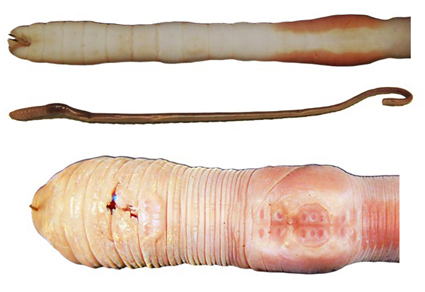

Abstract
Olmecadrilus gen. nov. an acanthodrilid meroic earthworm genus is described from the states of Oaxaca and Veracruz, Mexico. The new genus is characterized by a single gizzard, calciferous glands in segments 9–14 of the lamellar type, meronephridia (tufts in first segments, several closed parietal micronephridia in most of the body and paired medial open megameronephridia in last segments), last hearts in segment 13, tubular prostates in segments 17 and 19, spermathecae with diverticula and without genital nor penial setae. The genus included now five species, two formerly described in Ramiellona (Olmecadrilus mexicanus (Gates 1962) and Olmecadrilus wilsoni (Righi 1972)) and three new species described in this paper and sampled from tropical rain forests of Los Tuxtlas mountains, Veracruz. The new species Olmecadrilus tuxtlensis gen. et sp. nov., Olmecadrilus ocarinus sp. nov. and Olmecadrilus titepetlensis sp. nov., are separated by size, pigment, pattern of genital marks, shape of the spermatheca, and the position of seminal vesicles. We discuss the relationship of Olmecadrilus gen. nov. with other meroic (Ramiellona) and holoic genera (Kaxdrilus, Balanteodrilus) that present a single gizzard and calciferous glands, including comments on its relation with other meroic genera with multiple gizzards (Dichogaster, Eutrigaster, Zapatadrilus) also present in Mexico. Finally, a brief discussion is provided on the relationships of the meroic monogiceriat Mexican genera and other similar genera from India, Australia and New Zealand.
References
- Bhatia, B.L. & Chatterjee, G.B. (1925) On some Gregarine parasites of Indian Earthworms. Archiv für Protistenkunde, 52, 189–206. [https://www.zobodat.at/pdf/Archiv-fuer-Protistenkunde_53_1926_0361-0377.pdf]
- Buckley, T.R., James, S., Allwood, J., Bartlett, S., Howitt, R. & Prada, D. (2011) Phylogenetic analysis of New Zealand earthworms (Oligochaeta: Megascolecidae) reveals ancient clades and cryptic taxonomic diversity. Molecular Phylogenetics and Evolution, 58, 85–96. https://doi.org/10.1016/j.ympev.2010.09.024
- Cervantes, G., Fragoso, C., Espinosa De Los Monteros, A., Sánchez-Ramos, G., Lara-Villalón, M., Yañez-Pacheco, M.J., Lázaro-Castellanos, J.O. & James, S.W. (2016) New species of the earthworm genus Zapatadrilus (Clitellata, Acanthodrilidae) from northern Mexico. Zootaxa, 4189 (2), 311–326. https://doi.org/10.11646/zootaxa.4189.2.7
- Csuzdi, C.S. (2010) A monograph of the Paleotropical Benhamiinae earthworms. Hungarian Natural History Museum & Hungarian Academy of Sciences, Budapest, 348 pp.
- Dyne, G.R. (1997) Two new genera of Acanthodrilinae (Megascolecidae, Oligochaeta) from Cape York Peninsula and the Torres Strait. Memoirs of the Queensland Museum, 42 (1), 139–157. [https://www.biodiversitylibrary.org/page/40092706#page/142/mode/1up]
- Dyne, G.R. & Jamieson, B.G.M. (2004) Native Earthworms of Australia II (Megascolecidae, Acanthodrilinae). CD Monograph. Department of the Environment and Heritage, Australian Government, New South Wales, 200 pp.
- Edwards, C.A. & Arancon, N.Q. (2022) Biology and ecology of earthworms. Springer, New York, New York, 567 pp. https://doi.org/10.1007/978-0-387-74943-3
- Fragoso, C. (1993) Les Peuplements de Vers de Terre dans L’Est et Sud-Est du Mexique. Thèse, Université Paris 6, Paris, 228 pp.
- Fragoso, C. (1997) Annelida (Oligochaeta). In: González, E., Dirzo, R. & Vogt, R. (Eds.), Historia Natural de Los Tuxtlas. Universidad Nacional Autónoma de México-Comisión Nacional de la Biodiversidad, Ciudad de México, pp. 395–399.
- Fragoso, C. (2001) Las lombrices de Tierra de México (Annelida, Oligochaeta): Diversidad, Ecología y Manejo. Acta Zoológica Mexicana, New Series, Número Especial 1, 131–171. https://doi.org/10.21829/azm.2001.8401849
- Fragoso, C. (2007) Diversidad y patrones biogeográficos de las lombrices de tierra de México (Oligochaeta, Annelida). In: Brown, G.G. & Fragoso, C. (Eds.), Minhocas na America Latina: Biodiversidade e Ecologia. EMBRAPA Soja, Londrina, pp. 107–124.
- Fragoso, C. & Rojas, P. (2007) Two new species of the earthworm genus Balanteodrilus (Oligochaeta: Acanthodrilidae) from Eastern Mexico. Megadrilogica, 11, 107–114.
- Fragoso, C. & Rojas, P. (2014) New species and records of the earthworm genus Ramiellona (Annelida, Oligochaeta, Acanthodrilidae) from southern Mexico and Guatemala. Zootaxa, 3753 (6), 549–572. https://doi.org/10.11646/zootaxa.3753.6.3
- Fragoso, C. & Rojas, P. (2016) Lavellodrilus notosetosus sp. nov. (Annelida, Crassiclitellata, Acanthodrilidae): a new Mexican earthworm with uncommon characters, revealed by a preliminary revision of subfamily Acanthodrilinae. Zootaxa, 4154 (2), 101–138. https://doi.org/10.11646/zootaxa.4154.2.1
- Fragoso, C., Borges, S. & James, S. (1995) Native earthworms of the North Neotropical Region: current status and controversies. In: Hendrix, P. (Ed.), Earthworm ecology and biogeography in North America. Lewis Publishers, Boca Raton, Florida, pp. 67–115.
- Fragoso, C., Coria-Martínez, M.L. & Camarena L.M. (2009) An update of the earthworm fauna of Los Tuxtlas Ver. and adjacent regions: Are native species in the risk of extinction? In: Barois, I., Huising, E.J., Okoth, P., Trejo D. & De Los Santos, M. (Eds.), Below-Ground Biodiversity in Sierra de Santa Marta, Los Tuxtlas, Veracruz, México. Instituto de Ecología, A. C., Xalapa, pp. 219–228.
- Gates, G.E. (1962) On some earthworms of Eisen’s collections. Proceedings of the California Academy of Sciences, 4 (31), 185–225. [https://www.biodiversitylibrary.org/page/15657911#page/197/mode/1up]
- Gates, G.E. (1972) Burmese earthworms. An introduction to the systematics and biology of megadrile oligochaetes with special reference to Southeast Asia. Transactions of the American Philosophical Society, New Series, 62, 1–326. https://doi.org/10.2307/1006214
- James, S. & Davidson, S. (2002) Molecular phylogeny of earthworms (Annelida: Crassiclitellata) based on 28S, 18S and 16S gene sequences. Invertebrate Systematics, 26, 213–229. https://doi.org/10.1071/IS11012
- Jamieson, B.G.M. (1997) Some new and previously known earthworm species from Cape York Peninsula (Annelida: Oligochaeta: Megascolecidae). Memoirs of the Queensland Museum, 42 (1), 233–270. [https://biostor.org/reference/105289]
- Jamieson, B.G.M., Tillier, S., Tillier, A., Justine, J.L., Ling, E., James, S.W., McDonald, K. & Hugall, A.F. (2002) Phylogeny of the Megascolecidae and Crassiclitellata (Annelida, Oligochaeta): combined versus partitioned analysis using nuclear (28S) and mitochondrial (12S, 16S) rDNA. Zoosystema, 24 (4), 707–734. [https://sciencepress.mnhn.fr/en/periodiques/zoosystema/24/4/phylogenie-des-megascolecidae-et-crassiclitellata-annelida-oligochaeta-analyse-combinee-contre-analyse-partitionee-utilisant-l-adnr-nucleaire-28s-et-mitochondrial-12s-16s]
- Julka, J.M. (1988) Fauna of India. Megadrile Oligochaeta (Earthworms). Vol. 1. Family Octochaetidae. Zoological Survey of India, Calcutta, 400 pp.
- Lee, K.E. (1959) The Earthworm Fauna of New Zealand. New Zealand Department of Scientific and Industrial Research Bulletin, 130, 1–486.
- Lee, K.E. (1970) Application of numerical taxonomy to the classification of Megascolecidae (Annelida: Oligochaeta). Pedobiologia, 10, 257–264. https://doi.org/10.1016/S0031-4056(23)00419-5
- Misirlioğlu, M., Reynolds, J.W., Stojanović, M., Trakić, T., Sekulić, J., James, S.W., Csuzdi, C., Decaëns, T., Lapied, E., Phillips, H.R.P., Cameron, E.K. & Brown, G.G. (2023) Earthworms (Clitellata, Megadrili) of the world: an updated checklist of valid species and families, with notes on their distribution. Zootaxa, 5255 (1), 417–438. https://doi.org/10.11646/zootaxa.5255.1.33
- Pickford, G.E. (1938) Earthworms in Yucatan Caves. In: Pearse, A.S. (Ed.), Fauna of the Caves of Yucatan. Carnegie Institution of Washington Publication No. 491. Carnegie Institution of Washington, Washington, D.C., pp. 71–100.
- Righi, G. (1972) On some earthworms from Central America (Oligochaeta). Studies on the Neotropical Fauna, 7, 207–228. https://doi.org/10.1080/01650527209360445
- Segun, A.O. (1978) Monocystid Gregarine Parasites of Nigerian Earthworms. Journal of Protozoology, 25 (2), 157–162. https://doi.org/10.1111/j.1550-7408.1978.tb04387.x
- Schall, J.J. (2021) Stomatocystis goerresi, a new species of gregarine parasite Apicomplexa, Monocystidae) from the invasive Japanese earthworm Amynthas tokioensis (Megascolecidae), with a description of the parasite’s life cycle. Folia Parasitologica, 68, 022. https://doi.org/10.14411/fp.2021.022
- Stephenson, J. (1923) Oligochaeta. In: Shipley, A.E. (Ed.), The Fauna of British India including Ceylon and Burma. Taylor & Francis, London, pp. 1–518.