

Abstract
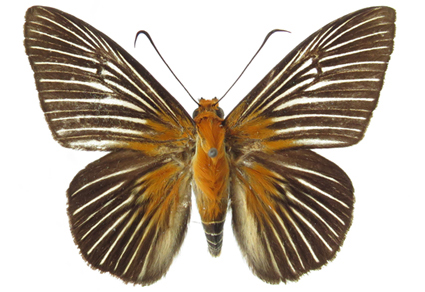
Despite the conspicuous different appearances in the males, Capila jayadeva Moore, 1866, C. translucida (Leech, 1893), C. hainana mackwoodi (Evans, 1914) and C. barroni (Riley & Godfrey, 1921) are proved to be conspecific based on an analysis of the 658 bp COI gene sequences, and the result is supported by the genitalia morphology. Considering the distinguishable wing patterns in the male and the allopatric distribution, the following subspecific combinations are proposed: C. jayadeva translucida, C. jayadeva mackwoodi, C. jayadeva barroni and C. jayadeva arooni Eliot, 1987. Therefore, with the nominate subspecies and C. jayadeva khambounei Uehara, 2024, the sexually dimorphic C. jayadeva currently includes six subspecies.
References
- Anonymous (2025) Capila jayadeva Moore, [1866] – Striped Dawnfly. In: Kunte, K., Sondhi, S. & Roy, P. (Eds.), Butterflies of India. Vol. 4.12. Indian Foundation for Butterflies, Bangalore (Bengaluru), Karnataka. Available from: https://www.ifoundbutterflies.org/capila-jayadeva (accessed 15 May 2025)
- Chou, I. (Ed.) (1994) Monographia Rhopalocerorum Sinensium. Henan Scientific and Technological Publishing House, Zhengzhou, 854 pp.
- Crowley, P. (1900) On the butterflies collected by the late Mr. John Whitehead in the interior of the island of Hainan. Proceedings of the Zoological Society of London, 3, 505–511.
- Eliot, J.N. (1987) On some butterflies from Nepal, Bhutan and Thailand. Tyô to Ga, 38 (1), 21–29.
- Elwes, H.J. & Edwards, J. (1897) A revision of the Oriental Hesperiidae. Transactions of the Zoological Society of London, 14 (4), 101–324, pls. 18–27. https://doi.org/10.1111/j.1096-3642.1897.tb00059.x
- Evans, W.H. (1914) Notes on Indian butterflies. The Journal of the Bombay Natural History Society, 23 (2), 302–310.
- Evans, W.H. (1949) A catalogue of the Hesperiidae from Europe, Asia & Australia in the British Museum (Natural History). The British Museum, London, 502 pp. https://doi.org/10.5962/bhl.title.105941
- Fan, X.L. & Wang, M. (2004) Notes on the genus Capila from China with a new species and a new record (Lepidoptera, Hesperiidae). Acta Zootaxonomica Sinica, 29 (1), 153–156.
- Godfrey, E.J. (1930) A revised list of the butterflies of Siam, with notes on their geographical distribution. Journal of the Natural History Society of Siam Supplement, 7 (4), 203–397.
- Hajibabaei, M., Janzen, D.H., Burns, J.M., Hallwachs, W. & Hebert, P.D. (2006) DNA barcodes distinguish species of tropical Lepidoptera. Proceedings of the National Academy of Sciences of the United States of America, 103, 968–971. https://doi.org/10.1073/pnas.0510466103
- Hebert, P.D., Cywinska, A., Ball, S.L. & deWaard, J.R. (2003) Biological identifications through DNA barcodes. Proceedings of the Royal Society B: Biological Sciences, 270, 313–321. https://doi.org/10.1098/rspb.2002.2218
- Hering, M. (1918) Neue Hesperiiden aus China. Mitteilungen aus dem Zoologischen Museum in Berlin, 9, 53–59.
- Inayoshi, Y. (2025) A Check List of Butterflies in Indo-China, Chiefly from Thailand, Laos & Vietnam. Available from: https://yutaka.it-n.jp/hes/90390001.html (accessed 15 May 2025)
- Kehimkar, I. (2008) The Book of Indian Butterflies. Oxford University Press, Oxford, 497 pp.
- Klots, A.B. (1970) Lepidoptera. In: Tuxen, S.L. (Ed.), Taxonomist’s Glossary of Genitalia in Insects. 2nd Edition. Munksgaard, Copenhagen, pp. 115–130.
- Kumar, S., Stecher, G. & Tamura, K. (2016) MEGA7: molecular evolutionary genetics analysis version 7.0 for bigger datasets. Molecular Biology and Evolution, 33 (7), 1870–1874. https://doi.org/10.1093/molbev/msw054
- Leech, J.H. (1893) Butterflies from China, Japan and Corea. Part V. Hesperiidae. John Henry Leech, London, 86 pp. [pp. 557–642] https://doi.org/10.5962/bhl.title.86314
- Miyazaki, S., Saito, T. & Saito, K. (2007) Notes on the butterflies of the southern part of Vietnam (5). Yadoriga, 212, 2–18.
- Monastyrskii, A.L. & Devyatkin, A.L. (2016) Butterflies of Vietnam (an illustrated checklist) 2nd edition. Planorama Meida Co., Ltd, Hanoi, 95 pp., 17 pls.
- Moore, F. ([1858]) In: Horsfield, T. & Moore, F. ([1858]) (Eds.), A catalogue of the Lepidopterous Insects in the Museum of the Honourable East-India Company, 1, pp. 17–278.
- Moore, F. (1866) On the leidopterous insects of Bengal. Proceedings of the Zoological Society of London, 3, 755–822.
- Nicéville, L. de (1893) On new and little-known butterflies from the Indo-Malayan Region. Journal of the Bombay Natural History Society, 7 (3), 322–357, pls. H + I + J.
- Riley, N.D. & Godfrey, E.J. (1921) Some undescribed Rhopalocera from Siam. Journal of the Natural History Society of Siam, 4 (3), 167–190, pls. 4–7.
- Seitz, A. (1922) Capila. In: Seitz, A. (Ed.), Grossschmetterlinge der Erde, IX. Alfred Kernen, Stuttgart, pp. 1031, pl. 163.
- Swinhoe, C. (1911–1912) Vol. IX. Rhopalocera. In: Moore, F. (Ed.), Lepidoptera Indica. L. Reeve and Co., London, pp. 1–278.
- Thompson, J.D., Gibson, T.J., Plewniak, F., Jeanmougin, F. & Higgins, D.G. (1997) The Clustal X windows interface: flexible strategies for multiple sequence alignment aided by quality analysis tools. Nucleic Acids Research, 25, 4876–4882. https://doi.org/10.1093/nar/25.24.4876
- Uehara, J. & Masui, A. (2024) Records of butterflies recently collected from Lao P. D. R., with descriptions of one species and two new subspecies. Butterflies, 95, 4–19.
- Wu, C.S. & Hsu, Y.F. (Eds.) (2017) Butterflies of China. The Straits Publishing House, Fuzhou, 2036 pp.
- Xue, G.X., Inayoshi, Y., Li, M. & Zou, E.K. (2024a) Some taxonomic notes on Capila translucida (Leech, 1894) and C. hainana Crowley, 1900 (Hesperiidae, Pyrginae). Zootaxa, 5410 (3), 384–391. https://doi.org/10.11646/zootaxa.5410.3.5
- Xue, G.X., Li, M., Rao, Z. & Qiao, Y.M. (2023) A discussion on the relationship of Capila omeia (Leech, 1894) and C. pseudomeia Fan & Wang, 2004 syn. n. (Hesperiidae, Pyrginae). Zootaxa, 5264 (4), 587–592. https://doi.org/10.11646/zootaxa.5264.4.8
- Xue, G.X., Niu, J.Q., Long, J.F. & Zeng, W.B. (2018) New information on the skipper fauna of Guangxi, China (Lepidoptera, Hesperiidae). Zootaxa, 4497 (2), 258–270. https://doi.org/10.11646/zootaxa.4497.2.6
- Xue, G.X., Xie, Y.X., Shen, G.C., Li, X.J., Li, M. & Guo, Y.C. (2024b) Study on the intraspecific variation of Capila lineata lineata Chou & Gu, 1994, with some taxonomic notes on the related taxa (Hesperiidae, Pyrginae). Zootaxa, 5446 (4), 573–580. https://doi.org/10.11646/zootaxa.5446.4.9
- Yu, T.T., Chang, Z., Dong, Z.W., Li, K.Q., Ma, F.Z., Wang, W. & Li, X.Y. (2022) A glimpse into the biodiversity of insects in Yunnan: An updated and annotated checklist of butterflies (Lepidoptera, Papilionoidea). Zoological Research, 43 (6), 1009–1010. https://doi.org/10.24272/j.issn.2095-8137.2022.313
- Yuan, F., Yuan, X.Q. & Xue, G.X. (2015) Fauna Sinica: Insecta. Vol. 55. Lepidoptera: Hesperiidae. Science Press, Beijing, 754 pp., 15 pls.