
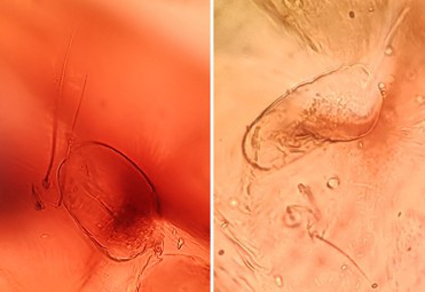

Abstract
Barbadocladius is a genus of orthoclad midges endemic to the Andes, currently comprising two described species: B. andinus and B. limay. In this study, we emend the diagnosis of the genus. The male, female, and pupa of B. andinus and the pupa of B. limay are redescribed based on new material from the Patagonian Andes. Morphological analyses exhibited the expected variation typical of pupal traits, while mitochondrial COI sequences showed marked genetic divergence between Patagonian and Peruvian populations. Phylogenetic and NMDS analyses do not indicate a latitudinal genetic structure, but possible cryptic diversity or incipient speciation events are suggested. The absence of intermediate samples limits conclusions about the nature of this divergence. Further integrative studies are needed to clarify the taxonomy and evolutionary history of the genus.
Beyond the taxonomic revision, this work provides an example of a population-level genetic analysis in a non-charismatic, non-economically relevant insect group. Such studies are usually restricted to taxa of agricultural, quarantine, or conservation concern. By applying integrative tools to Barbadocladius, we highlight how combining molecular and morphological evidence can reveal hidden diversity even in poorly known, non-model lineages, contributing to a broader understanding of Andean biogeography and evolutionary processes.
References
- Anderson, A.M., Stur, E. & Ekrem, T. (2013) Molecular and morphological methods reveal cryptic diversity and three new species of Nearctic Micropsectra (Diptera:Chironomidae). Freshwater Science, 32 (3), 892–921. https://doi.org/10.1899/12-026.1
- Boothroyd, I.K.G. & Cranston, P.S. (1995) Two Orthocladiinae (Chironomidae) genera common to New Zealand and Australia: Pirara n. gen. and Eukiefferiella Thienemann. In: Cranston, P.S. (Ed.), Chironomids: from Genes to Ecosystems. CSIRO, Melbourne, pp. 389–408.
- Carew, M.E., Pettigrove, V. & Hoffmann, A.A. (2005) The utility of DNA markers in classical taxonomy: Using cytochrome oxidase I markers to differentiate Australian Cladopelma (Diptera:Chironomidae) midges. Annals of the Entomological Society of America, 98 (4), 587–594. https://doi.org/10.1603/0013-8746(2005)098[0587:TUODMI]2.0.CO;2
- Carew, M.E., Pettigrove, V., Cox, R.L. & Hoffmann, A.A. (2007) DNA identification of urban Tanytarsini chironomids (Diptera:Chironomidae). Journal of the North American Benthological Society, 26 (4), 587–600. https://doi.org/10.1899/06-120.1
- Cranston, P.S. & Krosch, M.N. (2011) Barbadocladius Cranston & Krosch, a new genus of Orthocladiinae (Diptera: Chironomidae) from South America. Neotropical Entomology, 40 (5), 560–567. https://doi.org/10.1590/S1519-566X2011000500007
- Cranston, P.S., Hardy, N.B., Morse, G.E., Puslednik, L. & McCluen, S.R. (2010) When molecules and morphology concur: the “Gondwanan” midges (Diptera: Chironomidae). Systematic Entomology, 35, 636–648. https://doi.org/10.1111/j.1365–3113.2010.00531.x
- Darriba, D., Posada, D., Kozlov, A.M., Stamatakis, A., Morel, B. & Flouri, T. (2020) ModelTest-NG: A New and Scalable Tool for the Selection of DNA and Protein Evolutionary Models. Molecular Biology and Evolution, 37, 291–294. https://doi.org/10.1093/molbev/msz189
- Dalui, S., Sharma, L.K. & Thakur, M. (2025) Red Panda Phylogenetic Conundrum: Are There Two Distinct Species? Journal of Biogeography, 52 (8), e15175. https://doi.org/10.1111/jbi.15175
- Donato, M., Zanotto Arpellino, J.P., Marin Viegas, V.S. & Siri, A. (2024) Pampacladius, a new genus of Orthocladiinae (Diptera: Chironomidae) and comments on the Gondwana biogeography. Systematics and Biodiversity, 22 (1), 2413946. https://doi.org/10.1080/14772000.2024.2413946
- Edgar, R.C. (2004) MUSCLE: Multiple sequence alignment with high accuracy and high throughput. Nucleic Acids Research, 32, 1792–1797. https://doi.org/10.1093/nar/gkh340
- Edler, D., Klein, J., Antonelli, A. & Silvestro, D. (2021) raxmlGUI 2.0: A graphical interface and toolkit for phylogenetic analyses using RAxML. Methods in Ecology and Evolution, 12, 373–377. https://doi.org/10.1111/2041-210X.13512
- Ekrem, T. & Stur, E. (2007) Description of Tanytarsus hjulorum, new species, with notes and DNA barcodes of ome South African Tanytarsus (Diptera: Chironomidae). In: Andersen, T. (Ed.), Contributions to the Systematics and Ecology of Aquatic Diptera: A tribute to Ole A. Sæther. The Caddis Press, Columbus, Ohio, pp. 87–92.
- Ekrem, T., Stur, E. & Herbert, P.D.N. (2010) Females do count: Documenting Chironomidae (Diptera) species diversity using DNA barcoding. Organisms Diversity & Evolution, 10, 397–408. https://doi.org/10.1007/s13127-010-0034-y
- Ekrem, T., Willassen, E. & Stur, E. (2007) A comprehensive DNA sequence library is essential for identification with DNA barcodes. Molecular Phylogenetics and Evolution, 43 (2), 530–542. https://doi.org/10.1016/j.ympev.2006.11.021
- Folmer, O., Black, M., Hoeh, W., Lutz, R. & Vrijenhoek, R. (1994) DNA primers for amplification of mitochondrial cytochrome c oxidase subunit I from diverse metazoan invertebrates. Molecular marine biology and biotechnology, 3 (5), 294–299.
- Goetghebuer, M. (1932) Diptéres (Nématocéres). Chironomidae IV. Orthocladiinae, Corynoneurini, Clunioninae, Diamesinae. Faune de France, 23, 1–204.
- Hebert, P.D.N., Cywinska, A., Ball, S.L. & deWaard, J.R. (2003) Biological identifications through DNA barcodes. Proceedings of the Royal Society of London. Series B: Biological Sciences, 270 (1512), 313–321. https://doi.org/10.1098/rspb.2002.2218
- Karmokov, M.K. (2019) Karyotype characteristics, chromosomal polymorphism and gene COI sequences of Chironomus heteropilicornis Wülker, 1996 (Diptera, Chironomidae) from the South Caucasus. Comparative Cytogenetics, 13 (4), 339–357. https://doi.org/10.3897/CompCytogen.v13i4.35572
- Kimura, M. (1980) A simple method for estimating evolutionary rates of base substitutions through comparative studies of nucleotide sequences. Journal of molecular evolution, 16, 111–120. https://doi.org/10.1016/j.ympev.2011.03.003
- Krosch, M.N., Baker, A.M., Mather, P.B. & Cranston, P.S. (2011) Systematics and biogeography of the Gondwanan Orthocladiinae (Diptera: Chironomidae). Molecular Phylogenetics and Evolution, 59, 458–468. https://doi.org/10.1016/j.ympev.2011.03.003
- Maddison, W.P. & Maddison, D.R. (2021) Mesquite: A modular system for evolutionary analysis. Version. 3.70. Available from: http://www.mesquiteproject.org (accessed 19 November 2025)
- Makarchenko, E.A. & Semenchenko, A.A. (2023) Review of subfamily Prodiamesinae (Diptera: Chironomidae) from the Russian Far East and bordering territory. Zootaxa, 5323 (1), 1–26. https://doi.org/10.11646/zootaxa.5323.1.1
- Makarchenko, E.A., Semenchenko, A.A. & Palatov, D.M. (2023) Fauna and taxonomy of Diamesinae (Diptera, Chironomidae) from the Caucasus, with a morphological description and DNA barcoding of new taxa and a discussion of diagnostic problems for Diamesa Meigen and Pseudodiamesa Goetghebuer. Zootaxa, 5271 (2), 313–328. https://doi.org/10.11646/zootaxa.5271.2.6
- Martin, J. (2020) Chironomus calligraphus Goeldi, 1905 and C. hawaiiensis Grimshaw, 1901 are sibling species. CHIRONOMUS Journal of Chironomidae Research, 33, 59–63. https://doi.org/10.5324/cjcr.v0i33.3818
- Nei, M. & Kumar, S. (2000) Molecular evolution and phylogenetics. Oxford University Press, Oxford, 352 pp. https://doi.org/10.1093/oso/9780195135848.001.0001
- Pfenninger, M., Nowak, C., Kley, C., Steinke, D. & Streit, B. (2007) Utility of DNA taxonomy and barcoding for the inference of larval community structure in morphologically cryptic Chironomus (Diptera) species. Molecular Ecology, 16 (9), 1957–1968. https://doi.org/10.1111/j.1365-294X.2006.03136.x
- Prat, N., Ribera, C., Rieradevall, M., Villamarín, C. & Acosta, R. (2013) Distribution, Abundance and Molecular Analysis of Genus Barbadocladius Cranston & Krosch (Diptera, Chironomidae) in Tropical, High Altitude Andean Streams and Rivers. Neotropical Entomology, 42, 607–617. https://doi.org/10.1007/s13744-013-0161-1
- Roback, S.S. & Coffman, W.P. (1983) Results of the Catherwood Bolivian-Peruvian Altiplano Expedition part 2. Aquatic Diptera including montane Diamesinae and Orthocladiinae (Chironomidae) from Venezuela. Proceedings of the Academy of Natural Sciences of Philadelphia, 135, 9–79.
- Rodríguez Garay, G.N. & Paggi, A.C. (2015) Chironomidae (Diptera) en cursos de agua de Puna y Chaco Serrano de Catamarca (Argentina): primeros registros y distribución de géneros y especies. Revista de la Sociedad Entomológica Argentina, 74 (1–2), 15–25.
- Ronquist, F., Teslenko, M., van der Mark, P., Ayres, D.L., Darling, A., Höhna, S., Larget, B., Liu, L., Suchard, M.A. & Huelsenbeck, J.P. (2012) MrBayes 3.2: Efficient Bayesian phylogenetic inference and model choice across a large model space. Systematic Biology, 61, 539–542. https://doi.org/10.1093/sysbio/sys029
- Sæther, O.A. (1980) Glossary of chironomid morphology terminology (Diptera: Chironomidae). Entomologica Scandinavica Supplement, 14, 1–51.
- Sari, A. (2022) Evolutionary relationships among several species from the genus Cricotopus (Diptera: Chironomidae): What about Turkish representatives of this genus? Turkish Journal of Zoology, 46 (1), 129–143. https://doi.org/10.3906/zoo-2108-25
- Sari, A., Duran, M. & Bardakci, F. (2012) Discrimination of Orthocladiinae Species (Diptera: Chironomidae) by using cytochrome c oxidase subunit I. Acta Zoologica Bulgarica, Supplement 4, 73–80.
- Schutze, M.K., Mahmood, K., Pavasovic, A., Bo, W., Newman, J., Clarke, A.R., Krosch, M.N. & Cameron, S.L. (2015) One and the same: integrative taxonomic evidence that Bactrocera invadens (Diptera: Tephritidae) is the same species as the Oriental fruit fly Bactrocera dorsalis. Systematic Entomology, 40 (2), 472–486. https://doi.org/10.1111/syen.12114
- Simon, C., Frati, F., Beckenbach, A., Crespi, B.J., Liu, H. & Flook, P.K. (1994) Evolution, weighting, and phylogenetic utility of mitochondrial gene sequences and a compilation of conserved polymerase chain reaction primers. Annals of the Entomological Society of America, 87 (6), 651–701. https://doi.org/10.1093/aesa/87.6.651
- Sinclair, C.S. & Gresens, S.E. (2008) Discrimination of Cricotopus species (Diptera: Chironomidae) by DNA barcoding. Bulletin of Entomological Research, 98, 555–563. https://doi.org/10.1017/S0007485308005865
- Stamatakis, A. (2014) RAxML version 8: a tool for phylogenetic analysis and post-analysis of large phylogenies. Bioinformatics, 30, 1312–1313. https://doi.org/10.1093/bioinformatics/btu033
- Tamura, K., Stecher, G. & Kumar, S. (2021) MEGA11: molecular evolutionary genetics analysis version 11. Molecular biology and evolution, 38 (7), 3022–3027. https://doi.org/10.1093/molbev/msab120