

Abstract
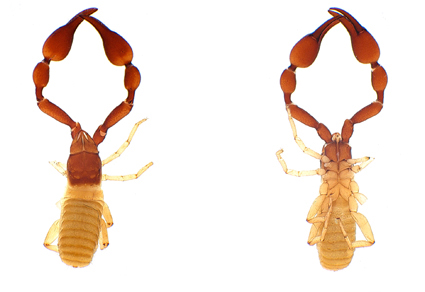
Poorly dispersing pseudoscorpions (Arachnida: Pseudoscorpiones) are often considered suitable models for biogeography studies. Several lineages show interesting distribution patterns, such as the genus Parobisium Chamberlin, 1930 that occurs in the western U.S.A. and eastern Asia but is absent in Europe and central Asia. Here we review the pseudoscorpion genus Parobisium using an integrative taxonomic approach and describe two new species from South Korea based on morphological and molecular data: Parobisium namkungi sp. nov. and P. troglophilum sp. nov. Phylogenetic analyses using three genetic markers, cytochrome c oxidase subunit I (COI), histone H3A, and 28S ribosomal DNA also reveal that two former subspecies, P. magnum ohuyeanum (Morikawa, 1952) and P. magnum chejuense (Morikawa, 1970), are genetically distinct enough to recognize them as separate species, P. ohuyeanum stat nov. and. P. chejuense stat. nov. The phylogenetic data show that there is an old split between the East Asian and North American lineages that is indicative of ancient vicariance rather than recent dispersal. Similar biogeographic patterns have been reported in other poorly dispersing invertebrate taxa, such as Grylloblattidae and flightless beetles, which also show deep genetic divergences across these landmasses. We hypothesize that Parobisium may once have been widespread in Holarctic but subsequently became restricted to isolated fragments in East Asia and North America.
References
- Beier, M. (1931) Zur Kenntnis der troglobionten Neobisien (Pseudoscorp.). Eos, Madrid, 7, 9–23.
- Chamberlin, J.C. (1930) A synoptic classification of the false scorpions or chela-spinners, with a report on a cosmopolitan collection of the same. Part II. The Diplosphyronida (Arachnida-Chelonethida). Annals and Magazine of Natural History, Series 10, 5 (3), 1–48 + 585–620. https://doi.org/10.1080/00222933008673173
- Chamberlin, J.C. (1931) The arachnid order Chelonethida. Stanford University Publications, Biological Sciences, 7 (1), 1–284.
- Chamberlin, J.C. & Malcolm, D.R. (1960) The occurrence of false scorpions in caves with special reference to cavernicolous adaptation and to cave species in the North American fauna (Arachnida-Chelonethida). The American Midland Naturalist, 64 (1), 105–115. https://doi.org/10.2307/2422895
- Christophoryová, J., Šťáhlavský, F. & Fedor, P. (2011) An updated identification key to the pseudoscorpions (Arachnida: Pseudoscorpiones) of the Czech Republic and Slovakia. Zootaxa, 2876 (1), 35–48. https://doi.org/10.11646/zootaxa.2876.1.4
- Cokendolpher, J.C. & Krejca, J.K. (2010) A new cavernicolous Parobisium Chamberlin 1930 (Pseudoscorpiones: neobisiidae) from Yosemite national Park, USA. Occasional papers. Museum of Texas Tech University. No. 297. Museum of Texas Tech University, Lubbock, Texas, 28 pp. https://doi.org/10.5962/bhl.title.156953
- Edward, K.L. & Harvey, M.S. (2008) Short-range endemism in hypogean environments: the pseudoscorpion genera Tyrannochthonius and Lagynochthonius (Pseudoscorpiones: Chthoniidae) in the semiarid zone of Western Australia. Invertebrate Systematics, 22 (2), 259–293. https://doi.org/10.1071/IS07025
- Feng, Z., Wynne, J.J. & Zhang, F. (2019) Two new subterranean-adapted pseudoscorpions (Pseudoscorpiones: Neobisiidae: Parobisium) from Beijing, China. Zootaxa, 4661 (1), 145–160. https://doi.org/10.11646/zootaxa.4661.1.7
- Feng, Z., Wynne, J.J. & Zhang, F. (2020) Cave-dwelling pseudoscorpions of China with descriptions of four new hypogean species of Parobisium (Pseudoscorpiones, Neobisiidae) from Guizhou Province. Subterranean Biology, 34, 61–98. https://doi.org/10.3897/subtbiol.34.49586
- Guo, X.B. & Zhang, F. (2016) Two new species of the genus Parobisium Chamberlin, 1930 from China (Pseudoscorpiones: Neobisiidae). Entomologica Fennica, 27, 140–148. https://doi.org/10.33338/ef.59458
- Harms, D. & Dunlop, J.A. (2017) The fossil history of pseudoscorpions (Arachnida: Pseudoscorpiones). Fossil Record, 20 (2), 215–238. https://doi.org/10.5194/fr-20-215-2017
- Harms, D., Harvey, M.S., Roberts, J.D. & Loria, S.F. (2024) Tectonically driven climate change and the spread of temperate biomes: Insights from dragon pseudoscorpions (Pseudotyrannochthoniidae), a globally distributed arachnid lineage. Journal of Biogeography, 51 (6), 1032–1048. https://doi.org/10.1111/jbi.14801
- Harvey, M.S. (1991) Catalogue of the Pseudoscorpionida. Manchester University Press, Manchester, vi + 726 pp.
- Harvey, M.S. (1998) Pseudoscorpion groups with bipolar distributions: a new genus from Tasmania related to the Holarctic Syarinus (Arachnida, Pseudoscorpiones, Syarinidae). Journal of Arachnology, 26, 429–441.
- Harvey, M.S. & Cullen, K.L. (2020) A remarkable new troglobitic Parobisium (Pseudoscorpiones: Neobisiidae) from California. Arachnology, 18 (6), 591–596. https://doi.org/10.13156/arac.2020.18.6.591
- Hlebec, D., Podnar, M. & Kučinić, M. & Harms, D. (2023) Molecular analyses of pseudoscorpions in a subterranean biodiversity hotspot reveal cryptic diversity and microendemism. Scientific Reports, 13 (430), 1–14. https://doi.org/10.1038/s41598-022-26298-5
- Hong, Y. (1996) Two new species of the genus Parobisium (Pseudoscorpionida: Neobisiidae) from Korea. Korean Journal of Systematic Zoology, 12 (3), 189–197.
- Jeong, K.H. & Harms, D. & Yoo, J.S. (2024) The pseudoscorpion genus Nipponogarypus (Pseudoscorpiones, Olpiidae) found in seashore habitats in Japan and Korea. Zoosystematics and Evolution, 100 (3), 1053–1060. https://doi.org/10.3897/zse.100.123213
- Jeong, K.H., Harms, D., Yoo, J.S. & Kim, S. (2025) Four new species of dragon pseudoscorpions (Pseudoscorpiones: Pseudotyrannochthoniidae: Spelaeochthonius) from caves in South Korea revealed by integrative taxonomy. PLoS One, 20 (7), e0325375. https://doi.org/10.1371/journal.pone.0325375
- Johnson, J., Loria, S.F., Joseph, M.M. & Harms, D. (2022) Biogeographical and diversification analyses of Indian pseudoscorpions reveal the Western Ghats as museums of ancient biodiversity. Molecular Phylogenetics and Evolution, 175, 107495. https://doi.org/10.1016/j.ympev.2022.107495
- Katoh, K. & Standley, D.M. (2013) MAFFT multiple sequence alignment software version 7: improvements in performance and usability. Molecular Biology and Evolution, 30 (4), 772–780. https://doi.org/10.1093/molbev/mst010
- Lorenz, M., Loria, S.F., Harvey, M.S. & Harms, D. (2022) The Hercules pseudoscorpions from Madagascar: A systematic study of Feaellidae (Pseudoscorpiones: Feaelloidea) highlights regional endemism and diversity in one of the “hottest” biodiversity hotspots. Arthropod Systematics & Phylogeny, 80, 649–691. https://doi.org/10.3897/asp.80.e90570
- Morikawa, K. (1955) Pseudoscorpions of forest soil in Shikoku. Memoirs of Ehime University, 2B (2), 215–222.
- Morikawa, K. (1958) Maritime pseudoscorpions from Japan. Memoirs of Ehime University, 2B (3), 5–11.
- Morikawa, K. (1960) Systematic studies of Japanese pseudoscorpions. Memoirs of Ehime University, 2B (4), 85–172.
- Ronquist, F. & Huelsenbeck, J.P. (2003) MrBayes 3: Bayesian phylogenetic inference under mixed models. Bioinformatics, 19 (12), 1572–1574. https://doi.org/10.1093/bioinformatics/btg180
- Sanmartín, I., Enghoff, H. & Ronquist, F. (2001) Patterns of animal dispersal, vicariance and diversification in the Holarctic. Biological Journal of the Linnean Society, 73 (4), 345–390. https://doi.org/10.1111/j.1095-8312.2001.tb01368.x
- Schawaller, W., Shear, W.A. & Bonamo, P.M. (1991) The first Paleozoic pseudoscorpions (Arachnida, Pseudoscorpionida). American Museum Novitates, 3009, 1–24.
- Schoville, S.D. & Kim, B.W. (2011) Phylogenetic relationships and relictualism of rock-crawlers (Grylloblattodea: Grylloblattidae) in cave and mountain habitats of Korea. Annals of the Entomological Society of America, 104 (2), 337–347. https://doi.org/10.1603/AN10125
- Schwarze, D., Harms, D., Hammel, J.U. & Kotthoff, U. (2022) The first fossils of the most basal pseudoscorpion family (Arachnida: Pseudoscorpiones: Pseudotyrannochthoniidae): evidence for major biogeographical shifts in the European paleofauna. Paläontologische Zeitschrift, 96 (1), 11–27. https://doi.org/10.1007/s12542-021-00565-8
- Shultz, J.W. & Regier, J.C. (2009) Caddo agilis and C. pepperella (Opiliones, Caddidae) diverged phylogenetically before acquiring their disjunct, sympatric distributions in Japan and North America. The Journal of Arachnology, 37 (2), 238–240. https://doi.org/10.1636/H08-66.1
- Stanczak, N., Harvey, M.S., Harms, D., Hammel, J.U., Kotthoff, U. & Loria, S.F. (2023) A new pseudoscorpion genus (Garypinoidea: Garypinidae) from the Eocene supports extinction and range contraction in the European paleobiota. PeerJ, 11, e15989. https://doi.org/10.7717/peerj.15989
- Tamura, K., Stecher, G. & Kumar, S. (2021) MEGA11: molecular evolutionary genetics analysis version 11. Molecular Biology and Evolution, 38 (7), 3022–3027. https://doi.org/10.1093/molbev/msab120
- Tominaga, O., Su, Z.H., Kim, C.G., Okamoto, M., Imura, Y. & Osawa, S. (2000) Formation of the Japanese Carabina fauna inferred from a phylogenetic tree of mitochondrial ND5 gene sequences (Coleoptera, Carabidae). Journal of Molecular Evolution, 50 (6), 541–549. https://doi.org/10.1007/s002390010057
- Trifinopoulos, J., Nguyen, L.T., von Haeseler, A. & Minh, B.Q. (2016) W-IQ-TREE: a fast online phylogenetic tool for maximum likelihood analysis. Nucleic Acids Research, 44 (W1), W232–W235. https://doi.org/10.1093/nar/gkw256
- Woo, K.S., Kim, L., Ji, H., Jeon, Y., Ryu, C.G. & Wood, C. (2019) Geological heritage values of the Yongcheon Cave (lava tube cave), Jeju Island, Korea. Geoheritage, 11 (2), 615–628. https://doi.org/10.1007/s12371-018-0315-y
- World Pseudoscorpiones Catalog (2025) World Pseudoscorpiones Catalog. Natural History Museum of Bern, Bern. Available from: http://wac.nmbe.ch (accessed 11 September 2025)
- You, J., Yoo, J-S., Harvey, M.S. & Harms, D. (n.d.) Some cryptic Korean karst creatures: revalidation of the pseudoscorpion genus Spelaeochthonius (Pseudoscorpiones: Pseudotyrannochthoniidae) and description of two new species from Korea. Journal of Arachnology, 50 (2), 135–157. [https://www.jstor.org/stable/27233959] https://doi.org/10.1636/JoA-S-21-025
- Zhang, C., Feng, Z.G. & Zhang, F. (2020) Two new cave-dwelling pseudoscorpions (Pseudoscorpiones: Neobisiidae: Parobisium) from Yunnan, China. Zootaxa, 4834 (1), 107–120. https://doi.org/10.11646/zootaxa.4834.1.7