

Abstract
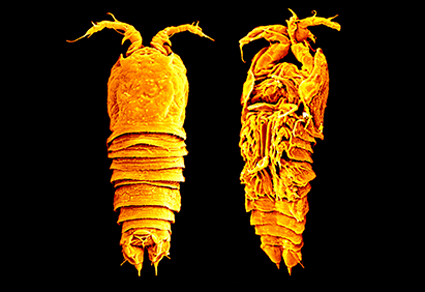
A new genus and species of Laophontidae, Indiaphonte bijoyi gen. et sp. nov. without sexual dimorphism in the male P3 endopod is described from Kavaratti Island off the southwestern coast of India. Several laophontid genera are known in which both sexes possess three-segmented exopods and two-segmented endopods of P2–P4 and the males lack sexual dimorphism in the endopod of P3. Of these, Tapholeon inconspicuus Gheerardyn & Fiers 2007a and T. uniarticulatus Wells 1967, and Indiaphonte gen. nov. share the unmodified outer distal seta on the male P3 ENP3. However, Indiaphonte gen. nov., and the other two species differ in the segmentation of P1 EXP, and, in this respect the new taxon resembles the other four species of that genus. However, the new species presented here and Tapholeon Wells 1967 differ in the shape of the habitus, armature of the second antennulary segment, in the reduced abexopodal seta on the antennary allobasis, and in the number of setae on the female P5 BENP and EXP. The males of Folioquinpes Fiers & Rutledge 1990 exhibit slight sexual dimorphism in the male P4 ENP consisting in the comparatively stronger outer distal spine of the male P4 ENP2. The sexual dimorphism of the male P4 ENP of I. bijoiy gen. et sp. nov. consists in the relatively longer ramus, and in an additional inner seta on ENP2. Given all the above, the proposal of a new genus, Indiaphonte gen. nov., for the new species described here from India, is justified. Some comments on the sexual dimorphism in the males of Laophontidae are given.
References
- Back, J. & Lee, W. (2014) A new genus (Copepoda, Harpacticoida, Laophontidae) from Jeju Island of Korea. ZooKeys, 447, 1–20. https://doi.org/10.3897/zookeys.447.7603
- Barnett, P.R.O. (1966) The comparative development of two species of Platychelipus Brady (Harpacticoida). In: Barnes, H. (Ed.), Some contemporary studies in marine science. Allen & Unwin Ltd., New York, pp. 113–127.
- Bodin, P. (1968) Recherches sur la systématique et la distribution des Copépodes Harpacticoïdes des substrats meubles des environs de Marseille. Note complémentaire. Recueil des Travaux de la Station Marine de l’Endoume, 43 (59), 271–277.
- Brady, G.S. (1880) A monograph of the free and semi-parasitic Copepoda of the British Islands. Vol. 2. Ray society, London, 182 pp. https://doi.org/10.5962/bhl.title.25924
- Brady, G.S. (1918) Copepoda. Scientific Reports of the Australian Antarctic Expedition, Series C, 5 (3), 1–48.
- Brady, G.S. & Robertson, D. (1873) Contributions to the study of the Entomostraca. No. VIII. On marine Copepoda taken in the west of Ireland. Annals and Magazine of Natural History, Series 4, 12 (68), 126–142.
- https://doi.org/10.1080/00222937308680724
- Bruno, M.C. & Cottarelli, V. (2011) Proposal of Fiersiphontina gen. nov., redescription of Fiersiphontina sensillata comb. nov., and new data on the distribution of Spiniferaphonte (Copepoda, Harpacticoida, Laophontidae). Zootaxa, 2809 (1), 1–19. https://doi.org/10.11646/zootaxa.2809.1.1
- Chappuis, P.A. (1954) Recherches sur la faune interstitielle des sédiments marins et d’eau douce á Madagascar. IV. Copépodes Harpacticoïdes psammiques de Madagascar. Mémoires de l’Institut Scintifique de Madagascar, Série A, 9, 45–73.
- Chappuis, P.A. (1960) Harpacticoïdes psammiques d’une plage près de Dakar. Bulletin de l’Institut Fondamental d’Afrique Noire, Série A, Sciences Naturelles, Série A, 22 (1), 193–197.
- Chislenko, L.L. (1967) Garpaktitsidy (Copepoda Harpacticoida) Karelskogo poberezh’ya Belogo morya. [Copepoda Harpacticoida of the Karelian coast of the White Sea]. Gidrobiologii Issled. na Karel’skom poberezh’e Belogo morya. Issledovaniya Fauny Morei, Explorations of the Fauna of the Seas, Hydrobiological researches of the Karelian Coast of the White-Sea., Academy of Sciences of the U.S.S.R., Zoolgical Institute, 7 (15), 48–196.
- Cordell, J.R. (2007) Free-living Copepoda (Orders Calanoida, Cyclopoida, and Harpacticoida). In: Carlton, J.T. (Ed.) The Light and Smith Manual: Intertidal invertebrates from Central California to Oregon. University of California Press, Berkeley and Los Angeles, pp. 446–464.
- Cottarelli, V. (1977) Mexicolaophonte arganoi n. gen n. sp. di Laophontidae (Crustacea, Copepoda, Harpacticoida) di acque interstiziali litorali Messicane. In: Subterranean Fauna of Mexico, Part III. Further Results of the Italian Zoological Missions to Mexico, sponsored by the National Academy of Lincei. Quaderni dell’Accademia Nazionale dei Lincei, 171, pp. 91–99.
- Cottarelli, V., Bruno, M.C. & Berera, R. (2006) Variazioni sul tema I: Description of Carcinocaris serrichelata, gen. nov., sp. nov., associated with xanthid crabs and new data on distribution of Xanthilaophonte trispinosa (Copepoda: Harpacticoida). Vie et Milieu, 56 (3), 203–213.
- Cottarelli, V., Bruno, M.C. & Berera, R. (2008) An intriguing new taxon of interstitial Laophontidae from the Indo-Pacific: Aequinoctiella gen. nov. (Copepoda: Harpacticoida). Vie et Milieu, 58 (3/4), 263–275.
- Cottarelli, V. & Forniz, C. (1991) Ricerche zoologiche della nave oceanografica ‘Minerva’ (C.N.R.) sulle isole circumsarde. XI. Laophontidae from the meiobenthos of some circumsardinian islets: Echinolaophonte armiger typica and Echinolaophonte minuta n. sp. (Crust., Copep., Harpact.). Annali del Museo Civico di Storia Naturale ‘Giacomo Doria’, Genova, 88, 665–676.
- Cottarelli, V., Saporito, P.E. & Puccetti, A.C. (1983) Novolaophonte viatorum n. gen., n. sp. (Crustacea, Copepoda, Harpacticoida) di acque interstiziali litorali del Massachusetts. Cahiers de Biologie Marine, 24 (3), 269–279.
- Cottarelli, V., Saporito, P.E. & Puccetti, A.C. (1985) Ricerche nell’Asia sudorientale 17. Indolaophonte ramai n. gen. n. sp. (Crustacea, Copepoda, Harpacticoida) di acque interstiziali litorali dell’isola di Bali (Indonesia). Bollettino del Museo Civico di Storia Naturale di Verona, 12, 273–281.
- Daday, E.V. (1903) Mikroskopische Süßwassertiere aus Kleinasien. Sitzungsberichte der Kaiserlichen Akademie der Wissenschaften in Wien, Matrhematisch-Naturtwissenschaftliche Classe, Abtheilung I, 112, 139–167.
- Edwards, C.L. (1891) Beschreibung einiger neuen Copepoden und eines neuen copepodenähnlichen Krebses, Leuckartella paradoxa. Archiv fur Naturgeschichte, Inaugural-Dissertation einer Hohen Philosophischen Faultat der Universität Leipzig, Berlin, 57 (1), 75–104.
- Fiers, F. (1986) Harpacticoid copepods from the west Indian Islands: Laophontidae (Copepoda, Harpacticoida). Amsterdam Expedition to the West Indian Islands, Report 48. Bijdragen tot de Dierkunde, 56 (1), 132–164. https://doi.org/10.1163/26660644-05601009
- Fiers, F. (1991a) Allocation of Laophonte trispinosa Sewell to Xanthilaophonte gen. nov. and the description of X. carcinicola spec. nov. (Harpacticoida: Laophontidae). Zoologische Mededelingen, 65, 287–312.
- Fiers, F. (1991b) A revision of the genus Laophontina Norman & T. Scott (Copepoda, Harpacticoida). Bulletin de l’Institut Royal des Sciences Naturelles de Belgique, Biologie, 61, 5–54.
- Fiers, F. (1992) Robustunguis gen. nov., a genus of decapod associated Laophontids (Copepoda: Harpacticoida). Zoologische Mededilingen, 66, 399–412.
- Fiers, F. & Rutledge, P. (1990) Harpacticoid copepods associated with Spartina alterniflora culms from the marshes of Cocodrie, Louisiana (Crustacea, Copepoda). Bulletin de l’Institut Royal des Sciences Naturelles de Belgique, Biologie, 60, 105–125.
- George, K.H. (1997) Mielkiella spinulosa gen. n. sp. n., a new taxon of the Laophontidae (Copepoda, Harpacticoida) from Porvenir (Tierra del Fuego, Chile). Microfauna Marina, 11, 71–86.
- Gheerardyn, H., Fiers, F., Vincx, M. & De Troch, M. (2006a) Peltidiphonte gen. nov., a new taxon of Laophontidae (Copepoda: Harpacticioda) from coral substrates of the Indo-West Pacific Ocean. Hydrobiologia, 553, 171–199.
- https://doi.org/10.1007/s10750-005-1134-0
- Gheerardyn, H., Fiers, F., Vincx, M. & De Troch, M. (2006b) Two new genera of Laophontidae (Copepoda: Harpacticoida) without sexual dimorphism in the endopods of the swimming legs. Zootaxa, 1327 (1), 41–62. https://doi.org/10.11646/zootaxa.1327.1.3
- Gheerardyn, H., Fiers, F., Vincx, M. & De Troch, M. (2007a) Revision of the genus Tapholeon Wells, 1967 (Copepoda, Harpacticoida, Laophontidae). Journal of Natural History, 41 (37–40), 2479–2510. https://doi.org/10.1080/00222930701695629
- Gheerardyn, H., Fiers, F., Vincx, M. & De Troch, M. (2007b) Spiniferaphonte, a new genus of Laophontidae (Copepoda: Harpacticoida), with notes on the occurrence of processes on the caudal rami. Journal of Crustacean Biology, 27 (2), 309–318. https://doi.org/10.1651/s-2723.1
- Gómez, S. & Morales-Serna, F.N. (2013) On a small collection of Laophontidae T. Scott (Copepoda: Harpacticoida) from Mexico. II. New records of Quinquelaophonte Wells, Hicks and Coull and description of Onychoquinpes permixtionis gen. nov. et sp. nov. Journal of Natural History, 47 (5–12), 1–30. https://doi.org/10.1080/00222933.2012.757658
- Hamond, R. (1973) Some Laophontidae (Crustacea: Harpacticoida) from off North Carolina. Transactions of the American Microscopical Society, 92 (1), 44–59. https://doi.org/10.2307/3225170
- Huys, R. (1990) A new family of harpacticoid copepods and an analysis of the phylogenetic relationships within the Laophontoidea T. Scott. Bijdragen tot de Dierkunde, 60 (2), 79–120. https://doi.org/10.1163/26660644-06002002
- Huys, R. (2009) Unresolved cases of type fixation, synonymy and homonymy in harpacticoid copepod nomenclature (Crustacea: Copepoda). Zootaxa, 2183 (1), 1–99. https://doi.org/10.11646/zootaxa.2183.1.1
- Huys, R. (2016) Harpacticoid copepods—their symbiotic associations and biogenic substrata: a review. Zootaxa, 4174 (1), 448–729.
- https://doi.org/10.11646/zootaxa.4174.1.28
- Huys, R. & Boxshall, G.A. (1991) Copepod evolution. The Ray Society, London, 468 pp.
- Huys, R., Gee, J., Moore, C. & Hamond, R. (1996) Marine and brackish water harpacticoid copepods. Part 1. In: Barnes, R. & Crothers, J. (Eds.), Synopses of the British fauna (New Series). Published for The Linnean Society of London and The Estuarine and Coastal Sciences Association by Field Studies Council Shrewsbury, London, 352 pp.
- Huys, R. & Lee, J. (2018) Philippiphonte aspidosoma gen. et sp. n., a radically divergent member of the Laophontidae from shell gravel in the East Sea, South Korea, including a review of Folioquinpes Fiers & Rutledge, 1990 (Copepoda, Harpacticoida). ZooKeys, 775, 15–46. https://doi.org/10.3897/zookeys.775.26404
- Huys, R. & Lee, W. (2000) Basal resolution of laophontid phylogeny and the paraphyly of Esola Edwards. Bulletin of the Natural History Museum, London, Zoology, 66 (1), 49–107.
- Huys, R. & Lee, W. (2009) Proposal of Marbefia, gen. n. and Inermiphonte, gen. n., including updated keys to the species of Pseudonychocamptus Lang, 1944 and Paralaophonte Lang, 1948 (Copepoda, Harpacticoida, Laophontidae). ZooKeys, 23, 1–38. https://doi.org/10.3897/zookeys.23.168
- Huys, R. & Willems, K.A. (1989) Laophontopsis Sars and the taxonomic concept of the Normanellinae (Copepoda: Harpacticoida): a revision. Bijdragen tot de Dierkunde, 59 (4), 203–227. https://doi.org/10.1163/26660644-05904002
- Itô, T. (1969) Descriptions and records of marine harpacticoid copepods from Hokkaido, II. Journal of the Faculty of Science, Hokkaido University, Zoology, Series 6, 17, 58–77.
- Jakobi, H. (1953) Novos Laophontidae (Copepoda-Crustacea) da costa Brasileira (Neue Laophontiden von der Brasilianischen Kueste). Dusenia, 4 (1), 47–60.
- Jakubisiak, S. (1932) Sur les harpacticoïdes hébergés par Maia squinado. Bulletin de la Société Zoologique de France, 57 (6), 506–513.
- Krishnaswamy, S. (1957) Two new psammophilous copepods from Madras. Zoologischer Anzei, 159 (9–10), 230–235.
- Kuru, S., Sönmez, S. & Karaytuğ, S. (2019) A new species of the genus Echinolaophonte Nicholls, 1941 (Copepoda, Harpacticoida, Laophontidae) from the Aegean Sea coast of Turkey. Turkish Journal of Zoology, 43 (2), 171–184. https://doi.org/10.3906/zoo-1809-20
- Lang, K. (1944) Monographie der Harpacticiden (vorläufige Mitteilung). Almqvist & Wiksells Boktryckeri AB, Uppsala, 39 pp.
- Lang, K. (1948) Monographie der Harpacticiden. Vol. II. Häkan Ohlsson, 2, pp. 897–1682.
- Lang, K. (1965) Copepoda Harpacticoidea from the Californian Pacific coast. Kungliga Svenska Vetenskapsakademiens Handlingar, Series 4, 10 (2), 1–560.
- Lee, W. (2003) A marine harpacticoid, Quinquelaophonte koreana sp. nov. from a sandy beach in Korea (Crustacea: Copepoda). Zoological Sciences, 20 (5), 657–668. https://doi.org/10.2108/zsj.20.657
- Lee, W. & Huys, R. (1999) Bathylaophonte gen. nov. from deep-sea hydrothermal vents and the polyphyly of Paronychocamptus (Copepoda: Harpacticoida). Cahiers de Biologie Marine, 40 (4), 293–328. https://doi.org/10.21411/CBM.A.36920EDF
- McCormack, E. (2006) Carraroenia ruthae gen. et sp. nov. (Copepoda, Harpacticoida, Laophontidae) from maerl substrates of the Irish west coast. Zootaxa, 1202 (1), 39–52. https://doi.org/10.11646/zootaxa.1202.1.4
- Mielke, W. (1981) Interstitielle Fauna von Galapagos. XXVIII. Laophontinae (Laophontidae), Ancorabolidae (Harpacticoida). Mikrofauna des Meeresbodens, 84, 1–106.
- Mielke, W. (1985) Interstitielle Copepoda aus dem zentralen Landesteil von Chile Cylindropsyllidae, Laophontidae, Ancorabolidae. Microfauna Marina, 2, 181–270.
- Mielke, W. (1997) On a small collection of Laophontidae (Copepoda) from Sulawesi, Indonesia. Microfauna Marina, 11, 223–250.
- Nicholls, A.G. (1941) A revision of the families Diosaccidae Sars, 1906 and Laophontidae T. Scott, 1905 (Copepoda, Harpacticoida). Records of the South Australian Museum, 7 (1), 65–110.
- Nicholls, A.G. (1957) Harpacticoid copepods commensal with crabs. Annals and Magazine of Natural History, Series 12, 10 (120), 896–904. https://doi.org/10.1080/00222935708656093
- Noodt, W. (1952) Marine Harpacticiden (Cop.) aus dem eulitoralen Sandstrand der Insel Sylt. Abhandlungen Mathematisch.-Naturwissenschaftlichen Klasse Akademie Wissenschaftliche Mainz, 1952 (3), 105–142.
- Noodt, W. (1958) Die Copepoda Harpacticoidea des Brandungsstrandes von Teneriffa (Kanarische Inseln). Abhandlungen der Mathematisch-Naturwissenschaftlichen Klasse, Akademie der Wissenschaften und der Literatur in Mainz, 1958 (2), 53–116.
- Norman, A.M. (1876) Crustacea, Tunicata, Polyzoa, Echinodermata, Actinozoa, Foraminifera, Polycistina and Spongida. In: Jeffreys, J.G. (Ed.), Preliminary Report of the Biological Results of a Cruise in H.M.S. ‘Valorous’ to Davis Strait in 1875. Proceedings of the Royal Society, 25, pp. 202–215.
- Norman, A.M. & Scott, T. (1905) Crustacea Copepoda new to science from Devon and Cornwall. Annals and Magazine of Natural History, Series 7, 15 (87), 284–300. https://doi.org/10.1080/03745480509443044
- Oh, J.H., Kim, D. & Lee, W. (2024) New genus of the family Laophontidae T. Scott, 1905 (Copepoda, Harpacticoida) from Hupo on the eastern coast of Korea. Biodiversity Data Journal, 12, e108106. https://doi.org/10.3897/BDJ.12.e108106
- Philippi, A. (1840) Zoologische Bemerkungen. VI. Pontarachna punctulum Ph., eine Hydrachnide des Meeres. Archiv für Naturgeschichte, 6 (1), 181–195.
- Ryss, A.Y. (2017) A simple express technique to process nematodes for collection slide mounts. Journal of Nematology, 49 (1), 27–32. https://doi.org/10.21307/jofnem-2017-043
- Sars, G.O. (1903) Copepoda Harpacticoida. Parts I & II. Misophriidae, Longipediidae, Cerviniidae, Ectinosomidae. An account of the Crustacea of Norway, with short descriptions and figures of all the species, 5, 1–28.
- Sars, G.O. (1905) Pacifische Plankton-Crustaceen. (Ergebnisse einer Reise nach dem Pacific. Schauinsland 1896–1897). II. Brackwasser–Crustaceen von den Chatham-Inseln. Zoologische Jahrbücher für Systematik, 21 (4), 371–414.
- Sars, G.O. (1907) Copepoda Harpacticoida. Parts XIX & XX. Canthocamptidae (concluded), Laophontidae (part). An account of the Crustacea of Norway, with short descriptions and figures of all the species, 5, 221–240.
- Sars, G.O. (1908a) Copepoda Harpacticoida. Parts XXIII & XXIV. Laophontidae (continued). An account of the Crustacea of Norway, with short descriptions and figures of all the species, 5, 257–276.
- Sars, G.O. (1908b) Copepoda Harpacticoida. Parts XXI & XXII. Laophontidae (continued). An account of the Crustacea of Norway, with short descriptions and figures of all the species, 5, 241–256.
- Schizas, N.V. & Shirley, T.C. (1994) Elapholaophonte decaceros n. gen., n. sp. (Copepoda: Harpacticoida, Laophontidae) from the Philippines. Transactions of the American Microscopical Society, 113 (2), 141–147. https://doi.org/10.2307/3226641
- Scott, A. (1896) Description of new and rare Copepoda. Report on the Investigations carried on in 1895 in connection with the Lancashire Sea-Fisheries Laboratory at University College, Liverpool, Proceedings and Transactions of the Liverpool Biological Society, 10, 134–158.
- Scott, T. (1903) On some new and rare Crustacea collected at various times in connection with the investigations of the Fishery Board for Scotland. Report of the Fishery Board for Scotland, 21 (3), 109–135.
- Scott, T. (1905) On some new and rare Crustacea from the Scottish seas. Reports of the Fishery Board for Scotland, 23 (3), 141–153.
- Sewell, R.B.S. (1924) Crustacea Copepoda: Fauna of the Chilka Lake. Memoirs of the Indian Museum, Calcutta, 5 (12), 771–851.
- Sewell, R.B.S. (1940) Copepoda, Harpacticoida. John Murray Expedition 1933-34 Scientific Reports, 7 (2), 117–382.
- Song, S.J., Lee, S., Kim, M., George, K.H. & Khim, J.S. (2023) Phylogenetic revision of Echinolaophonte Nicholls (Copepoda, Harpacticoida, Laophontidae T. Scott) including the establishment of two new genera and two new species. Zoosystematics and Evolution, 99 (1), 217–252. https://doi.org/10.3897/zse.99.90114
- Vervoort, W. (1964) Free-living Copepoda from Ifaluk Atoll in the Caroline Islands with notes on related species. Bulletin of the United States National Museum, 236, 1–431. https://doi.org/10.5479/si.03629236.236.1
- Wells, J.B.J. (1967) The littoral Copepoda (Crustacea) of Inhaca, Island, Mozambique. Transactions of the Royal Society of Edinburgh, 67 (7), 189–358. https://doi.org/10.1017/S0080456800024017
- Wells, J.B.J. (2007) An annotated checklist and keys to the species of Copepoda Harpacticoida (Crustacea). Zootaxa, 1568 (1), 1–872. https://doi.org/10.11646/zootaxa.1568.1.1
- Wells, J.B.J., Hicks, G.R.F. & Coull, B.C. (1982) Common harpacticoid copepods from New Zealand harbours and estuaries. New Zealand Journal of Zoology, 9 (2), 151–184. https://doi.org/10.1080/03014223.1982.10423847
- Willen, E. (1996) Two new genera of Laophontidae (Copepoda: Harpacticoida) from the high Antarctic Weddell Sea. Journal of Natural History, 30 (9), 1297–1327. https://doi.org/10.1080/00222939600771231
- WoRMS Editorial Board (2025) World Register of Marine Species. VLIZ. Available from: https://www.marinespecies.org (accessed 13 May 2025)
- Yeom, J., Nikitin, M.A., Ivanenko, V.N. & Lee, W. (2018) A new minute ectosymbiotic harpacticoid copepod living on the sea cucumber Eupentacta fraudatrix in the East/Japan Sea. PeerJ, 6, e4979. https://doi.org/10.7717/peerj.4979