

Abstract
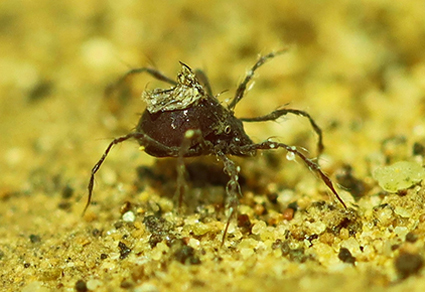
Two new species of Damaeus (Oribatida: Damaeidae)—D. kovali sp. nov. and D. kizilkobensis sp. nov.—are described from Crimean caves. Both new species are specialized cave-dwelling mites (eutroglophiles), without acquiring any obvious troglomorphic features in their morphology. Damaeus kovali sp. nov. undergoes its entire development cycle in caves, and we describe the morphology of all juvenile stages. If D. kizilkobensis sp. nov. also completes its ontogenetic development in caves is unknown, but according to Lebedinsky (1900), Damaeus nymphs were found in the same cave as the adults. Both species inhabit different caves located far from each other and they have not previously been found in other terrestrial habitats. The type material of two other epigeic (non-cave) species known from Crimea—D. tauricus and D. echinopus—is reexamined.
References
- Amelichev, G.N., Klimchouk, A.B., Tokarev, S.V. & Memetova, E.I. (2014) The Cadaster of karst caverns of the Crimea: past, present and future. Geopolitics and Ecogeodynamics of regions, 10 (1), 345–351. [in Russian]
- Aoki, J. (1966) Results of the speleological survey in south Korea 1966 V. damaeid mites (Acari, Cryptostigmata) found in a limestone cave of South Korea. Bulletin of the National Museum of Nature and Science, 9 (4), 563–569.
- Arillo, A. & Subías, L.S. (2006) Redescription of the longest-legged oribatid mite, Metabelbella phalangioides (Michael, 1890) com. nov., a species from Algeria and Southern Spain (Acariformes: Oribatida: Damaeidae). Systematic & Applied Acarology, 11, 57–62. https://doi.org/10.11158/saa.11.1.7
- Behan-Pelletier, V.M. & Norton, R.A. (1985) Epidamaeus (Acari: Damaeidae) of subarctic western North America and extreme northeastern USSR. Canadian Entomologist, 117, 277–319. https://doi.org/10.4039/Ent117277-3
- Bernini, F. (1980) Notulae Oribatologicae XXIV. Gli Acari Oribatei di alcune piccole grotte del Senese. Redia, 63, 359–405.
- Bruckner, A. (1995) Cave-dwelling oribatid mites (Acarina, Cryptostigmata) from East Austria. Verhandlungen der Zoologisch-Botanischen Gesellschaft in Österreich, 132, 81–107.
- Bulanova-Zachvatkina, E.M. (1957) Bulb-legged armored mites of the family Damaeidae Berl. Communication I. Zoologicheskij Zhurnal, 36 (8), 1167–1186. [in Russian]
- Bulanova-Zachvatkina, E.M. (1975) Superfamily Belboidea Dubinin, 1954 (=Damaeoidea Balogh, 1961). In: Gilyarov, M.S. & Krivolutsky, D.A. (Eds.), A Key to the Soil-Inhabiting Mites. Sarcoptifomes. Nauka, Moscow, pp. 120–143. [in Russian]
- Carl, J. (1904) Materialien zur Höhlenfauna der Krim. I. Aufsatz. Neue Höhlen-Crustaceen. Zoologischer Anzeiger, 28 (8/9), 322–329.
- Carl, J. & Lebedinsky, J. (1905) Materialien zur Höhlenfauna der Krim. II. Aufsatz. Ein neuen Typus Höhlenapterygoten. Zoologischer Anzeiger, 28 (16/17), 562–565.
- Cokendolpher, J.C. & Polyak, V.J. (1996) Biology of the caves at Sinkhole Flat, Eddy County, New Mexico. Journal of Cave and Karst Studies, 58 (3), 181–192.
- Ermilov, S.G., Sidorchuk, E.A. & Rybalov, L.B. (2010) Morphology of juvenile stages of Metabelba glabriseta Mahunka, 1982 and Damaeus auritus Koch, 1835 (Acari, Oribatida, Damaeidae). Annales Zoologici, 60, 599–616. https://doi.org/10.3161/000345410x550463
- Ermilov, S.G. & Smit, H. (2017) Additions to the oribatid mite fauna of the Caribbean, with a description of a new species of Epidamaeus (Acari, Oribatida, Damaeidae). Acarologia, 57 (4), 791–804. https://doi.org/10.24349/acarologia/20174194
- Ermilov, S.G., Subías, L.S., Shtanchaeva, U.Ya. & Friedrich, S. (2023) Faunistic and taxonomic contribution to the knowledge of oribatid mites (Acari, Oribatida) of Croatia, with description of a new species of Ceratoppia from a cave. Systematic and Applied Acarology, 28, 534–543. https://doi.org/10.11158/saa.28.3.10
- Guzmán-Sánchez, H. & Iglesias, R. (2005) Los ácaros (Acari: Oribatida) de los sótanos “El Tepozán” y “El Venado”, San Luis Potosí, México. Mundos Subterráneos, 16, 24–28.
- Guzmán-Sánchez, H. & Iglesias, R. (2009) Registros nuevos de ácaros oribátidos (Acari: Oribatei) de sótanos y suelos de México. Mundos Subterráneos, 20, 14–22.
- Hoffmann, A., López-Campos, G. & Vázquez, I. (2004) Los artrópodos de las cavernas de México. In: Llorente Bousquets, J., Morrone, J., Yáñez Ordóñez, O. & Vargas Fernández, I. (Eds.), Biodiversidad, taxonomía y biogeografía de artrópodos de México: Hacia una síntesis de su conocimiento. Vol. 3. CONABIO, Ciudad de México, pp. 229–326.
- Iglesias, R. & Guzmán-Sánchez, H. (2012) Nueva especie de Epidamaeus (Oribatei: Damaeidae) del estado de Guerrero, México. Dugesiana, 19 (2), 99–104. https://doi.org/10.32870/dugesiana.v19i2.4063
- Ivan, O. & Vasiliu, N.A. (2010) Fauna of oribatid mites (Acari, Oribatida) from the Movile Cave area (Dobrogea, Romania). Travaux de l`Institut de Speologie «Emile Racovitza», 19, 29–40.
- Jeannel, R. (1959) Situation geographique et peuplement des cavernes. Annales de spéléologie, 14, 333–338.
- Jeannel, R. (1965) Le genèse du peuplement des milieux souterrains. Revue d’ècologie et biologie du sol, 2, 1–22.
- Klimchouk, A.B., Amelichev, G.N. & Tymokhina, E.I. (2009) Karst features of the south-west part of the Piedmont Crimea from the standpoint of the theory of hypogene speleogenesis. Speleology and Karstology, 2, 35–53. [in Russian]
- Klimchouk, A.B., Tymokhina, E.I., Amelichev, G.M., Dublyansky, Yu.V. & Staubwasser, M. (2012) Age of the relief of the Inner range of the Mountainous Crimea according to the U/Th dating of the calcite deposit s of karst cavities. Reports of the National Academy of Sciences of Ukraine, 7, 88–96. [in Russian]
- Kniss, V.A. (1984) On the fauna of karst caves of Southeastern Bashkiria. Fauna and ecology of springtails. Nauka, Moscow, pp. 123–128. [in Russian]
- Kniss, V.A. (2001) Fauna of the Caves of Russia and Adjacent Countries. Bashkir State University, Ufa, 238 pp. [in Russian]
- Kolesnikov, V.B. & Turbanov, I.S. (2018) The cave-dwelling false scorpion genus Pseudoblothrus Beier, 1931 (Arachnida: Pseudoscorpiones: Syarinidae) in the Crimean Peninsula. Zootaxa, 4374 (4), 524–544. https://doi.org/10.11646/zootaxa.4374.4.4
- Koval, A.G. (2001) Fauna of Villyaburunskaya Cave of the Crimea. Peshchery, Perm, 27–29, 129–134. [in Russian]
- Lebedinsky, Ya. (1900) To the fauna of the Crimean caves. Zapiski Novorossiyskogo obshchestva estvoispytateley, 23 (2), 47–64. [in Russian]
- Leruth, R. (1939) La Biologie du domaine souterrain et la faune cavernicole de la Belgique. Mémoires du Musée royal d’histoire naturelle de Belgique, 87, 1–506.
- Ľuptáčik, P. & Miko, L. (2003) Oribatid mites (Acarina, Oribatida) of Slovak cave. Subterranean Biology, 1, 25–29.
- Mihelčič, F. (1958) Zoologisch-systematische Ergebnisse der Studienreise von H. Janetschek und W. Steiner in die spanische Sierra Nevada 1954. IX. Milben (Acarina). Sitzungsberichten der Österreische Akademie der Wissenschaften, Mathematiknaturwissenschaflichen Klasse, Abteilung I, 167, 35–57.
- Miko, L. (2006) Damaeidae. In: Weigmann, G. (Ed.), Hornmilben (Oribatida), Die Tierwelt Deutschlands Begründet 1925 von Friedrich Dahl. Teil 76. Goecke & Evers, Keltern, pp. 179–207.
- Miko, L. (2008) Taxonomy of European Damaeidae (Acari: Oribatida) II. Porobelba weigmanni n. sp. (Oribatida, Damaeidae), from East Slovakia, with comments on other known species of the genus. Zootaxa, 1844 (1), 55–62. https://doi.org/10.11646/zootaxa.1844.1.5
- Miko, L. (2015) Taxonomy of European Damaeidae VIII. Contribution to classification of genus Damaeus C. L. Koch, 1835, with a review of Adamaeus Norton, 1978 and Paradamaeus Bulanova-Zachvatkina, 1957 and redescription of three species. Zootaxa, 3980 (2), 151–188. https://doi.org/10.11646/zootaxa.3980.2.1
- Miko, L. (2016) Damaeus lupus n. sp. (Acarina), a new oribatid mite species from the Carpathian wilderness (Tatra Mountains, Slovakia). Acarologia, 56 (3), 279–292. https://doi.org/10.1051/acarologia/20162250
- Miko, L. & Mourek, J. (2008) Taxonomy of European Damaeidae (Acari: Oribatida). I. Kunstidamaeus Miko, 2006 with comments on Damaeus sensu lato. Zootaxa, 1820 (1), 1–26. https://doi.org/10.11646/zootaxa.1820.1.1
- Miko, L., Kolesnikov, V.B. & Murvanidze, M. (2017) Redescription of Belba paracorynopus Bulanova-Zachvatkina, 1962 (Acarina: Oribatida: Damaeidae) from Georgia. Systematic & Applied Acarology, 22 (11), 1884–1898. https://doi.org/10.11158/saa.22.11.8
- Muratov, M.V. (1954) About Miocene and Pliocene history of development of the Crimean Peninsula. Bulletin of the Moscow Society of Naturalists. Department of Geology, 29 (1), 4–20. [in Russian]
- Murvanidze, M. (2014) Oribatid mites of Georgian (Caucasus) caves including the description of a new species of Ghilarovus Krivolutsky, 1966. International Journal of Acarology, 40 (6), 463–472. https://doi.org/10.1080/01647954.2014.950604
- Nadolny, A.A. & Turbanov, I.S. (2025) A review of cave spiders (Arachnida, Araneae) of the Crimean Mountains, with descriptions of two new species. ZooKeys, 1230, 37–80. https://doi.org/10.3897/zookeys.1230.137029
- Nakamura, K., Nakamura, Y.-N. & Fujikawa, T. (2014) Oribatid fauna (Acari, Oribatida) from a cave in South Nippon (Japan), with a description of a new species. Acarologia, 54 (3), 249–269. https://doi.org/10.1051/acarologia/20142131
- Norton, R.A. (1977) A review of F. Grandjean’s system of leg chaetotaxy in the oribatei (Acari) and its application to the family Damaeidae. In: Dindal, D.L. (Ed.), Biology of oribatid mites. SUNY College of Environmental Science and Forestry, Syracuse, pp. 33–61.
- Norton, R.A. (1978) The genus Damaeus Koch (Acarina: Oribatei) in the eastern United States. Acarologia, 19 (1977), 331–353. https://doi.org/10.1080/01647957808684027
- Norton, R.A. & Behan-Pelletier, V. (2009) Oribatida. Chapter 15 In: Krantz, G.W. & Walter, D.E. (Eds.), A Manual of Acarology. 3rd Edition. Texas Tech University Press, Lubbock, Texas, pp. 421–564.
- Norton, R.A. & Ermilov, S.G. (2014) Catalogue and historical overview of juvenile instars of oribatid mites (Acari: Oribatida). Zootaxa, 3833 (1), 1–132. https://doi.org/10.11646/zootaxa.3833.1.1
- Norton, R.A. & Ermilov, S.G. (2021) Redescriptions of North American Epidamaeus (Acari, Oribatida, Damaeidae) species proposed by N. Banks, H.E. Ewing, A.P. Jacot, and J.W. Wilson. Zootaxa, 5021 (1), 1–65. https://doi.org/10.11646/zootaxa.5021.1.1
- Pérez-Íñigo, C. (1970) Bioespeleología de la cueva de Ojo Guareña. Ácaros Oribátidos. Boletín de la Real SociedadEspañola de Historia Natural, Biología, 67 (1969), 143–160.
- Pérez-Iñigo, C. (1976) Contribución al conocimiento de los Oribatidos cavernicolos. Volumen extraordinario del 1er Centenario de la Real Sociedad Española de Historia Natural, Trabajos científicos de Biología, 1976, 457–462.
- Prokopov, G.A. & Turbanov, I.S. (2017) To the question of speleofauna formation in the Crimean Peninsula. In: Materials of the II All-Russia Youth Conference “Biospeleological studies in Russia and neighbouring states”, Moscow, 1–2 December 2017. Filigran, Yaroslavl, pp. 99–106. [in Russian]
- Revelo-Tobar, H., Ojeda, M., García-Ayala, L.J. & Palacios-Vargas, J.G. (2024) Checklist of oribatid mites (Acari: Oribatida) from Mexico. Zootaxa, 5465 (1), 1–178. https://doi.org/10.11646/zootaxa.5465.1.1
- Schatz, H. (2016) Oribatid mites (Acari, Oribatida) from the biodiversity days in South Tyrol (Prov. Bolzano, Italy). Gredleriana, 16, 113–132.
- Sendra, A., Antić, D., Barranco, P., Borko, Š., Christian, E., Delić, T., Fadrique, F., Faille, A., Galli, L., Gasparo, F., Georgiev, D., Giachino, P.M., Kováč, L., Lukić, M., Marcia, P., Miculinić, K., Nicolosi, G., Palero, F., Paragamian, K., Pérez, T., Polak, S., Prieto, C.E., Turbanov, I., Vailati, D. & Reboleira, A.S.P.S. (2020) Flourishing in subterranean ecosystems: Euro-Mediterranean Plusiocampinae and tachycampoids (Diplura, Campodeidae). European Journal of Taxonomy, 591, 1–138. https://doi.org/10.5852/ejt.2020.591
- Seniczak, S. & Seniczak, A. (2011) Differentiation of external morphology of Damaeidae (Acari: Oribatida) in light of the ontogeny of three species. Zootaxa, 2775 (1), 1–36. https://doi.org/10.11646/zootaxa.2775.1.1
- Silvestri, F. (1949) Descrizione di due specie nuove cavernicole di Campodeidae (Insecta: Diplura) della regione Monte Tauro. Bollettino del Laboratorio di Entomologia Agraria, Portici, 9, 27–31.
- Sket, B. (2008) Can we agree on an ecological classification of subterranean animals? Journal of Natural History, 42 (21–22), 1549–1563. https://doi.org/10.1080/00222930801995762
- Subías, L.S. (2012) Un nuevo oribátido cavernícola, Damaeus gevi n. sp., de España (Acari: Oribatida: Damaeidae) con un camuflaje de cadáveres de oribátidos adheridos a sus exuvias. Revista Ibérica de Aracnología, 20, 31–34.
- Subías, L.S. (2022) Listado sistemático, sinonímico y biogeográfico de los ácaros oribátidos (Acariformes: Oribatida) del mundo (excepto fósiles). Monografías Electrónicas S.E.A., 12, 1–538.
- Tarman, K. (1969) The origin of cave acarofauna. Actes du IVe Congres International de Speleologie en Yougoslavie, 4–5, 253–256.
- Turbanov, I.S. & Kolesnikov, V.B. (2021) Three new hypogean species of the false scorpions genus Ephippiochthonius Beier, 1930 (Arachnida: Pseudoscorpiones: Chthoniidae) from the Crimean Peninsula. Arthropoda Selecta, 30 (2), 193–204. https://doi.org/10.15298/arthsel.30.2.06
- Turbanov, I.S., Palatov, D.M. & Golovatch, S.I. (2016a) The state of the art of biospeleology in Russia and other countries of the former Soviet Union: a review of the cave (endogean) invertebrate fauna. 2. Arachnida – Acknowledgements. Entomological Review, 96 (9), 1297–1333. https://doi.org/10.1134/S0013873816090116
- Turbanov, I.S., Palatov, D.M. & Golovatch, S.I. (2016b) The state of the art of biospeleology in Russia and other countries of the former Soviet Union: a review of the cave (endogean) invertebrate fauna. 3. References and summaries. Entomological Review, 96 (9), 1334–1358. https://doi.org/10.1134/S0013873816090128
- Vandel, A. (1964) Biospéologie. La Biologie des Animaux Cavernicoles. Gauthier-Villars, Paris, 679 pp.
- Vargovitsh, R.S. (2009) New cave Arrhopalitidae (Collembola: Symphypleona) from the Crimea (Ukraine). Zootaxa, 2047 (1), 1–47. https://doi.org/10.11646/zootaxa.2047.1.1
- Willmann, C. (1941) Die Acari der Höhlen der Balkanhalbinsel. (Nach dem Material der “Biospeologica balcanica”). Studien aus dem Gebiete der Allgemeinen Karstforschung, der Wissenschaftlichen Höhlenkunde, der Eiszeitforschung und den Nachbargebieten, Brünn, Biologische Serie 8, 1–80.
- Willmann, C. (1954) Mährische Acari hauptsachlich aus dem Gebiete des Mährischen Karstes. Československá parasitologie, 1, 213–272.
- Winkler, A. (1912) Ein neue blinder Trechus aus der Krim. Koleopterologische Rundschau, 1, 134–135.