

Abstract
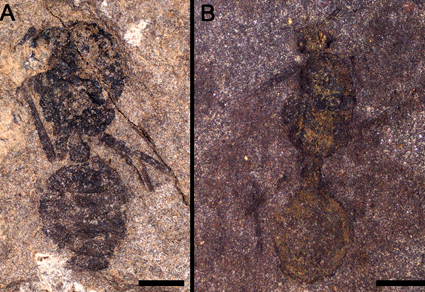
The Ningming Basin was characterized by a humid subtropical monsoon climate during the early Oligocene, which supported a rich assemblage of plant and fish fossils. However, the insect fauna from this period has remained poorly documented, with only a single damselfly species formally described. Recent investigations have yielded a distinct collection of insect fossils, comprising at least five orders and represented by 98 specimens, among which ants are the predominant group. In addition, we report four distinct types of herbivory traces and one pathogen‑related damage type on contemporaneous leaves, providing direct evidence of biological interactions. These findings significantly expand the known early Oligocene entomofauna from southern China and enhance our understanding of terrestrial ecosystems under a humid subtropical monsoon regime during this epoch.
References
- Archibald, S.B. & Cannings, R.A. (2021) The head of Cephalozygoptera (Odonata). Zootaxa, 5047 (1), 97–100. https://doi.org/10.11646/zootaxa.5047.1.10
- Archibald, S.B., Cannings, R.A., Erickson, R.J., Bybee, S.M. & Mathewes, R.W. (2021) The Cephalozygoptera, a new, extinct suborder of Odonata with new taxa from the early Eocene Okanagan Highlands, western North America. Zootaxa, 4934, 1–133. https://doi.org/10.11646/zootaxa.4934.1.1
- Bechly, G. (1996) Morphologische Untersuchungen am Flügelgeäder der rezenten Libellen und deren Stammgruppenvertreter (Insecta; Pterygota; Odonata), unter besonderer Berücksichtigung der Phylogenetischen Systematik und des Grundplanes der Odonata. Petalura, 2, 1–402.
- Bureau of Geology and Mineral Resources of Guangxi Zhuang Autonomous Region. (1985) Regional Geology of Guangxi Zhuang Autonomous Region. Geological Publishing House, Beijing, 853 pp.
- Carpenter, F.M., Snyder, T.E., Alexander, C.P., James, M.T. & Hull, F.M. (1938) Fossil insects from the Creede Formation, Colorado. Psyche, 45 (2–3), 105–119. https://doi.org/10.1155/1938/46082
- Chen, G.J. & Chang, M. (2011) A new early cyprinin from Oligocene of South China. Science China: Earth Sciences, 54 (4), 481–492. https://doi.org/10.1007/s11430-011-4182-5
- Chen, G.J., Chang, M.M., Wu, F.X. & Liao, X.W. (2021) Guiclupea superstes, gen. et sp. nov., the youngest ellimmichthyiform (clupeomorph) fish to date from the Oligocene of South China. PeerJ, 9, e11418. https://doi.org/10.7717/peerj.11418
- Chen, G.J., Liu, J. & Chang, M.M. (2018) Evolutionary hotspot of Cenozoic fish: Paleogene ichthyofauna from the onshore basins around Beibu Gulf. Chinese Science Bulletin, 63 (27), 2863–2875. https://doi.org/10.1360/N972018-00569
- Chen, G.Q., Chen, Y.F., Kuang, G.D. & Zhu, Q.P. (2004) Biostratigraphy of Tertiary fossil fishes from Ningming Basin, Guangxi. Vertebrata PalAsiatica, 42 (1), 81–85.
- Chen, Y.F. & Manchester, S.R. (2015) Winged fruits of Deviacer in the Oligocene from the Ningming Basin in Guangxi, South China. PLoS ONE, 10 (12), e0144009. https://doi.org/10.1371/journal.pone.0144009
- Chen, Y.F. & Zhang, D.X. (2005) Bauhinia larsenii, a fossil legume from Guangxi, China. Botanical Journal of the Linnean Society, 147 (4), 437–440. https://doi.org/10.1111/j.1095-8339.2005.00373.x
- Chen, Y.F., Wang, H.S., Liufu, Y.Q., Hu, Q., Fu, Q.Y. & Xie, Z.M. (2018) A new species of Palaeocarya (Juglandaceae) from the Ningming Basin in Guangxi, South China. Phytotaxa, 367 (1), 55–62. https://doi.org/10.11646/phytotaxa.367.1.6
- Chen, Y.F., Wong, W.O., Hu, Q., Liufu, Y.Q. & Xie, X.M. (2017) A new fossil-species of Acer (Sapindaceae) from the Ningming Basin in Guangxi, South China. Phytotaxa, 298 (2), 158–164. https://doi.org/10.11646/phytotaxa.298.2.5
- CoBabe, E.A., Chamberlain, K.R., Ivie, M.A. & Giersch, J.J. (2002) A new insect and plant Lagerstätte from a Tertiary lake deposit along the Canyon Ferry Reservoir, southwestern Montana. Rocky Mountain Geology, 37 (1), 13–30. https://doi.org/10.2113/gsrocky.37.1.13
- Córdova-Tabares, V.M., Riquelme, F., Varela-Hernández, F. & Estrada-Ruiz, E. (2024) Spider-ant predation in Oligo-Miocene Mexican amber. Palaeoentomology, 7 (3), 435–442. https://doi.org/10.11646/palaeoentomology.7.3.13
- Dong, J.L., Sun, B.N., Ma, F.J., Wang, Q.J., Jin, P.H., Wang, W.J., Deng, P., Yang, Y. & Li, X.J. (2015) Paliurus fruits from the Oligocene of South China and their phytogeographic implications. PLoS ONE, 10 (11), e0140653. https://doi.org/10.1371/journal.pone.0140653
- Dong, J.L., Sun, B.N., Mao, T., Liu, C.H., Wang, X.L., Sun, M.X., Ma, F.J. & Wang, Q.J. (2018) The occurrence of Burretiodendron from the Oligocene of South China and its geographic analysis. Palaeogeography, Palaeoclimatology, Palaeoecology, 512, 95–105. https://doi.org/10.1016/j.palaeo.2017.07.004
- Dong, J.L., Wang, W.J., Deng, P., Wang, J., Ma, F.J., Wang, Q.J., Yang, Y. & Sun, B.N. (2016) New material of Palaeocarya from the Oligocene of Ningming, Guangxi, South China. PalZ, 90 (2), 399–412. https://doi.org/10.1007/s12542-016-0302-z
- Engel, M.S., Nguyen, L.T. & Nel, A. (2024) A new genus of polistine wasps from the Oligocene of Aix-en-Provence, France (Hymenoptera: Vespidae). Palaeoentomology, 7 (2), 217–220. https://doi.org/10.11646/palaeoentomology.7.2.4
- Garrouste, R. & Nel, A. (2015) New Eocene damselflies and first Cenozoic damsel-dragonfly of the isophlebiopteran lineage (Insecta: Odonata). Zootaxa, 4028 (3), 354–366. https://doi.org/10.11646/zootaxa.4028.3.2
- Garrouste, R. & Nel, A. (2019) Alaskan Palaeogene insects: a challenge for a better knowledge of the Beringian ‘route’ (Odonata: Aeshnidae, Dysagrionidae). Journal of Systematic Palaeontology, 17 (22), 1939–1946. https://doi.org/10.1080/14772019.2019.1572235
- Gaudant, J., Nel, A., Nury, D., Véran, M. & Carnevale, G. (2018) The uppermost Oligocene of Aix-en-Provence (Bouches-du-Rhône, Southern France): A Cenozoic brackish subtropical Konservat-Lagerstätte, with fishes, insects and plants. Comptes Rendus Palevol, 17 (7), 460–478. https://doi.org/10.1016/j.crpv.2017.08.002
- Grimaldi, D. & Engel, M.S. (2005) Evolution of the Insects. Cambridge University Press, Cambridge, 755 pp.
- Huang, D.Y., Liu, Q., Lian, X.N., Fu, Y.Z. & Nel, A. (2022) A new calopterygid damselfly (Odonata, Zygoptera) from the Oligocene Ningming Basin, Guangxi, South China. Palaeoentomology, 5 (2), 113–119. https://doi.org/10.11646/palaeoentomology.5.2.3
- Huang, D.Y., Lian, X.N. & Nel, A. (2025) A new damselfly family from the Paleocene of the Sanshui Basin, South China (Odonata, Zygoptera). Journal of Paleontology, 98 (6), 1041–1047. https://doi.org/10.1017/jpa.2024.43
- Ivany, L.C., Patterson, W.P. & Lohmann, K.C. (2000) Cooler winters as a possible cause of mass extinctions at the Eocene/Oligocene boundary. Nature, 407 (6806), 887–890. https://doi.org/10.1038/35038044
- Kaulfuss, U., Szawaryn, K., Lee, D. & Ruta, R. (2024) The first beetle species described from Oligocene New Zealand amber (Coleoptera: Scirtidae). Palaeoentomology, 7 (4), 529–538. https://doi.org/10.11646/palaeoentomology.7.4.12
- Kuang, G.D., Chen, G.Q. & Chen, Y.F. (2004) New information on the Tertiary biostratigraphy of the Ningming Basin, Guangxi. Journal of Stratigraphy, 28 (4), 362–366.
- Labandeira, C.C., Wilf, P., Johnson, K.R. & Marsh, F. (2007) Guide to insect (and other) damage types on compressed plant fossils, version 3.0. Smithsonian Institution, Washington, D.C., 25 pp.
- LaPolla, J.S. (2023) Fossil ants (Hymenoptera: Formicidae) of the early Oligocene Canyon Ferry Reservoir deposit. Palaeoentomology, 6 (4), 385–397. https://doi.org/10.11646/palaeoentomology.6.4.10
- Li, H.M., Chen, Y.F., Chen, G.J., Kuang, G.D. & Huang, Z.T. (2003) Tertiary fossil winged fruits of Palaeocarya from Ningming of Guangxi, South China. Acta Palaeontologica Sinica, 42 (4), 543–547.
- Li, S.F., Valdes, P.J., Farnsworth, A., Davies-Barnard, T., Su, T., Lunt, D.J., Spicer, R.A., Liu, J., Deng, W.Y.D., Huang, J., Tang, H., Ridgwell, A., Chen, L.L. & Zhou, Z.K. (2021) Orographic evolution of northern Tibet shaped vegetation and plant diversity in eastern Asia. Science Advances, 7 (5), eabc7741. https://doi.org/10.1126/sciadv.abc7741
- Ling, C.C., Ma, F.J., Dong, J.L., Zhou, G.H., Wang, Q.J. & Sun, B.N. (2021) A mid-altitude area in southwestern China experienced a humid subtropical climate with subtle monsoon signatures during the early Oligocene: Evidence from the Ningming flora of Guangxi. Palaeogeography, Palaeoclimatology, Palaeoecology, 579, 110601. https://doi.org/10.1016/j.palaeo.2021.110601
- Liu, Q., Zeng, G.C., Lian, X.N., Fu, Y.Z., Cai, C.Y. & Huang, D.Y. (2021) A new amber outcrop from the Oligocene Nanning Basin of Guangxi, southern China. Palaeoentomology, 4 (4), 326–330. https://doi.org/10.11646/palaeoentomology.4.4.7
- Ma, F.J., Sun, B.N., Wang, Q.J., Dong, J.L., Yang, G.L. & Yang, Y. (2015) A new species of Meliolinites associated with Buxus leaves from the Oligocene of Guangxi, southern China. Mycologia, 107 (3), 505–511. https://doi.org/10.3852/14-270
- Maccracken, S.A., Miller, I.M., Johnson, K.R., Sertich, J.M. & Labandeira, C.C. (2022) Insect herbivory on Catula gettyi gen. et sp. nov. (Lauraceae) from the Kaiparowits Formation (Late Cretaceous, Utah, USA). PLoS ONE, 17, e0261397. https://doi.org/10.1371/journal.pone.0261397
- McCobb, L.M.E., Duncan, I.J., Jarzembowski, E.A., Stankiewicz, B.A., Wills, M.A. & Briggs, D.E.G. (1998) Taphonomy of the insects from the insect bed (Bembridge Marls), late Eocene, Isle of Wight, England. Geological Magazine, 135 (4), 553–563. https://doi.org/10.1017/S0016756898001204
- Münz, P.A. (1919) A venational study of the suborder Zygoptera (Odonata) with keys for the identification of genera. Memoirs of the American Entomological Society, 3, 1–78. https://doi.org/10.5962/bhl.title.8499
- Nel, A. & Jouault, C. (2022) The odonatan insects from the Paleocene of Menat, central France. Acta Palaeontologica Polonica, 67 (3), 631–648. https://doi.org/10.4202/app.00960.2021
- Nel, A. & Zheng, D.R. (2021) The recently proposed odonatan ‘suborder’ Cephalozygoptera: Fact or fiction. Palaeoentomology, 4 (2), 165–170. https://doi.org/10.11646/palaeoentomology.4.2.5
- Nel, A., Martínez-Delclòs, X., Paicheler, J.C. & Henrotay, M. (1993) Les ‘Anisozygoptera’ fossiles. Phylogénie et classification (Odonata). Martinia, Numéro Hors Série, 3, 1–311.
- Nel, A., Nel, P. & Garrouste, R. (2024) A new Plecia Wiedemann from the Oligocene of Lubéron (France) (Diptera: Bibionidae). Palaeoentomology, 7 (4), 465–467. https://doi.org/10.11646/palaeoentomology.7.4.4
- Nel, A., Wei, M.C., Niu, G.Y., Garrouste, R. & Jouault, C. (2023) Description of a new fossil genus of conifer sawfly (Hymenoptera: Diprionidae) revealed by UV light. Palaeoentomology, 6 (3), 313–320. https://doi.org/10.11646/palaeoentomology.6.3.14
- Ning, Z.S., Zhou, T.M., Hu, Y.K. & Liang, Z.H. (1994) Tertiary in Petroliferous Regions of China. Petroleum Industry Press, Beijing, 374 pp.
- Petrulevičius, J.F. & Nel, A. (2007) Enigmatic and little known Odonata (Insecta) from the Paleogene of Patagonia and northwest Argentina. Annales de la Société Entomologique de France, (N.S.), 43 (3), 341–347. https://doi.org/10.1080/00379271.2007.10697530
- Riek, E.F. & Kukalová-Peck, J. (1984) A new interpretation of dragonfly wing venation based upon Early Carboniferous fossils from Argentina (Insecta: Odonatoidea) and basic character states in pterygote wings. Canadian Journal of Zoology, 62 (6), 1150–1166. https://doi.org/10.1139/z84-166
- Shi, G.L., Zhou, Z.Y. & Xie, Z.M. (2010) A new Cephalotaxus and associated epiphyllous fungi from the Oligocene of Guangxi, South China. Review of Palaeobotany and Palynology, 161 (3–4), 179–195. https://doi.org/10.1016/j.revpalbo.2010.04.002
- Shi, G.L., Zhou, Z.Y. & Xie, Z.M. (2012) A new Oligocene Calocedrus from South China and its implications for transpacific floristic exchanges. American Journal of Botany, 99 (1), 108–120. https://doi.org/10.3732/ajb.1100331
- Simonsen, T.J., Archibald, S.B., Rasmussen, J.A., Sylvestersen, R.L., Olsen, K. & Ware, J.L. (2022) Danowhetaksa gen. nov. with two species from the early Eocene Ølst Formation from Denmark, the first Palearctic Whetwhetaksidae (Odonata: Cephalozygoptera). Zootaxa, 5099 (5), 586–592. https://doi.org/10.11646/zootaxa.5099.5.5
- Sun, B.N., Wang, Q.J., Konrad, W., Ma, F.J., Dong, J.L. & Wang, Z.X. (2017) Reconstruction of atmospheric CO₂ during the Oligocene based on leaf fossils from the Ningming Formation in Guangxi, China. Palaeogeography, Palaeoclimatology, Palaeoecology, 467, 5–15. https://doi.org/10.1088/1475-7516/2019/10/019
- Tian, Y., Shaw, D. & Schneider, S. (2018) Oligocene fossil assemblages from Lake Nanning (Yongning Formation; Nanning Basin, Guangxi Province, SE China): Biodiversity and evolutionary implications. Palaeogeography, Palaeoclimatology, Palaeoecology, 505, 100–119. https://doi.org/10.1016/j.palaeo.2018.05.033
- Varela-Hernández, F., Riquelme, F. & Estrada-Ruiz, E. (2024) Elektroformica azquil gen. et sp. nov., a new formicine ant from Oligo-Miocene Mexican amber. Palaeoentomology, 7 (5), 684–692. https://doi.org/10.11646/palaeoentomology.7.5.11
- Wang, Q.J., Zheng, J., Sun, B.N., Ma, F.J., Wang, Z. & Wang, W.M. (2020) Carbon isotope and paleoclimatic implications of three plants from the Oligocene Ningming Formation, Guangxi. Acta Sedimentologica Sinica, 38 (2), 358–366. https://doi.org/10.1088/1475-7516/2019/10/019
- Wang, W.M., Chen, G.J. & Liao, W. (2015) Oligocene palynoflora from Nanning Basin in Guangxi and its palaeoenvironmental significance. Quaternary Sciences, 35 (3), 650–659.
- Wang, W.M., Chen, G.J., Chen, Y.F. & Kuang, G.D. (2003) Tertiary palynostratigraphy of the Ningming basin, Guangxi. Journal of Stratigraphy, 27 (4), 324–327.
- Ware, J.L., Simonsen, T.J., Rasmussen, J.A. & Archibald, S.B. (2025) Systematics of the extinct suborder Cephalozygoptera (Odonata): a wing-based analysis comparing its genera with those of extant Zygoptera. American Museum Novitates, 4043, 1–19. https://doi.org/10.1206/4043.1
- Wedmann, S., Poschmann, M. & Hörnschemeyer, T. (2010) Fossil insects from the Late Oligocene Enspel Lagerstätte and their palaeobiogeographic and palaeoclimatic significance. Palaeobiodiversity and Palaeoenvironments, 90 (1), 49–58. https://doi.org/10.1007/s12549-009-0013-5
- Wilson, M.V.H. (1978) Paleogene insect faunas of western North America. Quaestiones Entomologicae, 14 (1), 13–34.
- Xu, S.L., Kodrul, T.M., Wu, Y., Maslova, N.P. & Jin, J.H. (2021) Early Oligocene fruits and leaves of Burretiodendron (Malvaceae s.l.) from South China. Journal of Systematics and Evolution, 59 (5), 1100–1110. https://doi.org/10.1111/jse.12577
- Zachos, J.C., Dickens, G.R. & Zeebe, R.E. (2008) An early Cenozoic perspective on greenhouse warming and carbon-cycle dynamics. Nature, 451 (7176), 279–283. https://doi.org/10.1038/nature06588
- Zachos, J.C., Shackleton, N.J., Revenaugh, J.S., Pälike, H. & Flower, B.P. (2001) Climatic response to orbital forcing across the Oligocene-Miocene boundary. Science, 292 (5515), 274–278. https://doi.org/10.1126/science.1058288