

Abstract
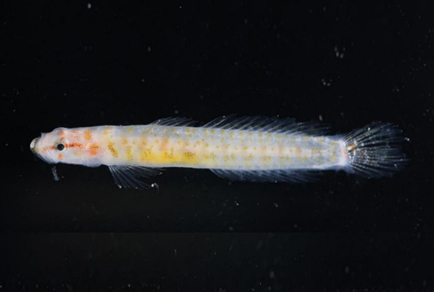
A new wriggler of genus Xenisthmus was collected from Taiping Island, South China Sea, Taiwan, while SCUBA diving for a coral reef fish survey. The new species, Xenisthmus aureus sp. nov., can be well distinguished from other congeners by the following unique combination of features: (1) fins: second dorsal fin rays I/11; anal fin rays I/10; pectoral fin rays15; (2) squamation: longitudinal scale series 60–62; perdorsal scales 0; (3) vertebral count 10+16=26; (4) preopercular canal present with 4 pores γ, δ, ε, and ε1; and (5) specific colouration: lateral side of trunk with an upper horizontal series of 20–22 yellow spots; a median series of oblique golden yellow stripes or becoming smaller, irregular golden yellow marks; the orange red cross mark on eye, radiating into mouth and posterior area horizontally, and extending up to top eye margin to downward vertically behind the maxillary on cheek; pectoral fin base with a upper, large oblique golden yellow mark; and caudal fin base with a very small median black spot. A species comparison of other congeners will also be briefly discussed in this paper.
References
- Akihito, P., Hayashi, M. & Yoshino, T. (1984) Suborder Gobioidei. In: Masuda, H., Amaoka, K., Araga, C., Uyeno, C.T. & Yoshino, T., (Eds.), The Fishes of Japanese Archipelago. Tokai University Press, Tokyo, pp. 228–289.
- Chen, I-S. & Fang, L.S. (2006) A new species of Rhinogobius (Teleostei: Gobiidae) from the Hanjiang basin, in Guangdong Province, China. Ichthyological Research, 53, 247–253. https://doi.org/10.1007/s10228-006-0342-6
- Chen, I-S., Harefa, H., Jiang, G.C. & Chang, C.W. (2022) A new wriggler of Eleotrid (Teleostei: Xenisthmidae) from Taiwan. Zootaxa, 5189 (1), 13–17. https://doi.org/10.11646/zootaxa.5189.1.4
- Gill, A.C. & Hoese, D.F. (2004) Three new Australian species of the fish genus Xenisthmus (Gobioidei: Xenisthmidae). Records of the Australian Museum, 56 (2), 241–246. https://doi.org/10.3853/j.0067-1975.56.2004.1428
- Gill, A.C. & Randall, J.E. (1994) Xenisthmus balius, a new species of fish from the Persian Gulf (Gobioidei: Xenisthmidae). Proceedings of the Biological Society of Washington, 107 (3), 445–450.
- Gill, A.C., Bogorodsky, S.V. & Mal, A.O. (2017) Review of Red Sea Xenisthmus Snyder (Teleostei: Gobioidei: Xenisthmidae), with description of a new species. Zootaxa, 4286 (2), 203–214. https://doi.org/10.11646/zootaxa.4286.2.4
- Herre, A.W.C.T. (1938) Luzoneleotris, a new genus of eleotrid fishes from Luzon. Stanford Ichthyological Bulletin, 1 (2), 59–60.
- Jordan, D.S. & Seale, A. (1906) The fishes of Samoa. Description of the species found in the archipelago, with a provisional check-list of the fishes of Oceania. Bulletin of the Bureau of Fisheries, 25 (1905), 173–455. https://doi.org/10.5962/bhl.title.46247
- Klunzinger, C.B. (1871) Synopsis der Fische des Rothen Meeres. II. Theil. Verhandlungen der K.-K. zoologisch-botanischen Gesellschaft in Wien, 21, 441–688. https://doi.org/10.5962/bhl.title.1148
- Miller, P.J. (1988) New species of Coryrogobius, Thorogobius, and Wheelerigobius from West Africa (Teleostei: Gobiidae). Journal of Natural History, 22, 1245–1262.
- https://doi.org/10.1080/00222938800770761
- Sanzo, L. (1911) Distribuzione delle papille cutanee (organi ciatiforme) e suo valore sistematico nei gobi. Mitteilungen aus der zoologischen Sation zu Neapel, 20, 249–328.
- Schultz, L.P., Woods, L.P. & Lachner, E.A. (1966) Fishes of the Marshall and Marianas islands. Vol. 3. Families from Kraemeriidae through Antennariidae. Bulletin of the United States National Museum, 202 (3), 1–176. https://doi.org/10.5479/si.03629236.202.3
- Shao, K.T. (2022) The fish database of Taiwan. WWW Web electronic publication. Available from: http://fishdb.sinica.edu.tw (accessed 30 April 2022)
- Smith, J.L.B. (1958) The fishes of the family Eleotridae in the western Indian Ocean. Ichthyological Bulletin, Department of Ichthyology, Rhodes University, 11, 137–163.
- Snyder, J.O. (1908) Descriptions of eighteen new species and two new genera of fishes from Japan and the Riu Kiu Islands. Proceedings of the United States National Museum, 35 (1635), 93–111. https://doi.org/10.5479/si.00963801.1635.93
- Whitley, G.P. (1933) Studies in ichthyology. No. 7. Records of the Australian Museum, 19, 60–112. https://doi.org/10.3853/j.0067-1975.19.1933.691
- Wongrat, P. & Miller, P.J. (1991) The innervation of head neuromast rows in eleotridine gobies (Teleostei: Gobioidei). Journal of Zoology, 225, 27–42. https://doi.org/10.1111/j.1469-7998.1991.tb03799.x