

Abstract
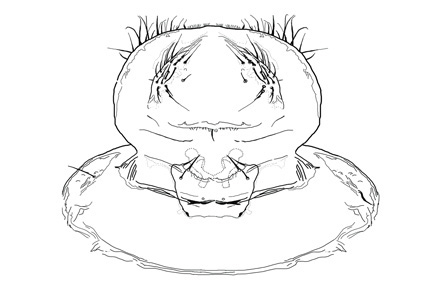
A rare intersexual form of the genus Fannia R.-D. is described. It was found among a large amount of specimens of the genus collected between 1963 and 2014 in the southernmost region of South America. A brief historical account of these specimens within the family Fanniidae is presented, as well as a thorough morphological description of external characters as well as the description and interpretation of the genitalia. A very brief discussion of the possible cause of this phenomenon is also included.
References
- Blackith, R.M. & Blackith, R.E. (1991) A bizarre specimen of Pseudonupedia intersecta (Meigen) (Diptera: Anthomyiidae). Irish Naturalists’ Journal, 23, 424.
- Brust, R.A. (1966) Gynandromorphs and intersexes in mosquitoes (Diptera: Culicidae). Canadian Journal of Zoology, 44, 911–921. https://doi.org/10.1139/z66-093
- Cilek, J.E. & Knapp, F.W. (1994) Face fly (Diptera: Muscidae) gynandromorph. Journal of Medical Entomology, 31 (5), 760–762. https://doi.org/10.1093/jmedent/31.5.760
- Domínguez, M.C. & Pont, A.C. (2014) Fanniidae (Insecta: Diptera). Fauna of New Zealand, 71, 1–91.
- Domínguez, M.C. & Roig-Juñent, S.A. (2008) A phylogeny of the family Fanniidae Schnabl (Insecta: Diptera: Calyptratae) based on adult morphological characters, with special reference to the Austral species of the genus Fannia. Invertebrate Systematics, 22 (5), 563–587. https://doi.org/10.1071/IS08003
- Kim, D., Hyun, S. & Choi, K.S. (2025) First report of an intersex individual of the click beetle Pectocera fortunei (Elateridae) and additional cases of gynandromorphism in Coleoptera (Lucanidae, Scarabaeidae). Biodiversity Data Journal, 13, e144929. https://doi.org/10.3897/BDJ.13.e144929
- Fusco, G. & Minelli, A. (2023) Descriptive versus causal morphology: gynandromorphism and intersexuality. Theory in Biosciences, 142 (1), 1–11. https://doi.org/10.1007/s12064-023-00385-1
- Goldschmidt, R. (1934) Lymantria. Bibliographica Genetica, 11, 1–186.
- Iwasa, M. & Shinonaga, S. (1982) A wild-caught gynandromorph in a muscid fly, Hydrotaea zao Shinonaga et Kano, 1973 (Diptera, Muscidae). Japanese Journal of Entomology, 50, 649–651.
- Kurahashi, H. (1977) A gynandromorph in Parasarcophaga harpax (Diptera, Sarcophagidae), with special reference to “hypopygium circumversum” of the calyptrate postabdomen. Japanese Journal of Entomology, 45, 372–376.
- Laugé, G. (1985) Sex determination: genetic and epigenetic factors. In: Kerkut, G.A. & Gilbert, L.I. (Eds.), Comprehensive insect physiology, biochemistry and pharmacology. Vol. 1. Embryogenesis and reproduction. Pergamon Press, Oxford, pp. 295–318.
- Narita, S., Pereira, R., Kageyama, D. & Kjellberg, F. (2010) Gynandromorphs and intersexes: potential to understand the mechanism of sex determination in arthropods. Terrestrial arthropod reviews, 3 (1), 63–96. https://doi.org/10.1163/187498310X496190
- Nihei, S.S. & Carvalho, C.J.B. de. (2002) Occurrence of gynandromorphism in Polietina orbitalis (Stein, 1904) (Diptera: Muscidae: Muscinae). Studia dipterologica, 9, 73–81.
- O’hara, J.E. (1983) Two bilateral gynandromorphs in the Calyptratae (Diptera): Hydrotaea meteorica (Muscidae) and Siphona hokkaidensis (Tachinidae). The Canadian Entomologist, 115 (4), 379–386. https://doi.org/10.4039/Ent115379-4
- Pont, A.C. & Carvalho, C.J.B. de. (1994) Neotropical Fannidae (Diptera): A key to the Fannia anthracina-group. Entomologist’s monthly Magazine, 130, 229–238.
- Rozkošný, R., Frantisek, G. & Pont, A.C. (1997) The European Fanniidae (Diptera). Acta Scientiarum Naturalium Academiae Scientiarum Bohemicae, Brno, 31, 1–80.
- Rubini, P.G., Vecchi, M. & Franco, M.G. (1980) Mitotic recombination in Musca domestica L. and its influence on mosaicism, gynandromorphism and recombination in males. Genetical Research, 35, 121–130. https://doi.org/10.1017/S0016672300013999
- Vikhrev, N.E. (2019) New data on two rare species of Fannia (Diptera, Fanniidae). Amurian Zoological Journal, 11 (3), 247–253. https://doi.org/10.33910/2686-9519-2019-11-3-247-253
- Wang, M.F., Li, W., Zhao, Y.W., Wu, J. & Zhang, D. (2017) Descriptions of three new carbonaria-group species of Fannia Robineau-Desvoidy from China, with a key to the carbonaria-group species (Diptera, Fanniidae). ZooKeys, (657), 93–107. https://doi.org/10.3897/zookeys.657.9153