
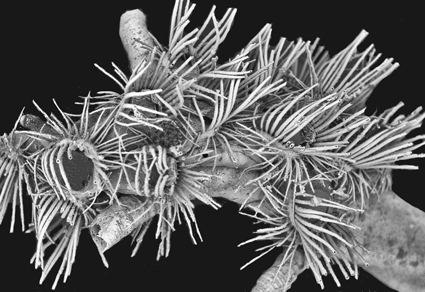

Abstract
In extant literature, the bryozoan genus Chaperia Jullien, 1881 comprises 22 named species, seven of them solely fossil, with the two earliest temporal records dating from the New Zealand Oligocene. All but four of the putative extant species are confined to the Southern Hemisphere. A 2009 New Zealand checklist accepted three named indigenous Chaperia species (one of them misidentified), plus two yet-to-be named species and one other of uncertain identity. Restudy of this material, plus examination of Chaperia in new collections from throughout New Zealand’s Exclusive Economic Zone (EEZ) and the Norfolk Ridge, has yielded additional new species, such that 17 species of Chaperia are now recognised in the EEZ at the present day, 15 of them new to science. Vestigial ooecia have been found in all of the species and small, sparsely distributed adventitious avicularia have also been discovered in two of them. The taxonomic usefulness of the available morphological characters of Chaperia species is discussed, as is the status of all other putative extant species and their relationship to the Zealandian species. It is hypothesized that Chaperia evolved from an austral Chaperiopsis ancestor in the late Paleocene or Eocene.
References
- Audouin, J.V. (1826) Explication sommaire des planches de polypes de l’Égypte et de la Syrie, publiées par Jules-César Savigny, Membre de l’Institut. In: Description de l’Égypte, ou recueil des observations et des Recherches qui ont été faites en Égypte pendant l’Expedition de l’Armée française. Histoire naturelle. Tome 1. Imprimerie Impériale, Paris, pp. 225–244.
- Bock, P.E. (2025) The Bryozoa Home Page. Available from: https://www.bryozoa.net (accessed 8 December 2025)
- Boonzaaier-Davids, M., Ma, K.C.K. & McQuaid, C.D. (2023) Epibiotic association of encrusting cheilostome bryozoans on shells of an invasive mussel from rocky shores of South Africa, with the description of a new aviculiferous species of Chaperia. Zootaxa, 5258 (2), 197–210. https://doi.org/10.11646/zootaxa.5258.2.2
- Brown, D.A. (1952) The Tertiary Cheilostomatous Polyzoa of New Zealand. Trustees of the British Museum (Natural History), London, xii + 405 pp. https://doi.org/10.5962/bhl.title.118779
- Busk, G. (1879) Polyzoa. Philosophical Transactions of the Royal Society, 168, 193–199, pl. 10. https://doi.org/10.1098/rstl.1879.0016
- Busk, G. (1884) Report on the Polyzoa collected by H.M.S. Challenger during the years 1873–76. Part 1. The Cheilostomata. Report on the Scientific Results of the Voyage of H.M.S. Challenger, Zoology, 10 (30), xxiv + 1–216, 36 pls.
- Cáceres-Chamizo, J. & Moyano, G.H.I. (1992) Ancéstrulas y patrones astogenéticos de especies de briozoos marinos chilenos I. Boletín de la Sociedad de Biología de Concepción, 63, 27–42.
- Florence, W.K. (2016) Some deep-water cheilostome Bryozoa from the south coast of South Africa. African Natural History, 12, 5–11. https://doi.org/10.17159/2305-7963/2016/v12n1a2
- Gordon, D.P. (1982) The genera of the Chaperiidae (Bryozoa). New Zealand Journal of Zoology, 9, 1–23. https://doi.org/10.1080/03014223.1982.10423832
- Gordon, D.P. (1984) The marine fauna of New Zealand: Bryozoa: Gymnolaemata from the Kermadec Ridge. Memoirs. New Zealand Oceanographic Institute, 91, 1–198.
- Gordon, D.P. (1986) The marine fauna of New Zealand: Bryozoa: Gymnolaemata (Ctenostomata and Cheilostomata Anasca) from the western South Island continental shelf and slope. Memoirs. New Zealand Oceanographic Institute, 95, 1–121.
- Gordon, D.P. (2009) New bryozoan taxa from a new marine conservation area in New Zealand, with a checklist of Bryozoa from Greater Cook Strait. Zootaxa, 1987 (1), 39–60. https://doi.org/10.11646/zootaxa.1987.1.2
- Gordon, D.P. (2013) New Zealand’s genetic diversity. In: Dymond, J. (Ed.), Ecosystem Services in New Zealand – Conditions and Trends. Manaaki Whenua Press, Lincoln, pp. 162–191.
- Gordon, D.P. (2023) Kingdom Animalia, phylum Bryozoa (bryozoans). In: Kelly, M., Mills, S., Terezow, M., Sim-Smith, C. & Nelson, W. (Eds.), The Marine Biota of Aotearoa New Zealand. Updating our marine biodiversity inventory. NIWA Biodiversity Memoir, 136, 263–281.
- Gordon, D.P. & Taylor, P.D. (2015) Bryozoa of the Early Eocene Tumaio Limestone, Chatham Island, New Zealand. Journal of Systematic Palaeontology, 13, 983–1070. https://doi.org/10.1080/14772019.2014.991905
- Gordon, D.P., Taylor, P.D. & Bigey, F.P. (2009) Phylum Bryozoa – moss animals, sea mats, lace corals. In: Gordon, D.P. (Ed.), New Zealand Inventory of Biodiversity. Volume One. Kingdom Animalia: Radiata, Lophotrochozoa, Deuterostomia. Canterbury University Press, Christchurch, pp. 271–297.
- Gordon, D.P., Beaumont, J., MacDiarmid, A., Robertson, D. & Ahyong, S. (2010) Marine biodiversity of Aotearoa New Zealand. PLoS ONE, 5 (8), e10905. https://doi.org/10.1371/journal.pone.0010905
- Harmer, S.F. (1926) The Polyzoa of the Siboga Expedition. Part 2. Cheilostomata Anasca. Siboga-Expeditie, 28b, i–viii + 181–501, pls. 13–34.
- Hayami, T. (1974) Bryozoa fossils in the Mizunami group. Bulletin of the Mizunami Fossil Museum, 1, 221–225.
- Hayward, P.J. & Cook, P.L. (1983) The South African Museum’s Meiring Naude cruises part 13. Bryozoa II. Annals of the South African Museum, 91, 1–161.
- Hincks, T. (1881) Contributions towards a general history of the marine Polyzoa. IV. Foreign Membraniporina (second series). V. Foreign Cheilostomata (Miscellaneous). Annals and Magazine of Natural History, Series 5, 7, 147–61, pls. 8–10. https://doi.org/10.1080/00222938109459489
- d’Hondt, J.-L. (1988) Bryozoa from the coast of Israel. Bollettino di Zoologia, 3, 191–203. https://doi.org/10.1080/11250008809386617
- Jelly, E.C. (1889) A Synonymic Catalogue of the Recent Marine Bryozoa. Dulau & Co., London, xv + 322 pp. https://doi.org/10.5962/bhl.title.29998
- Jullien, J. (1881) Remarques sur quelques espèces des Bryozoaires Cheilostomiens. Bulletin de la Société zoologique de France, 6, 163–168.
- Jullien, J. (1883) Bryozoaires. Espèces draguées dans l’océan Atlantique en 1881. Bulletin de la Société zoologique de France, 7, 497–529, pls. 13–17. https://doi.org/10.5962/bhl.part.27178
- Jullien, J. (1888) Bryozoaires. Mission scientifique du Cap Horn 1882–1883, 6 (Zoologie Part 3), 1–92, 15 pls.
- Kelly, M., Mills, S., Terezow, M., Sim-Smith, C. & Nelson, W. (2023) The Marine Biota of Aotearoa New Zealand. Updating our marine biodiversity inventory. NIWA Biodiversity Memoir, 136, 1–494.
- Kirkpatrick, R. (1888) Polyzoa of Mauritius. Annals and Magazine of Natural History, Series 6, 1, 72–85, pls. 7–10. https://doi.org/10.1080/00222938809460685
- Kluge, H. [G.A.] (1914) Die Bryozoen der Deutschen Südpolar-Expedition 1901 – 1903, I. Die Familien Aetidae, Cellularidae, Bicellaridae, Farciminaridae, Flustridae, Membraniporidae and Cribrilinidae. Deutsche Südpolar-Expedition, 15, Zoologie 7 (5), 599–678, pls. 27–34.
- Lamouroux, J.V.F. (1824–26) Description des Polypiers flexibles. In: Quoy, [J.R.C.] & Gaimard, [J.P.] (Eds.), Voyage autour du Monde … excutée sur … ‘Uranie et la Physicienne, pendant les années 1817, 1818, 1819 et 1820 … par M. Louis de Freycinet. Pillet Aîné, Paris, pp. 603–643.
- Livingstone, A.A. (1928) The Bryozoa. Supplementary report. Scientific Reports of the Australasian Antarctic Expedition 1911–1914, Series C, 9 (1), 1–93, 7 pls.
- Livingstone, A.A. (1929) Papers from Dr Th. Mortensen’s Pacific Expedition 1914–16. XLIX. Bryozoa Cheilostomata from New Zealand. Videnskabelige Meddelelser fra Dansk naturhistorisk Forening i Kjøbenhavn, 87 (49), 45–104, pls. 1 + 2.
- MacGillivray, P.H. (1869) Descriptions of some new genera and species of Australian Polyzoa; to which is added a list of species found in Victoria. Transactions and Proceedings of the Royal Society of Victoria, 9, 126–148.
- MacGillivray, P.H. (1879) Polyzoa. In: McCoy, F. (Ed.), Prodromus of the Zoology of Victoria. Vol. 1. Decade 3. Government Printer, Melbourne, pp. 15–35, pls. 24–26. [Decade 3, pp. 1–50, pls. 21–30.]
- MacGillivray, P.H. (1882) Descriptions of new, or little-known, Polyzoa. Part I. Transactions and Proceedings of the Royal Society of Victoria, 18, 115–121, 1 pl.
- MacGillivray, P.H. (1886) Polyzoa. In: McCoy, F. (Ed.), Prodromus of the Zoology of Victoria. Vol. 2. Decade 13. Government Printer, Melbourne, pp. 99–111, pls. 126–128. [Decade 13, pp. 79–118, pls. 121–30.]
- Marcus, E. (1921) Papers from Dr. Th. Mortensen’s Pacific Expedition 1914–16. VI. Bryozoen von den Auckland- und Campbell-Inseln. Videnskabelige Meddelelser fra Dansk naturhistorisk Forening i Kjøbenhavn, 73, 85–121, pl. 5.
- Mawatari, S.F. & Mawatari, S. (1984) Studies on Japanese anascan Bryozoa 7. Division Malacostega (5). Environmental Science, Hokkaido University, 7, 109–120.
- Mortimer, N., Campbell, H.J., Tulloch, A.J., King, P.R., Stagpoole, V.M., Wood, R.A., Rattenbury, M.S., Sutherland, R., Adams, C.J., Collot, J. & Seton, M. (2017) Zealandia: Earth’s hidden continent. GSA Today, 27 (3), 27–35. https://doi.org/10.1130/GSATG321A.1
- Muñoz, M. & Moyano, G.H.I. (1988) Distribución especial de epibiontes coloniales sobre Macrocystis pyrifera en tres localidades de la VIII Región, Chile. Boletín de la Sociedad de Biología de Concepción, 59, 115–132.
- O’Donoghue, C.H. & O’Donoghue, E. (1923) A preliminary list of Bryozoa (Polyzoa) from the Vancouver Island region. Contributions to Canadian Biology, New Series, 1, 145–204. https://doi.org/10.1139/f22-010
- Orbigny, A.D. d’ (1835–47) Voyage dans l’Amérique méridionale .. executé pendant ... 1826 … 33 par Alcide d’Orbigny, &c. P. Bertrand, Paris and V. Levrault, Strasbourg, 7 Tom. + Atlas, 2 Tom. [unknown pagination, Zoophytes in Tom. V, 4, pp. 7–28, pls. 1–13.]
- Orr, R.J.S., Sannum, M.M., Boessenkool, S., Di Martino, E., Gordon, D.P., Mello, H., Obst, M., Ramsfjell, M.H., Smith, A.M. & Liow, L.H. (2021) A molecular phylogeny of historical and contemporary specimens of an under-studied micro-invertebrate group. Ecology and Evolution, 11, 309–320. https://doi.org/10.1002/ece3.7042
- Osburn, R.C. (1950) Bryozoa of the Pacific Coast of America Part 1, Cheilostomata-Anasca. Allan Hancock Pacific Expeditions, 14 (1), 1–269. https://doi.org/10.5962/bhl.title.6542
- Ostrovsky, A.N. (2007) Brood chambers in cheilostome Bryozoa: Diversity and revised terminology. In: Hageman, S.J., Key, M.M. Jr & Winston, J.E. (Eds.), Bryozoan Studies 2007. Virginia Museum of Natural History Special Publication 15. irginia Museum of Natural History, Martinsville, Virginia, pp. 195–203.
- Ostrovsky, A.N. (2013) Evolution of Sexual Reproduction in Marine Invertebrate Invertebrates. Example of gymnolaemate bryozoans. Springer, Dordrecht, xxxii + 356 pp. https://doi.org/10.1007/978-94-007-7146-8
- Ostrovsky, A.N., Dick, M.H. & Mawatari, S.F. (2007) The internal-brooding apparatus in the bryozoan genus Cauloramphus (Cheilostomata: Calloporidae) and its inferred homology to ovicells. Zoological Science, 24, 1187–1196. https://doi.org/10.2108/zsj.24.1187
- Ramalho, L.V. & Calliari, L. (2015) Bryozoans from Rio Grande do Sul continental shelf, southern Brazil. Zootaxa, 3955 (4), 569–587. https://doi.org/10.11646/zootaxa.3955.4.8
- Schindelin, J., Arganda-Carreras, I., Frise, E., Kaynig, V., Longair, M., Pietzsch, T., Preibisch, S., Rueden, C., Saalfeld, S., Schmid, B., Tinevez, J.-Y., White, D.J., Hartenstein, V., Eliceira, K., Tomcak, P. & Cardona, A. (2012) Fiji: an open-source platform for biological-image analysis. Nature Methods, 9, 676–682. https://doi.org/10.1038/nmeth.2019
- Silén, L. (1941) Cheilostomata Anasca (Bryozoa) collected by Prof. Dr. Sixten Bock’s expedition to Japan and the Bonin Islands 1914. Arkiv för Zoologi, 33A (12), 1–130, 9 pls.
- Stoliczka, F. (1865) Fossile Bryozoen aus dem tertiären Grünsandsteine der Orakei-Bay bei Auckland mit Betrachtungen über neue oder Weniger bekannte Bryozoan-Sippen und deren Classification. Reise der Novara, Geologischer Teil, 1 (2), 89–158, pls. 17–20.
- Uttley, G.H. (1949) The Recent and Tertiary Polyzoa (Bryozoa) in the collection of the Canterbury Museum, Christchurch. Records of the Canterbury Museum, 5 (4), 167–192, pls. 34–39.
- Uttley, G.H. & Bullivant, J.S. (1972) Biological results of the Chatham Islands 1954 Expedition. Part 7. Bryozoa Cheilostomata. New Zealand Oceanographic Institute Memoir, 57, 1–61.
- Vieira, L.M., Gordon, D.P., Souza, F.B.C. & Haddad, M.A. (2010) New and little-known cheilostomatous Bryozoa from the south and southeastern Brazilian continental shelf and slope. Zootaxa, 2722 (1), 1–53. https://doi.org/10.11646/zootaxa.2722.1.1
- Waters, A.W. (1924) The ancestrula of Membranipora pilosa, L., and of other cheilostomatous Bryozoa. Annals and Magazine of Natural History, Series 9, 14 (84), 594–612, pls. 18 + 19. https://doi.org/10.1080/00222932408633167
- Waters, A.W. (1925) Ancestrulae of cheilostomatous Bryozoa.—Part II. Annals and Magazine of Natural History, Series 9, 15 (86), 341–352, pls. 21 + 22. https://doi.org/10.1080/00222932508633216