

Abstract
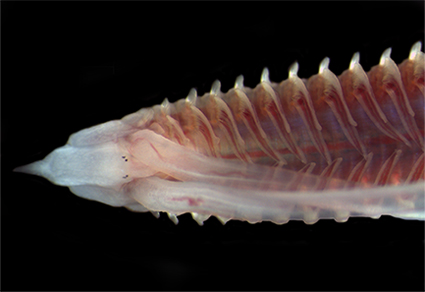
Scolelepis (Scolelepis) squamata (O. F. Müller, 1806) is a marine annelid previously considered cosmopolitan, but now recognized to be restricted to European waters. However, multiple species have recently been removed from synonymy with S. squamata, confirming that this species is not globally widespread. This study incorporated morphological and molecular data to show that Scolelepis (Scolelepis) capensis (McIntosh, 1924) from South Africa should be removed from synonymy with the nominal species. Phylogenetic analyses based on mitochondrial (COI), and nuclear (18S and 28S) markers show that S. capensis and S. squamata sensu stricto fall into separate clades. Scolelepis capensis is morphologically similar to S. squamata and S. agilis from the Atlantic coast of North America, but can be distinguished mainly by the shape and number of hooded hooks in the noto- and neuropodia, and the chaetigers where they first appear. This study contributes to ongoing taxonomic revisions of unresolved and pseudocosmopolitan polychaete species in South Africa, thus increasing our knowledge of local biodiversity. Further studies are necessary to evaluate the taxonomic status of S. capensis throughout southern Africa.
References
- Abe, H. & Sato‐Okoshi, W. (2021) Molecular identification and larval morphology of spionid polychaetes (Annelida, Spionidae) from northeastern Japan. ZooKeys, 1015 (1), 1–86. https://doi.org/10.3897/zookeys.1015.54387
- Alvarez-Aguilar, A., van Rensburg, H. & Simon, C.A. (2022) Impacts of alien polychaete species in marine ecosystems: a systematic review. Journal of the Marine Biological Association of the United Kingdom, 102 (1–2), 3–26. https://doi.org/10.1017/S0025315422000315
- Bally, R. (1983) Intertidal zonation on sandy beaches of the west coast of South Africa. Cahiers de Biologie Marine, 24 (1), 85–103.
- Bally, R. (1987) The ecology of sandy beaches of the Benguela ecosystem. South African Journal of Marine Science, 5 (1), 759–770. https://doi.org/10.2989/025776187784522685
- Bayed, A., Cherkaoui, E. & Glemarec, M. (2006) Population dynamics of Scolelepis squamata (Annelida: Polychaeta) from a Northwest African beach. Cahiers de Biologie Marine, 47 (2), 143–155.
- Bick, A. (2001) The morphology and ecology of Dipolydora armata (Polychaeta, Spionidae) from the western Mediterranean Sea. Acta Zoologica, 82 (3), 177–187. https://doi.org/10.1046/j.1463-6395.2001.00078.x
- Blainville, H. de. (1828) Dictionnaire des Sciences Naturelles, 47, 368–501.
- Blake, J.A., Maciolek, N.J. & Meißner, K. (2020) 7.4.1 Family Spionidae Grube, 1850. In: Purschke, G, Böggemann, M & Westheide, W. (Eds.), Handbook of Zoology, a Natural History of the Phyla of the Animal Kingdom. Annelida: Pleistoannelida, Sedentaria II. De Gruyter, Berlin, pp. 1–103.
- Bonavia, C., Krause, M. & Williams, J. (2025) Morphological and molecular investigation of Scolelepis agilis (Verrill, 1873) (Annelida: Spionidae) from beaches of the Atlantic coast of North America. African Zoology, 60 (1–2), 94–118. https://doi.org/10.1080/15627020.2024.2373809
- Branch, G.M. & Branch, M.L. (2018) Living Shores: Interacting with Southern Africa’s Marine Ecosystems. Penguin Random House South Africa, Cape Town, 336 pp.
- Branch, G.M., Griffiths, C.L., Branch, M.L. & Beckley, L.E. (2022) Two Oceans: A guide to the marine life of southern Africa. Struik Publishers, Cape Town, 464 pp.
- Bursey, M. & Wooldridge, T. (2002) Diversity of benthic macrofauna of the flood-tidal delta of the Nahoon Estuary and adjacent beach, South Africa. African Zoology, 37 (2), 231–246. https://doi.org/10.1080/15627020.2002.11657178
- Claparède, E. (1868) Les annélids chétopodes du Golfe de Naples. Memoires de la Société de physique et d’histoire naturelle de Genève, 19, 313–584.
- Claparède, E. (1869) Les Annélides Chétopodes du Golte de Naples. Seconde Partie. Annélides sédentaires. Memoires de la Société de physique et d’histoire naturelle de Genève, 20, 1–225. https://doi.org/10.5962/bhl.title.2142
- Darling, J.A. & Carlton, J.T. (2018) A framework for understanding marine cosmopolitanism in the anthropocene. Frontiers in Marine Science, 5, 293. https://doi.org/10.3389/fmars.2018.00293
- Day, J.H. (1955) The Polychaeta of South Africa. Part 3. Sedentary species from cape shores and estuaries. Zoological Journal of the Linnean Society, 42, 407–452. https://doi.org/10.1111/j.1096-3642.1955.tb02216.x
- Day, J.H. (1962) Polychaeta from several localities in the western Indian Ocean. Proceedings of the Zoological Society of London, 139 (4), 627–656. https://doi.org/10.1111/j.1469-7998.1962.tb01597.x
- Day, J.H. (1967) A monograph on the Polychaeta of southern Africa. Part 2 British Museum of Natural History Publications, 656, 459–841. https://doi.org/10.5962/bhl.title.8596
- Day, J.H., Field, J.G. & Penrith, M.J. (1970) The benthic fauna and fishes of False Bay, South Africa. Transactions of the Royal Society of South Africa, 39 (1), 1–108. https://doi.org/10.1080/00359197009519103
- Day, J.H. (1974) A guide to marine life on South African shores. 2nd Edition. A.A. Balkema, Cape Town, 300 pp.
- Delgado-Blas, V.H. (2006) Partial revision of Scolelepis (Polychaeta: Spionidae) from the Grand Caribbean Region, with the description of two new species and a key to species recorded in the area. Contributions to Zoology, 75 (1–2), 75–97. https://doi.org/10.1163/18759866-0750102003
- Delle Chiaje, S. (1829 1830 1831) Memorie sulla storia e notomia degli animali senza vertebre del Regno di Napoli. 4 (1–8). Stamperia della Societa’ Tipografica, Napoli, 214 pp.
- De Silva, P.H.D.H. (1961) Contributions to the knowledge of the polychaete fauna of Ceylon. Part 1, Five new species, two new varieties and several new records principally from the southern coast. Spolia Zeylanica National Museums of Ceylon, 29, 164–194.
- Douglass, T.G. & Jones, I. (1991) Parasites of California spionid polychaetes. Bulletin of Marine Science, 48 (2), 308–317.
- Dreyer, H. & Wägele, J.-W. (2001) Parasites of crustaceans (Isopoda: Bopyridae) evolved from fish parasites: molecular and morphological evidence. Zoology, 103, 157–178.
- Ehlers, E. (1897) Polychaeten. Ergebnisse der Hamburger Magalhaensischen Sammelreise, 1892/93, 3, 1–148.
- Eibye-Jacobsen, D. & Soares, A.G. (2000) New records of Scolelepis (Polychaeta: Spionidae) from the sandy beaches of Madagascar, with the description of a new species. Bulletin of Marine Science, 6 (1), 571–586.
- Elgetany, A.H., van Rensburg, H., Hektoen, M., Matthee, C., Budaeva, N., Simon, C.A. & Struck, T.H. (2020) Species delineation in the speciation grey zone - the case of Diopatra (Annelida, Onuphidae). Zoologica Scripta, 49 (4), 516–534. https://doi.org/10.1111/zsc.12421
- Folmer, O., Black, M., Hoeh, W., Lutz, R. & Vrijenhoek, R. (1994) DNA primers for amplification of mitochondrial cytochrome c oxidase subunit I from diverse metazoan invertebrates. Molecular Marine Biology and Biotechnology, 3 (5), 294–299.
- Gallego, R., Heimeier, D., Lavery, S. & Sewell, M.A. (2015) The meroplankton communities from the coastal Ross Sea: a latitudinal study. Hydrobiologia, 761, 195–209. https://doi.org/10.1007/s10750-015-2487-7
- Gravier, C. (1905) Sur les annélides polychètes de la Mer Rouge (Cirratuliens, Spionidiens, Ariciens). Bulletin du Museum national d’histoire naturelle, 11, 42–46.
- Grube, A.E. (1850) Die Familien der Anneliden. Archiv für Naturgeschichte, Berlin, 16 (1), 249–364.
- Hall, T.A. (1999) BioEdit: a user-friendly biological sequence alignment editor and analysis program for Windows 95/98/NT. Nucleic Acids Symposium Series, 41, 95–98.
- Harris, L., Campbell, E.E., Nel, R. & Schoeman, D. (2014) Rich diversity, strong endemism, but poor protection: addressing the neglect of sandy beach ecosystems in coastal conservation planning. Diversity and Distributions, 20, 1120–1135. https://doi.org/10.1111/ddi.12226
- Hodgson, A.N. (1987) Distribution and abundance of the microbenthic fauna of the Kariega Estuary. South African Journal of Zoology, 22 (2), 153–162. https://doi.org/10.1080/02541858.1987.11448037
- Imajima, M. (1992) Spionidae (Annelida, Polychaeta) from Japan. VIII. The genus Scolelepis. Bulletin of the National Science Museum, Tokyo, Series A (Zoology), 18 (1), 1–34.
- International Commission on Zoological Nomenclature (1999) International Code on Zoological Nomenclature. International Trust for Zoological Nomenclature, London, 306 pp.
- Jones, M.L. (1962) On some polychaetous annelids from Jamaica, the West Indies. Bulletin of the American Museum of Natural History, 124, 169–212.
- Kara, J., Macdonald, A.H.H. & Simon, C.A. (2018) Integrative taxonomic methods reveal an incorrect synonymisation of the South African Pseudonereis podocirra (Schmarda) as the widespread Pseudonereis variegata (Grube) from Chile. Invertebrate Systematics, 32, 1282–1297. https://doi.org/10.1071/IS18016
- Krebes, L., Blank, M., Jürss, K., Zettler, M.L. & Bastrop, R. (2010) Glacial-driven vicariance in the amphipod Gammarus duebeni. Molecular Phylogenetics and Evolution, 54, 372–385. https://doi.org/10.1016/j.ympev.2009.07.034
- Kumar, S., Stecher, G. & Tamura, K. (2018) MEGA X: Molecular Evolutionary Genetics Analysis across Computing Platforms. Molecular Biology and Evolution, 35 (6), 1547–1549. https://doi.org/10.1093/molbev/msy096
- Lee, G.H., Lee, H.-E. & Min, G.-S. (2021) DNA barcoding of Scolelepis (Parascolelepis) papillosa (Annelida, Spionidae) in Korea, with additional taxonomic notes. Animal Systematics, Evolution and Diversity, 37 (4), 349–353.
- Lee, G.H. & Min, G.-S. (2022) A new Polychaete, Scolelepis (Parascolelepis) brunnea sp. nov. (Annelida: Spionidae), from Korea. Zoological Science, 39 (5), 500–506. https://doi.org/10.2108/zs220031
- Lobo, J., Teixeira, M.A., Borges, L.M., Ferreira, M.S., Hollatz, C., Gomes, P.A., Sousa, R., Ravara, A., Costa, M.H. & Costa, F.O. (2016) Starting a DNA barcode reference library for shallow water polychaetes from the southern European Atlantic coast. Molecular Ecology Resources, 16, 298–313. https://doi.org/10.1111/1755-0998.12441
- Maciolek, N.J. (1987) New species and records of Scolelepis (Polychaeta: Spionidae) from the east coast of North America, with a review of the subgenera. Bulletin of the Biological Society of Washington, 7, 16–40.
- Mikac, B., Semprucci, F., Guidi, L., Ponti, M., Abbiati, M., Balsamo, M. & Dovgal, I. (2020) Newly discovered associations between peritrich ciliates (Ciliophora: Peritrichia) and scale polychaetes (Annelida: Polynoidae and Sigalionidae) with a review of polychaete–peritrich epibiosis. Zoological Journal of the Linnean Society, 188 (4), 939–953. https://doi.org/10.1093/zoolinnean/zlz111
- McIntosh, W.C. (1924) Notes from the Gatty Marine Laboratory, St. Andrews. Annals and Magazine of Natural History, Series 9, 14 (79), 1–52. https://doi.org/10.1080/00222932408633091
- McIntosh, W.C. (1925) A second contribution to the marine polychaetes of South Africa. Union South African Fisheries Marine Biological Survey, Report, 5 (4), 1–93.
- Mclachlan, A. (1985) The ecology of two sandy beaches near Walvis Bay. Madoqua, 5 (2), 155–163.
- McLachlan, A., Wooldridge, T. & Dye, A.H. (1981) The ecology of sandy beaches in southern Africa. African Zoology, 16 (4), 219–231. https://doi.org/10.1080/02541858.1981.11447760
- Meißner, K. (2005) Revision of the genus Spiophanes (Polychaeta, Spionidae); with new synonymies, new records and descriptions of new species. Zoosystematics and Evolution, 81 (1), 3–65. https://doi.org/10.1002/mmnz.200310001
- Meißner, K. & Götting, M. (2015) Spionidae (Annelida: ‘Polychaeta’: Canalipalpata) from Lizard Island, Great Barrier Reef, Australia: the genera Malacoceros, Scolelepis, Spio, Microspio and Spiophanes. Zootaxa, 4019 (1), 378–413. https://doi.org/10.11646/zootaxa.4019.1.15
- Millard, N.A.H. & Broekhuysen, G.I. (1970) The ecology of South African Estuaries. Part X. St. Lucia: A second report. Zoologica Africana, 5 (2), 277–307. https://doi.org/10.1080/00445096.1970.11447398
- Müller, O.F. (1806) Zoologia Danica seu animalium Daniae et Norvegiae rariorum ac minus notorum descriptiones et historia. Havniae [Copenhague], N. Christensen, 4 (1–5), 1–46.
- Nylander, J.A.A., Wilgenbusch, J.C., Warren, D.L. & Swofford, D.L. (2008) AWTY (are we there yet?): a system for graphical exploration of MCMC convergence in Bayesian phylogenetics. Bioinformatics, 24 (4), 581–583. https://doi.org/10.1093/bioinformatics/btm388
- Pamungkas, J. & Glasby, C.J. (2019) Status of polychaete (Annelida) taxonomy in Indonesia, including a checklist of Indonesian species. Raffles Bulletin of Zoology, 67, 595–639.
- Palanivel, P.S., Veeraiyan, B., Palingam, G. & Perumal, M. (2019) Influence of physico-chemical parameters and pCO2 concentration on mangroves-associated polychaetes at Pichavaram, southeast coast of India. SN Applied Sciences, 1 (12), 1550. https://doi.org/10.1007/s42452-019-1581-2
- Radashevsky, V.I. (2023) Origin of the pointed snout in Scolelepis and the mouth region in spionid polychaetes (Annelida: Spionidae). Zoological Journal of the Linnean Society, 199, 124–139. https://doi.org/10.1093/zoolinnean/zlad024
- Rambaut, A. (2018) FigTree. Version 1.4.4. Institute of Evolutionary Biology, University of Edinburgh, Edinburgh. Available from: http://tree.bio.ed.ac.uk/software/figtree (accessed 9 June 2025)
- Rambaut, A., Suchard, M.A., Xie, D. & Drummond, A.J. (2013) Tracer. Version 1.6. Edinburgh, Scotland: Institute of Evolutionary Biology, University of Edinburgh, Edinburgh. Available from: http://tree.bio.ed.ac.uk/software/tracer/ (accessed 9 June 2025)
- Raupach, M.J., Mayer, C., Malyutina, M. & Wägele, J.-W. (2009) Multiple origins of deep-sea Asellota (Crustacea: Isopoda) from shallow waters revealed by molecular data. Proceedings of the Royal Society B: Biological Sciences, 276 (1658), 799–808. https://doi.org/10.1098/rspb.2008.1063
- Rocha, M.B. & Cesar de Paiva, P. (2012) Scolelepis (Polychaeta: Spionidae) from the Brazilian coast with a diagnosis of the genus. Zoologia, 29 (4), 385–393. https://doi.org/10.1590/S1984-46702012000400011
- Ronquist, F., Teslenko, M., Van Der Mark, P., Ayres, D.L., Darling, A., Höhna, S., Larget, B., Liu, L., Suchard, M.A. & Huelsenbeck, J.P. (2012) MrBayes 3.2: Efficient Bayesian phylogenetic inference and model choice across a large model space. Systematic Biology, 61 (3), 539–542. https://doi.org/10.1093/sysbio/sys029
- Sampieri, B.R., Steiner, T.M., Baroni, P.C., Da Silva, C.F., Teixeira, M.A.L., Vieira, P.E., Costa, F.O. & Amaral, A.C.Z. (2020) How oogenesis analysis combined with DNA barcode can help to elucidate taxonomic ambiguities: a polychaete study-based approach. Biota Neotropica, 20, 3. https://doi.org/10.1590/1676-0611-bn-2020-0959
- Sato-Okoshi, W., Abe, H., Nishitani, G. & Simon, C.A. (2017) And then there was one: Polydora uncinata and Polydora hoplura (Annelida: Spionidae), the problematic polydorid pest species represent a single species. Journal of the Marine Biological Association of the United Kingdom, 97 (8), 1675–1684. https://doi.org/10.1017/S002531541600093X
- Shorthouse, D.P. (2010) SimpleMappr, an online tool to produce publication-quality point maps. Available from: https://www.simplemappr.net (accessed 27 April 2025)
- Simon, C.A., Sato-Okoshi, W. & Abe, H. (2019a) Hidden diversity within the cosmopolitan species Pseudopolydora antennata (Claparède, 1869) (Spionidae: Annelida). Marine Biodiversity, 49, 25–42. https://doi.org/10.1007/s12526-017-0751-y
- Simon, C.A., Williams, L.-G. & Henninger, T. (2019b) A new species of Rhynchospio (Annelida: Spionidae) in South Africa. Marine Biodiversity, 49, 663–672. https://doi.org/10.1007/s12526-017-0842-9
- Simon, C.A., Kara, J., du Toit, A., van Rensburg, H., Naidoo, C. & Matthee, C.A. (2021) Reeling them in: taxonomy of marine annelids used as bait by anglers in the Western Cape Province, South Africa. PeerJ, 9, e11847. https://doi.org/10.7717/peerj.11847
- Simon, C.A., Kara, J., Clarke, D.T. & Sedick, S. (2022) Revisiting ‘A monograph on the Polychaeta of southern Africa’: establishing taxonomic research priorities in southern Africa. African Journal of Marine Science, 44 (1), 83–100. https://doi.org/10.2989/1814232X.2022.2041094
- Sink, K.J., Van der Bank, M.G., Majiedt, P.A., Harris, L.R., Atkinson, L.J., Krikman, S.P. & Karenyi, N. (2018) South African National Biodiversity Assessment 2018 Technical Report. Vol. 4. Marine Realm. South African National Biodiversity Institute, Pretoria. Available from: http://hdl.handle.net/20.500.12143/6372 (accessed 30 September 2025)
- Sonnenberg, R., Nolte, A.W. & Tautz, D. (2007) An evaluation of LSU rDNA D1-D2 sequences for their use in species identification. Frontiers in Zoology, 4, 1–12. https://doi.org/10.1186/1742-9994-4-6
- Souza, J.R. & Borzone, C.A. (2000) Population dynamics and secondary production of Scolelepis squamata (Polychaeta: Spionidae) in an exposed sandy beach of southern Brazil. Bulletin of Marine Science, 67 (1), 221–233.
- Speybroeck, J., Alsteens, L., Vincx, M. & Degraer, S. (2007) Understanding the life of a sandy beach polychaete of functional importance–Scolelepis squamata (Polychaeta: Spionidae) on Belgian sandy beaches (northeastern Atlantic, North Sea). Estuarine, Coastal and Shelf Science, 74 (1–2), 109–118. https://doi.org/10.1016/j.ecss.2007.04.002
- Surugiu, V. (2016) On the taxonomic status of the European Scolelepis (Scolelepis) squamata (Polychaeta: Spionidae), with description of a new species from southern Europe. Zootaxa, 4161 (2), 151–176.
- Surugiu, V. (2023) Redescription of Scolelepis tridentata (Southern, 1914) (Annelida: Spionidae), with description of a new species of Scolelepis from the Black Sea. The European Zoological Journal, 90 (2), 584–603. https://doi.org/10.1080/24750263.2023.2229855
- Surugiu, V., Schwenter, M. & Meißner, K. (2022) Fixing the identity of Scolelepis squamata (Annelida: Spionidae)–neotype designation, redescription and DNA barcode sequences. Systematics and Biodiversity, 20 (1), 1–25. https://doi.org/10.1080/14772000.2021.2003906
- Surugiu, V., Stefan, A. & Popa, O.P. (2020) Morphological and molecular characterization of Scolelepis neglecta (Polychaeta: Spionidae). Vie et Milieu-Life and Environment, 70 (1), 33–45. https://doi.org/10.57890/r7nh4s74
- Treadwell, A.L. (1914) Polychaetous annelids of the Pacific Coast in the collections of the Zoological Museum of the University of California. University of California Publications in Zoology, 13, 175–234.
- Treadwell, A.L. (1939) New polychaetous annelids from New England, Texas and Puerto Rico. American Museum Novitates, 1023, 1–7.
- Verrill, A.E. (1873) Report upon the invertebrate animals of Vineyard Sound and the adjacent waters, with an account of the physical characters of the region. Report on the Condition of the Sea Fisheries of the South Coast of New England, 1, 295–778. https://doi.org/10.5962/bhl.title.57652
- Williams, J.D. & Radashevsky, V.I. (1999) Morphology, ecology, and reproduction of a new Polydora species from the east coast of North America (Polychaeta: Spionidae). Ophelia, 51 (2), 115–127. https://doi.org/10.1080/00785326.1999.10409403
- Zhou, J., Ji, W. & Li, X. (2009) A new species of Scolelepis (Polychaeta: Spionidae) from sandy beaches in China, with a review of Chinese Scolelepis species. Zootaxa, 2236 (1), 37–49. https://doi.org/10.11646/zootaxa.2236.1.3