

Abstract
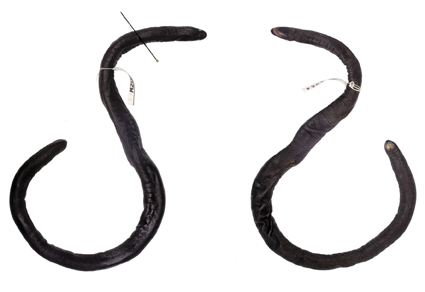
Caecilian amphibians (Gymnophiona) are characterized by their snake-like bodies and secretive habits. Although most of them are predominantly terrestrial and fossorial as adults, the family Typhlonectidae includes species well-adapted to aquatic and semi-aquatic lifestyles. Among typhlonectids, Chthonerpeton is the most speciose genus and occurs mainly along the east coast of South America. Here we describe a new species of Chthonerpeton from Itaboraí, Rio de Janeiro, Brazil. The new taxon is similar to C. perissodus and C. braestrupi but can be readily diagnosed from them and all other congeners by a unique combination of features traditionally used for diagnosing species of the genus (e.g., position of the tentacles, dentition, body shape and proportions, color pattern, number of annuli and vertebrae). We also provide a taxonomic key to the ten currently recognized species of Chthonerpeton and discuss the implications of the newly described species for the systematics of this genus of Neotropical caecilians.
References
- Carmo, L.F., Miguel, I.R., Pinna, P.H., Fernandes, D.S. & Woitovicz-Cardoso, M. (2019) Amphibians of the Parque Nacional da Restinga de Jurubatiba, a sandy coastal environment in southeastern Brazil. Biota Neotropica, 19, e20190727. https://doi.org/10.1590/1676-0611-bn-2019-0727
- Cascon, P. & Lima-Verde, J.S. (1994) Uma nova espécie de Chthonerpeton do nordeste brasileiro (Amphibia, Gymnophiona, Typhlonectidae). Revista Brasileira de Biologia, 54, 549–553.
- Frost, D.R. (2025) Amphibian Species of the World 6.2, an Online Reference. Available from: https://amphibiansoftheworld.amnh.org (accessed 29 October 2025)
- Gonzalez, R.C., Gomes, D.F., Prado, P.C., Quinhones, R. & Salles, R.O.L. (2018) Regurgitating Micrurus corallinus (Serpentes, Elapidae) reveals another record for the rare caecilian Chthonerpeton aff. braestrupi (Gymnophiona, Typhlonectidae). Herpetology Notes, 11, 663–665.
- Gudynas, E. & Williams, J.D. (1986) The southernmost population of a caecilian, Chthonerpeton indistinctum, in Uruguay. Journal of Herpetology, 20, 250–253. https://doi.org/10.2307/1563951
- Gudynas, E., Williams, J.D. & Azpelicueta, M. (1988) Morphology, ecology and biogeography of the South American caecilian Chthonerpeton indistinctum (Amphibia: Gymnophiona: Typhlonectidae). Zoologische Mededelingen, 62, 5–28.
- Kotharambath, R., Wilkinson, M., Oommen, O.V. & Gower, D.J. (2015) A new species of Indian caecilian highlights challenges for species delimitation within Gegeneophis Peters, 1879 (Amphibia: Gymnophiona: Indotyphlidae). Zootaxa, 3948 (1), 60–70. https://doi.org/10.11646/zootaxa.3948.1.4
- Leitão-Martins, L., Mendonça, L.R., De-Oliveira-Nogueira, C.H., Maciel, H.L.R. & Silveira, L.S. (2021) “Lady and the Tramp”: Chthonerpeton aff. braestrupi Taylor, 1968 (Amphibia: Typhlonectidae) as prey of two Erythrolamprus miliaris (Linnaeus, 1758) (Serpentes: Dipsadidae). Herpetology Notes, 14, 945–947.
- Maciel, A.O., de Moraes, B.V., Nascimento, F.A.C., Borges-Nojosa, D.M. & Lima, D.C. (2013) First records of Chthonerpeton arii Cascon and Lima-Verde, 1994 (Amphibia: Gymnophiona: Typhlonectidae) out of the type locality. Check List, 9, 818–819. https://doi.org/10.15560/9.4.818
- Maciel, A.O., Leite, J.M., Leite, R.R., Leite, J.R. & Cascon, P. (2015) A new species of Chthonerpeton Peters 1880 (Amphibia: Gymnophiona: Typhlonectidae) from the state of Piauí, northeastern Brazil. Journal of Herpetology, 49, 308–313. https://doi.org/10.1670/13-067
- Maciel, A.O., Sampaio, M.I., Hoogmoed, M.S. & Schneider, H. (2017) Phylogenetic relationships of the largest lungless tetrapod (Gymnophiona, Atretochoana) and the evolution of lunglessness in caecilians. Zoologica Scripta, 46, 255–263. https://doi.org/10.1111/zsc.12206
- Maciel, A.O., Castro, T.M., Sturaro, M.J., Silva, I.E.C., Ferreira, J.G., Santos, R., Risse-Quaioto, B., Barboza, B.A., Oliveira, J.C.F., Sampaio, I. & Schneider, H. (2019) Phylogenetic systematics of the Neotropical caecilian amphibian Luetkenotyphlus (Gymnophiona: Siphonopidae) including the description of a new species from the vulnerable Brazilian Atlantic Forest. Zoologischer Anzeiger, 281, 76–83. https://doi.org/10.1016/j.jcz.2019.07.001
- Napoli, M.F., Soeiro, M., Trevisan, C.C. & Silva, R.M.L. (2015) New record of Chthonerpeton noctinectes da Silva, Britto-Pereira and Caramaschi, 2003 (Gymnophiona, Typhlonectidae) from the Monte Cristo Island, Todos-os-Santos Bay, Bahia State, northeastern Brazil. Herpetology Notes, 8, 43–45.
- Nussbaum, R.A. (1986) Chthonerpeton onorei, a new caecilian (Amphibia: Gymnophiona: Typhlonectidae) from Ecuador. Revue Suisse de Zoologie, 93, 911–918. https://doi.org/10.5962/bhl.part.79519
- Nussbaum, R.A. & Wilkinson, M. (1987) Two new Chthonerpeton (Amphibia: Gymnophiona: Typhlonectidae) from Brazil. Occasional papers of the Museum of Zoology, University of Michigan, 716, 1–15.
- San Mauro, D., Gower, D.J., Müller, H., Loader, S.P., Zardoya, R., Nussbaum, R.A. & Wilkinson, M. (2014) Life-history evolution and mitogenomic phylogeny of caecilian amphibians. Molecular Phylogenetics and Evolution, 73, 177–189. https://doi.org/10.1016/j.ympev.2014.01.009
- Santos, R.O., Wilkinson, M., Couto Ribeiro, G., Carvalho, A.B. & Zaher, H. (2024) The first fossil record of an aquatic caecilian (Gymnophiona: Typhlonectidae). Zoological Journal of the Linnean Society, 202, 1–23. https://doi.org/10.1093/zoolinnean/zlad188
- Sherlock, M.B., Streicher, J.W., Gower, D.J., Maddock, S.T., Nussbaum, R.A., Oommen, O.V., Silva, A.S., Day, J.J. & Wilkinson, M. (2024) Genomic SNPs resolve the phylogeny of an ancient amphibian island radiation from the Seychelles. Molecular Phylogenetics and Evolution, 108130. https://doi.org/10.1016/j.ympev.2024.108130
- Silva, H.R., Britto-Pereira, M.C. & Caramaschi, U. (2003) A new species of Chthonerpeton (Amphibia: Gymnophiona: Typhlonectidae) from Bahia, Brazil. Zootaxa, 381 (1), 1–11. https://doi.org/10.11646/zootaxa.381.1.1
- Silva, F.F.G., Mott, T., Garey, M.V. & Vitule, J.R.S. (2007) Chthonerpeton viviparum Parker & Wettstein, 1929 (Amphibia, Gymnophiona, Typhlonectinae) in Paraná state, Brazil and the first record of predation of this species by Hoplias malabaricus (Bloch, 1794) (Actinopterygii, Erythrinidae). Pan-American Journal of Aquatic Sciences, 2, 261–262.
- Tanner, K. (1971) Notizen zur Pflege und zum Verhalten einiger Blindwühlen (Amphibia: Gymnophiona). Salamandra, 7, 91–100.
- Taylor, E.H. (1968) The caecilians of the world: A taxonomic review. The University of Kansas Press, Lawrence, Kansas, 848 pp.
- Wilkinson, M. (2012) Caecilians. Current Biology, 22, R668–R669. https://doi.org/10.1016/j.cub.2012.06.019
- Wilkinson, M. (2020) Taxonomic status of the Guyanese endemic caecilian Caecilia pressula Taylor, 1968 (Amphibia: Gymnophiona: Caeciliidae). Herpetological Journal, 30, 227–229. https://doi.org/10.33256/hj30.4.227229
- Wilkinson, M. & Nussbaum, R.A. (1997) Comparative morphology and evolution of the lungless caecilian Atretochoana eiselti (Taylor) (Amphibia: Gymnophiona: Typhlonectidae). Biological Journal of the Linnean Society, 62, 39–109. https://doi.org/10.1111/j.1095-8312.1997.tb01616.x
- Wilkinson, M. & Nussbaum, R.A. (1999) Evolutionary relationships of the lungless caecilian Atretochoana eiselti (Amphibia: Gymnophiona: Typhlonectidae). Zoological Journal of the Linnean Society, 126, 191–123. https://doi.org/10.1111/j.1096-3642.1999.tb00153.x
- Wilkinson, M. & Nussbaum, R.A. (2006) Caecilian phylogeny and classification. In: Exbrayat, J.-M. (Ed.), Reproductive Biology and Phylogeny of Gymnophiona (caecilians). Science Publishers, Inc., Enfield, pp. 39–78.
- Wilkinson, M., San Mauro, D., Sherratt, E. & Gower, D.J. (2011) A nine-family classification of caecilians (Amphibia: Gymnophiona). Zootaxa, 2874 (1), 41–64. https://doi.org/10.11646/zootaxa.2874.1.3