

Abstract
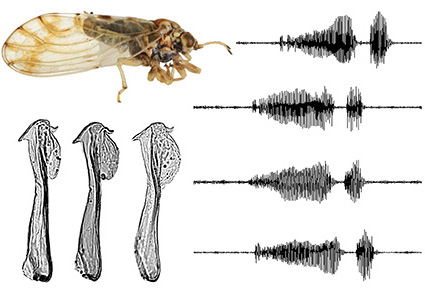
In many insect taxa, comparative analysis of acoustic signals is a useful tool for recognition of biological species. However, in species that do not perceive each other’s signals due to allopatry, different biotopic preferences, or host specializations, signal patterns can be similar. I revealed two pairs of morphologically distinctive Aphalara species producing almost identical vibrational signals. Aphalara avicularis and A. freji were not strictly sympatric, but acoustic interactions between them due to physical contact between their host plants or accidental landing of insects on alien hosts is quite possible. A. borealis and A. maculipennis were strictly sympatric and are certainly able to perceive each other’s signals. Apparently, during the mate search, the studied species, in addition to vibrational communication, use chemical or/and visual cues. Thus, in the taxonomy of psyllids, the acoustic signal pattern is by no means always a reliable species trait. Distinct differences in the genitalia shape certainly indicate that the studied taxa are different species. At the same time, the similarity of signals in such species, even if they are strictly sympatric, cannot be evidence of their taxonomic synonymy.
References
- Avosani, S., Sullivan, T.E., Ciolli, M., Mazzoni, V. & Suckling, D.M. (2020) Can vibrational playbacks disrupt mating or influence other relevant behaviours in Bactericera cockerelli (Triozidae: Hemiptera)? Insects, 11, 299, 1–13. https://doi.org/10.3390/insects11050299
- Burckhardt, D. & Lauterer, P. (1997) Systematics and biology of the Aphalara exilis (Weber & Mohr) species assemblage (Hemiptera: Psyllidae). Entomologica scandinavica, 28 (3), 271–305. https://doi.org/10.1163/187631297X00088
- Burckhardt, D., Ouvrard, D., Queiroz, D. & Percy, D. (2014) Psyllid host-plants (Hemiptera: Psylloidea): resolving a semantic problem. Florida Entomologist, 97 (1), 242–246. https://doi.org/10.1653/024.097.0132
- Claridge, M.F. (1985) Acoustic signals in the Homoptera: behavior, taxonomy and evolution. Annual Review of Entomology, 30, 297–317. https://doi.org/10.1146/annurev.ento.30.1.297
- Čokl, A., Blassioli-Moraes, M.C., Laumann, R.A., Žunič, A. & Borges, M. (2019) Chapter 7. Stinkbugs: multisensory communication with chemical and vibratory signals transmitted through different media. In: Hill, P.S.M., Lakes-Harlan, R., Mazzoni, V., Narins, P.M., Virant-Doberlet, M. & Wessel, A. (Eds.), Biotremology: studying vibrational behavior. Springer, Cham, pp. 91–122. https://doi.org/10.1007/978-3-030-22293-2_7
- Guédot, C., Millar, J.G., Horton, D.R. & Landolt, P.J. (2009) Identification of a sex attractant pheromone for male winterform pear psylla, Cacopsylla pyricola. Journal of Chemical Ecology, 35 (12), 1437–1447. https://doi.org/10.1007/s10886-009-9725-2
- Guédot, C., Horton, D.R. & Landolt, P.J. (2010) Sex attraction in Bactericera cockerelli (Hemiptera: Triozidae). Environmental Entomology, 39 (4), 1302–1308. https://doi.org/10.1603/EN10048
- Liao, Y.-C. & Yang, M.-M. (2015) Acoustic communication of three closely related psyllid species: a case study in clarifying allied species using substrate-borne signals (Hemiptera: Psyllidae: Cacopsylla). Annals of the Entomological Society of America, 108 (5), 902–911. https://doi.org/10.1093/aesa/sav071
- Liao, Y.-C. & Yang, M.-M. (2017) First evidence of vibrational communication in Homotomidae (Psylloidea) and comparison of substrate-borne signals of two allied species of the genus Macrohomotoma Kuwayama. Journal of Insect Behaviour, 30, 567–581. https://doi.org/10.1007/s10905-017-9640-2
- Liu, Z., Xin, Y., Xu, B., Raffa, K.F. & Sun, J. (2017) Sound-triggered production of antiaggregation pheromone limits overcrowding of Dendroctonus valens attacking pine trees. Chemical Senses, 42 (1), 59–67. https://doi.org/10.1093/chemse/bjw102
- Lubanga, U.K., Guédot, C., Percy, D.M. & Steinbauer, M.J. (2014) Semiochemical and vibrational cues and signals mediating mate finding and courtship in Psylloidea (Hemiptera): a synthesis. Insects, 5, 577–595. https://doi.org/10.3390/insects5030577
- Ossiannilsson, F. (1992) The Psylloidea (Homoptera) of Fennoscandia and Denmark. Fauna Entomologica Scandinavica, 26, 1–347. https://doi.org/10.1163/9789004273511
- Percy, D.M., Taylor, G.S. & Kennedy, M. (2006) Psyllid communication: acoustic diversity, mate recognition and phylogenetic signal. Invertebrate Systematics, 20, 431–445. https://doi.org/10.1071/IS05057
- Popov, A.V. (1998) Sibling species of the singing cicadas, Cicadetta prasina (Pall.) and C. pellosoma (Uhler) (Homoptera, Cicadidae). Entomologicheskoe Obozrenie, 77 (2), 315–326. [in Russian with English summary, English translation: Entomological Review, 78 (3), 309–310 (1998)]
- PoWO (2023) Plants of the World Online. Facilitated by the Royal Botanic Gardens, Kew. Published on the Internet. Available from: http://www.plantsoftheworldonline.org/ (accessed 12 November 2023)
- Ragge, D.R. & Reynolds, W.J. (1998) The songs of the grasshoppers and crickets of Western Europe. Harley Books in association with The Natural History Museum, London, 591 pp. https://doi.org/10.1163/9789004632189
- Shestakov, L.S. & Elhashash, A. (2020) The role of acoustic and vibrational signals in host-parasitoid interaction in Tachinidae (Diptera) and stink-bugs (Pentatomidae). Sensornye Sistemy, 24 (1), 14–18. [in Russian with English summary] https://doi.org/10.31857/S0235009220010114
- Sueur, J. & Puissant, S. (2002) Spatial and ecological isolation in cicadas: first data from Tibicina (Hemiptera: Cicadoidea) in France. European Journal of Entomology, 99, 477–484. https://doi.org/10.14411/eje.2002.063
- Stockton, D.G., Pescitelli, L.E., Martini, X. & Stelinski, L.L. (2017) Female mate preference in an invasive phytopathogen vector: how learning may influence mate choice and fecundity in Diaphorina citri. Entomologia Experimentalis et Applicata, 164, 16–26. https://doi.org/10.1111/eea.12590
- Taylor, G.S., Austin, A.D., Jennings, J.T., Purcell, M.F. & Wheeler, G.S. (2010) Casuarinicola, a new genus of jumping plant lice (Hemiptera: Triozidae) from Casuarina (Casuarinaceae). Zootaxa, 2601 (1), 1–27. https://doi.org/10.11646/zootaxa.2601.1.1
- Tishechkin, D.Y. (2006) Vibratory communication in Psylloidea (Homoptera). In: Drosopoulos, S. & Claridge, M.F. (Eds.), Insect sounds and communication: physiology, behavior, ecology and evolution. CRC Press, Taylor and Francis Group, Boca Raton, London and New York, pp. 357–363. https://doi.org/10.1201/9781420039337.ch27
- Tishechkin, D.Y. (2007a) New data on vibratory communication in jumping plant lice of the families Aphalaridae and Triozidae (Homoptera, Psyllinea). Zoologicheskiy Zhurnal, 86 (5), 547–553. [in Russian with English summary, English translation: Entomological Review, 2007, 87 (4), 394–400] https://doi.org/10.1134/S0013873807040021
- Tishechkin, D.Y. (2007b) The possibility to use bioacoustic characters in the taxonomy of the jumping plant lice with an example of the genus Craspedolepta (Homoptera, Psyllinea, Aphalaridae) and description of a new species from Transbaikalia. Zoologicheskiy Zhurnal, 86 (6), 691–700. [in Russian with English summary, English translation: Entomological Review, 2007, 87 (5), 561–570] https://doi.org/10.1134/S0013873807050065
- Tishechkin, D.Yu. (2008) On the similarity of temporal pattern of vibrational calling signals in different species of Fulgoroidea (Homoptera: Auchenorrhyncha). Russian Entomological Journal, 17 (4), 349–357. Available from: https://kmkjournals.com/upload/PDF/REJ/17/ent17_4%20349_357%20(Tishechkin).pdf (accessed 21 March 2023)
- Tishechkin, D.Yu. (2022) Macropsidius bogutensis (Mityaev, 1990) species group (Hemiptera: Auchenorrhyncha: Cicadellidae: Eurymelinae: Macropsini) in Kazakhstan: taxonomy, biology, and evolution. Zootaxa, 5165 (3), 405–414. https://doi.org/10.11646/zootaxa.5165.3.5
- Tishechkin, D.Yu. (2023) An enigma of Handianus Ribaut, 1942 (Hemiptera: Cicadellidae: Deltocephalinae: Athysanini): identical host preferences and male calling signals in two morphologically distinctive sympatric species. Zootaxa, 5239 (4), 585–592. https://doi.org/10.11646/zootaxa.5239.4.9
- Tishechkin, D.Yu. & Bukhvalova, M.A. (2010) Acoustic communication in grasshopper communities (Orthoptera: Acrididae: Gomphocerinae): segregation of acoustic niches. Russian Entomological Journal, 18 (3), 165–188. Available from: https://kmkjournals.com/upload/PDF/REJ/18/ent18_3_165_188_Tishechkin_Bukhvalova.pdf (accessed 21 March 2023)
- Virant-Doberlet, M., King, R.A., Polajnar, J. & Symondson, W.O.C. (2011) Molecular diagnostics reveal spiders that exploit prey vibrational signals used in sexual communication. Molecular Ecology, 20, 2204–2216. https://doi.org/10.1111/j.1365-294X.2011.05038.x
- Virant-Doberlet, M., Kuhelj, A., Polajnar, J. & Šturm, R. (2019) Predator-prey interactions and eavesdropping in vibrational communication networks. Frontiers in Ecology and Evolution, 7, 203. https://doi.org/10.3389/fevo.2019.00203
- Wenninger, E.J. & Hall, D.G. (2007) Daily timing of mating and age at reproductive maturity in Diaphorina citri (Hemiptera: Psyllidae). Florida Entomologist, 90 (4), 715–722. https://doi.org/10.1653/0015-4040(2007)90[715:DTOMAA]2.0.CO;2
- Wenninger, E.J., Stelinski, L.L. & Hall, D.G. (2008) Behavioral evidence for a female-produced sex attractant in Diaphorina citri. Entomologia Experimentalis et Applicata, 128, 450–459. https://doi.org/10.1111/j.1570-7458.2008.00738.x
- Wenninger, E.J., Hall, D.G. & Mankin, R.W. (2009) Vibrational communication between the sexes in Diaphorina citri (Hemiptera: Psyllidae). Annals of the Entomological Society of America, 102 (3), 547–555. https://doi.org/10.1603/008.102.0327