

Abstract
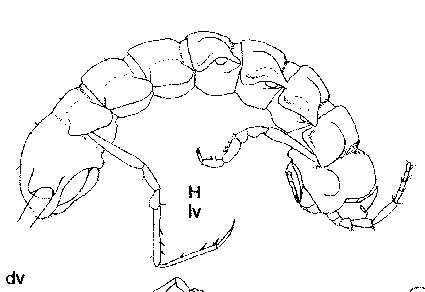
Vemathambema falciclava sp. nov. is described from the mid-bathyal zone of southeastern Australia. It is the first record of the genus outside the Atlantic Ocean. The species differs from its 2 congeners, V. elongata and V. argentinensis, primarily by a strong upward pointing falciform projection on the first antennular article. The various diagnoses presented in the literature of the family and the two known genera Echinothambema Menzies (1956) and Vemathambema Menzies (1962) differ somewhat from those of Menzies (l.c.). A review finds that Menzies’ diagnoses (1962, emended from Menzies, 1956 to cover the new genus Vemathambema) is correct. It is shown further that the uniramous long uropods in the family are bi-articulate with a tiny terminal setiferous article. A key to species in the family is presented.
References
- Malyutina, M.V., Wägele, J.W. & Brenke, N. (2001) New records of little known deep-sea Echinothambematidae (Crustacea: Isopoda: Asellota) with redescription of Vemathambema elongata Menzies, 1962 and description of a new species from the Argentina Basin. Organisms, Diversity & Evolution, Series 1, Electronic Supplement, 6, 1–28. [http:/www.senkenberg.uni-frankfurt.de/odes/01-06.htm] https://doi.org/10.1078/1439-6092-00024
- Menzies, R.J. (1956) New abyssal tropical Atlantic isopods, with observations on their biology. American Museum Novitates, 1798, 9–11. [http://hdl.handle.net/2246/4844]
- Menzies, R.J. (1962) The isopods of abyssal depths in the Atlantic Ocean. Vema Research Series, 1, 79–206. [https://research.nhm.orgpdfs/19789)19789.pdf]
- Mezhov, B.V. (1981) Isopoda. In: Benthos of the submarine Marcus-Necker mountains and adjacent Pacific regions. Trudy Instituta Okeanologi, Akademi Nauk SSR, Moscow, pp. 62–82. [in Russian]
- Wägele, J.-W. (1989) Evolution und phylogentisches System der Isopoda. Stand der Forschung und neue Erkenntnisse. Zoologica, 140, 1–262. https://doi.org/10.16/o3o4(76)90017-6