

Abstract
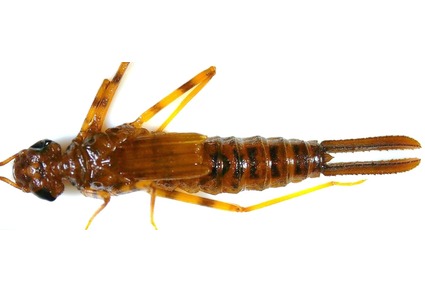
The larva of the Banded Jewel, Africocypha centripunctata (Gambles, 1975) is described from its type locality, the Obudu montane region of Nigeria. Specimens of this Nigerian-Cameroonian highland range-restricted species are compared with specimens of the more widespread Chlorocypha spp. from western Nigeria. The broad and blunt-tipped cerci of A. centripunctata is adjudged to be a reliable larval diagnostic character of the species from Chlorocypha spp., in addition to a greater body size (F-0 ≥ 16 mm). The montane habitat requirements of larvae of A. centripunctata include lotic systems with good riparian cover, coarse particulate organic matter, high dissolved oxygen saturation and low water temperature. Given the conservation importance of this endangered species, knowledge of its larval identity and ecology could aid more-informed conservation interventions. As odonate larval collections are a major part of the results of hydrobiological assessments for conservation decision makers, an in-depth study of their species-level descriptions is recommended in West Africa.
References
- Adedapo, A.M. & Akindele, E.O. (2024) New records of some aquatic insect species in Nigeria: a need to intensify field expeditions in West Africa. Aquatic Insects, 45 (4), 1–16. https://doi.org/10.1080/01650424.2024.2368466
- Adedapo, A.M., Kowobari, E.D., Fagbohun, I.R., Oladeji, T.A., Amoo, T.O. & Akindele, E.O. (2023) Using macroinvertebrate functional traits to reveal ecological conditions of two streams in Southwest Nigeria—a case study. Aquatic Ecology, 57 (2), 281–297. https://doi.org/10.1007/s10452-023-10010-4
- Akindele, E.O., Adedapo, A.M., Adu, S.S. & Ogbogu, S.S. (2021) First report of the larva of a vulnerable damselfly in Nigeria with some ecological notes: a case for umbrella species conservation approach. Tropical Conservation Science, 14, 1–7. https://doi.org/10.1177/19400829211044629
- Akindele, E.O., Adedapo, A.M., Akinpelu, O.T., Fagbohun, I.R., Kowobari, E.D., Oladeji, T.A., Adeniyi, A.V. & Aliu, O.O. (2024) Freshwater macroinvertebrates along the Nigeria-Cameroon border enhance the conservation value of the lower Guinea forest biodiversity hotspot. Journal of Environmental Management, 355, 120532. https://doi.org/10.1016/j.jenvman.2024.120532
- Akindele, E.O., Adedapo, A.M., Fagbohun, I.R., Akinpelu, O.T., Amoo, T.O., Aliu, O.O. & Adeniyi, A.V. (2022) Conservation evaluation of three Nigerian streams in different vegetation zones demonstrates why pristine freshwater ecosystems in the Afrotropics should be protected. Aquatic Conservation: Marine and Freshwater Ecosystems, 32 (1), 1–8. https://doi.org/10.1002/aqc.3778
- Akindele, E.O., Oladeji, T.A., Kowobari, E.D., Adedapo, A.M., Fagbohun, I.R., Akinpelu, O.T. & Oyeku, O.G. (2023) Gold mining impairs the biological water quality of a culturally important river and UNESCO World Heritage Site in Nigeria. Environmental Pollution, 326, 121470. https://doi.org/10.1016/j.envpol.2023.121470
- Akinpelu, O.T., Arimoro, F.O., Ayanwale, A.V., Chukwuemeka, V.I., Adedapo, A.M. & Akindele, E.O. (2025) Comparative investigation provides further insights on how riparian deforestation and different land uses impact the distribution of freshwater macroinvertebrates in Nigerian streams. Ecohydrology & Hydrobiology, 25 (1), 90–105. https://doi.org/10.1016/j.ecohyd.2024.01.006
- BirdLife International (2026) Site factsheet: Obudu Plateau. Available from: https://datazone.birdlife.org/site/factsheet/6734-obudu-plateau (accessed 22 May 2026)
- Cezário, R.R., Pena Firme, P., Pestana, G.C., Vilela, D.S., Juen, L., Cordero-Rivera, A. & Guillermo, R. (2020) Sampling methods for dragonflies and damselflies. In: Santos, J.C. & Fernandes, G.W. (Eds.), Measuring arthropod biodiversity: A handbook of sampling methods. Springer International Publishing, Cham, pp. 223–240. https://doi.org/10.1007/978-3-030-53226-0_9
- Chadd, R. & Extence, C. (2004) The Conservation of Freshwater Macroinvertebrate Populations - A Commununity Based Classification Scheme. Aquatic Conservation: Marine and Freshwater Ecosystems, 14, 597–624. https://doi.org/10.1002/aqc.630
- Clausnitzer, V. & Dijkstra, K.-D.B. (2018) Africocypha centripunctata. The IUCN Red List of Threatened Species 2018. IUCN. https://doi.org/10.2305/IUCN.UK.2018-1.RLTS.T169202A75106103.en
- de Sélys-Longchamps, E. (1853) Synopsis des Caloptérygines. Bruxelles. Bulletin Academie royale Belgique Serie, 20, 1–73.
- de Sélys-Longchamps, E. (1879) Quatriemes Additions au Synopsis des Calopterygines. Bulletin Academie royale Belgique Serie, 47, 349–409.
- De Vries, J.P.R., Buesink, R., van Leeuwen, J., Ekpah, O., Adedapo, A.M., Owolabi, B.A., Erhomosele, E.I., Williams Adu, B., Kehinde Abike, K., Ogbogu, S. & Dijkstra, K.-D.B. (2024) Dragonflies and Damselflies in Cross River State, Nigeria (Odonata). IDF-Report, International Dragonfly Fund, 184, 52 pp.
- Dijkstra, K.-D.B. (2003) Problems in Chlorocypha classification: four cases from West Africa and a discussion of the taxonomic pitfalls (Odonata: Chlorocyphidae). International Journal of Odonatology, 6 (2), 109–126. https://doi.org/10.1080/13887890.2003.9748383
- Dijkstra, K.-D.B. (2013) Three new genera of damselflies (Odonata: Chlorocyphidae, Platycnemididae). International Journal of Odonatology, 16 (3), 269–274. https://doi.org/10.1080/13887890.2013.832606
- Dijkstra, K.-D.B., Monaghan, M.T. & Pauls, S.U. (2014) Freshwater biodiversity and aquatic insect diversification. Annual Review of Entomology, 59 (1), 143–163. https://doi.org/10.1146/annurev-ento-011613-161958
- Dijkstra, K.-D.B., Mézière, N. & Kipping, J. (2015) Sixty new dragonfly and damselfly species from Africa (Odonata). Odonatologica, 44, 447–678.
- Dijkstra, K.-D.B. (Ed.) (2016) African Dragonflies and Damselflies Online (Version 1 July 2016). Available from: https://web.archive.org/web/20230322194453/http://addo.adu.org.za (accessed 27 March 2026)
- Ebong, E.D., Abong, A.A., Ulem, E.B. & Ebong, L.A. (2021) Geoelectrical resistivity and geological characterization of hydrostructures for groundwater resource appraisal in the Obudu Plateau, Southeastern Nigeria. Natural Resources Research, 30, 2103–2117. https://doi.org/10.1007/s11053-021-09818-4
- Edegbene, A.O., Arimoro, F.O., Odoh, O. & Ogidiaka, E. (2015) Effect of anthropogenicity on the composition and diversity of aquatic insects of a municipal river in North Central Nigeria. Biosciences Research in Today’s World, 1 (1), 55–66.
- Edia, O.E., Castella, E., Konan, M.K., Gattolliat, J.L. & Ouattara, A. (2016) Diversity, distribution and habitat requirements of aquatic insect communities in tropical mountain streams (South-eastern Guinea, West Africa). Annales de Limnologie-International Journal of Limnology, 52, 285–300. https://doi.org/10.1051/limn/2016016
- Ekpah, O. & Suhling, F. (2025) Occurrence and distribution of Odonata (Insect: dragonflies and damselflies) in Nigeria. International Journal of Odonatology, 28, 146–158. https://doi.org/10.48156/1388.2025.1917346
- Ekpah, O., Kemabonta, K.A., Ogbogu, S.S. & Fomekong-Lontchi, J. (2020) Records of lost and associated species of Odonata in Cross River National Park, Nigeria. Odonatologica, 49 (3–4), 245–258. https://doi.org/10.60024/zenodo.4268549
- Fraser, F.C. (1928) Odonata of the African continent. Transactions of the Entomological Society of London, 1928, 123–138. https://doi.org/10.1111/j.1365-2311.1928.tb01196.x
- Fraser, F.C. (1947) The Odonata of the Ivory Coast based on the mission of Dr. R. Paulin and P. Lepesmee. Transactions Royal Entomological Society London, 98, 19–39.
- Fraser, F.C. (1949) A revision of the Chlorocyphidae with notes on the differentiation of the Selysian species rubida, glauca, cyanifrons and curta. Bulletin de l’Institut royal des Sciences naturelles de Belgique, 25, 1–50.
- Gambles, R.M. (1975) A new species of Chlorocypha Fraser, 1928 (Odonata: Chlorocyphidae) from Nigeria, and some new or little-known Nigerian subspecies of forms better known from the Cameroons. Entomologists Monthly Magazine, 110, 105–121.
- Galic, N., Forbes, V., Grimm, V., Schmolke, A., Vaugeois, M. & Brain, R. (2024) Ecological risk assessment when species-specific data are scarce: how trait-based approaches and modeling can help. BioScience, 74 (10), 701–709. https://doi.org/10.1093/biosci/biae086
- Giugliano, L., Hardersen, S. & Santini, G. (2012) Odonata communities in retrodunal ponds: a comparison of sampling methods. International Journal of Odonatology, 15 (1), 13–23. https://doi.org/10.1080/13887890.2012.660403
- Karani, A., Kairu, A., Githaiga, M., Gichira, A. & Thuita, S. (2026) Description of the final instar larvae of the threatened Kenya Jewel Platycypha amboniensis Martin 1915 (Odonata: Chlorocyphidae) from Mount Kenya. Agrion, 30 (1), 19–24.
- Karsch, F. (1893) Die Insecten der Berglandschaft Adeli im Hinterlande von Togo (Westafrika) nach dem von den Herren Hauptmann Eugen Kling imd Dr. Richard Büttner, gesammelten Materiale bearbeitet von Dr. F. Karsch, mit einem Vorworte von Dr. Richard Büttner. I Abtheilung Apterygola, Odonata, Orthoptera saltatoria. Lepidoptera. Rhopalocera. Berliner Entomologische Zeitschrift, 38, 17–48. https://doi.org/10.5962/bhl.title.8524
- Karsch, F. (1899) Odonaten von Johann-Alrecht-Höhe (Nord- Kamerun), gesammelt von Herrn Leopold Conradt. Entomologische Nachrichten, 25, 161–176.
- Kehinde, T.O. (2017) Conserving Insect Diversity in the Tropics: Challenges and Prospects. Nigerian Journal of Entomology, 33, 0331–0094. https://doi.org/10.36108/NJE/7102/33(0120)
- Kowobari, E.D., Oladeji, T.A., Adedapo, A.M., Fagbohun, I.R., Opanike, O.O. & Akindele, E.O. (2024) Heavy metal bioaccumulation in the macroinvertebrate functional feeding guilds of an impaired stream in Southwest Nigeria. Chemistry and Ecology, 40 (3), 241–253. https://doi.org/10.1080/02757540.2024.2305702
- Longfield, C. (1959) The Odonata of N. Angola. Part II. Publicacoes culturais Companhia Diamantes Angola, 45, 13–42.
- Martin, R. (1915) Insectes Pseudoneuroptères. II. Odonata. In: Jeanel, R. (Ed.), Voyage de Ch. Allaud et R. Jeannel en Afrique Orientale (1911–1912). Résultats Scientifiques Insectes. A. Schultz, Paris, pp. 19–50.
- Nnoli, H., Kyerematen, R., Adu-Acheampong, S. & Hynes, J. (2019) Change in aquatic insect abundance: Evidence of climate and land-use change within the Pawmpawm River in Southern Ghana. Cogent Environmental Science, 5 (1), 1594511. https://doi.org/10.1080/23311843.2019.1594511
- Orr, A.G.W., Dow, R.A. & Steinhoff, P.O.M. (2024) Descriptions of larvae of four mainly DNA barcode-matched species of chlorocyphids from south-east Asia (Odonata: Chlorocyphidae) with notes on the generic and species level larval identification of Oriental region members of the family. Zootaxa, 5486 (3), 301–337. https://doi.org/10.11646/zootaxa.5486.3.1
- Oruonye, E.D., Ahmed, Y.M. & Ejati, T.H. (2016) Prospect of Tourism Development on the Mambilla Plateau: Lessons from Obudu Mountain Resort, Nigeria. IRA-International Journal of Management and Social Sciences, 5 (1), 87–97. https://doi.org/10.21013/jmss.v5.n1.p10
- Parr, M.J. (1977) A second species of Pentaphlebia Foerster (Zygoptera: Amphipterygidae), from the Nigerian-Cameroun border. Odonatologica, 6 (2), 77–82.
- Pinhey, E. (1959) Notes on African Odonata nymphs. Journal of the Entomological Society of Southern Africa, 22, 469–488.
- Pinhey, E.C.G. (1961) Dragonflies collected on an expedition from Rhodesia to Nigeria in 1958. Part 1. Entomologists Monthly Magazine, 96, 256–271.
- Raebel, E.M., Merckx, T., Riordan, P., Macdonald, D.W. & Thompson, D.J. (2010) The dragonfly delusion: why it is essential to sample exuviae to avoid biased surveys. Journal of Insect Conservation, 14 (5), 523–533. https://doi.org/10.1007/s10841-010-9281-7
- Samways, M.J. & Wilmot, B.C. (2003) Chapter 3 Odonata. In: de Moor, I.J., Day, J.A. & de Moor, F.C. (Eds.), Guides to the Freshwater Invertebrates of Southern Africa, Volume 7: Insecta I Ephemeroptera, Odonata and Plecoptera. Water Research Commission, South Africa, pp. 160–212.
- Simaika, J.P. & Samways, M.J. (2012) Using dragonflies to monitor and prioritize lotic systems: a South African perspective. Organisms Diversity and Evolution, 12 (3), 251–259. https://doi.org/10.1007/s13127-012-0104-4
- Suhling, F., Muller, O. & Martens, A. (2014) The dragonfly larvae of Namibia (Odonata). Libellula supplement, 13, 5–106.
- Uyizeye, E., Clausnitzer, V., Kipping, J., Dijkstra, K.-D.B., Willey, L. & Kaplin, B.A. (2021) Developing an odonate-based index for prioritizing conservation sites and monitoring restoration of freshwater ecosystems in Rwanda. Ecological Indicators, 125, 107586. https://doi.org/10.1016/j.ecolind.2021.107586