

Abstract
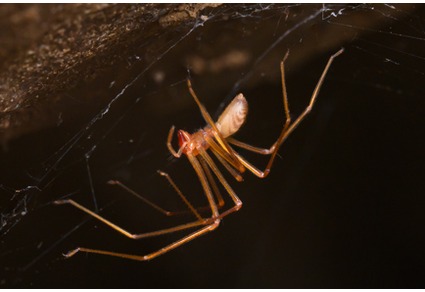
We present a morphological description of a recently discovered species of spider in the family Trogloraptoridae from the Columbia River Gorge in northwestern Oregon. The family was previously monotypic (Trogloraptor marchingtoni) and only known from populations near the southwestern Oregon—northern California border. Trogloraptor tulishpun sp. nov. retains the key family synapomorphy, distinctive subsegmented raptorial tarsi, and an oblique membranous division of the basal segment of the anterior lateral spinnerets. Trogloraptor tulishpun is distinguished from T. marchingtoni by its color pattern, clypeal height, vulvar and palp structure. We have found T. tulishpun in four localities in the Columbia River Gorge, which show little mitochondrial sequence divergence from one another, but are highly genetically distinct from T. marchingtoni. Trogloraptor tulishpun is found in basalt features, including lava tubes and shallow talus caves, and has been observed to eat arachnids and moths, making them top predators in these environments.
References
- Álvarez-Padilla, F. & Hormiga, G. (2007) A Protocol For Digesting Internal Soft Tissues And Mounting Spiders For Scanning Electron Microscopy. Journal of Arachnology, 35, 538–542. https://doi.org/10.1636/Sh06-55.1
- Barrett, R.D.H. & Hebert, P.D.N. (2005) Identifying spiders through DNA barcodes. Canadian Journal of Zoology, 83 (3), 481–491. https://doi.org/10.1139/z05-024
- Benedict, E.M. & Malcolm, D.R. (1973) A new cavernicolous species of Apochthonius (Chelonethida: Chthoniidae) from the western United States with special reference to troglobitic tendencies in the genus. Transactions of the American Microscopical Society, 92 (4), 620–628. https://doi.org/10.2307/3225272
- Caetano, D.S., Labarque, F.S. & Ramírez, M.J. (2023) Evolution and comparative morphology of raptorial feet in spiders. Arthropod Structure & Development, 74, 101257, 1–20. https://doi.org/10.1016/j.asd.2023.101255
- Chousou-Polydouri, N., Carmichael, A., Tamas, S., Saucedo, A., Gillespie, R., Griswold, C. & Wood, H. (2019) Giant Goblins above the waves at the southern end of the world: The biogeography of the spider family Orsolobidae (Araneae, Dysderoidea). Journal of Biogeography, 46, 332–342. https://doi.org/10.1111/jbi.13487
- Folmer, O., Black, M., Hoeh, W., Lutz, R. & Vrijenhoek, R. (1994) DNA primers for amplification of mitochondrial cytochrome c oxidase subunit I from diverse metazoan invertebrates. Molecular Marine Biology and Biotechnology, 3 (5), 294–299.
- Griswold, C.E., Audisio, T. & Ledford, J.M. (2012) An extraordinary new family of spiders from caves in the Pacific Northwest (Araneae, Trogloraptoridae, new family). ZooKeys, 215, 77–102. https://doi.org/10.3897/zookeys.215.3547
- Hamilton, H., Smyth, R.L., Young, B.E., Howard, T.G., Tracey, C., Breyer, S., Cameron, D.R., Chazal, A., Conley, A.K., Frye, C., & Schloss, C. (2022) Increasing Taxonomic Diversity and Spatial Resolution Clarifies Opportunities for Protecting US Imperiled Species. Ecological Applications, 32 (3), e2534, 1–19. https://doi.org/10.1002/eap.2534
- Hedin, M., Ramírez, M.J. & Monjaraz-Ruedas, R. (2025) Phylogenomics of North American cybaeid spiders (Araneae, Cybaeidae), including the description of new taxa from the Klamath Mountains Geomorphic Province. ZooKeys, 1226, 47–75. https://doi.org/10.3897/zookeys.1226.140204
- Kulkarni, S., Wood, H., Lloyd, M. & Hormiga, G. (2020) Spider‐specific probe set for ultraconserved elements offers new perspectives on the evolutionary history of spiders (Arachnida, Araneae). Molecular Ecology Resources, 20 (1), 185–203. https://doi.org/10.1111/1755-0998.13099
- Kulkarni, S., Wood, H.M. & Hormiga, G. (2023) Advances in the reconstruction of the spider tree of life: A roadmap for spider systematics and comparative studies. Cladistics, 39 (6), 479–532. https://doi.org/10.1111/cla.12557
- Katoh, K., Rozewicki, J. & Yamada, K.D. (2019) MAFFT online service: multiple sequence alignment, interactive sequence choice and visualization. Briefings in Bioinformatics, 20, 1160–1166. https://doi.org/10.1093/bib/bbx108
- Kumar, S., Stecher, G., Suleski, M., Sanderford, M., Sharma, S. & Tamura, K. (2024) MEGA12: Molecular Evolutionary Genetics Analysis Version 12 for adaptive and green computing. Molecular Biology and Evolution, 41, 1–9. https://doi.org/10.1093/molbev/msae263
- Mammola, S., Cardoso, P., Culver, D.C., Deharveng, L., Ferreira, R.L., Fišer, C., Galassi, D.M.P., Griebler, C., Halse, S., Humphreys, W.F., Isaia, M., Malard, F., Martinez, A., Moldovan, O.T., Niemiller, M.L., Pavlek, M., Reboleira, A.S.P.S., Souza-Silva, M., Teeling, E.C., Wynne, J.J. & Zagmajster, M. (2019) Scientists’ warning on the conservation of subterranean ecosystems. BioScience, 69 (8), 641–650. https://doi.org/10.1093/biosci/biz064
- Michalik, P., Kallal, R., Dederichs, T.M., Labarque, F.M., Hormiga, G., Giribet, G. & Ramírez, M.J. (2019) Phylogenomics and genital morphology of cave raptor spiders (Araneae, Trogloraptoridae) reveal an independent origin of a flow‐through female genital system. Journal of Zoological Systematics & Evolutionary Research, 57 (4), 737–747. https://doi.org/10.1111/jzs.12315
- Michalik, P., Smith, H.M., Milledge, G. & Harms, D. (2024) Another ghost of Gondwana—Progradungula barringtonensis Michalik & Smith, sp. nov., a new species of the relict spider genus Progradungula (Araneae: Gradungulidae) from a temperate rainforest in eastern Australia. Austral Entomology, 63 (1), 72–81. https://doi.org/10.1111/aen.12675
- Miller, M.A., Pfeiffer, W. & Schwartz, T. (2010) Creating the CIPRES Science Gateway for inference of large phylogenetic trees. In: Proceedings of the Gateway Computing Environments Workshop (GCE). IEEE, New Orleans, Louisiana, pp. 1–8. https://doi.org/10.1109/GCE.2010.5676129
- Myers, N., Mittermeier, R.A., Mittermeier, C.G., da Fonseca, G.A.B. & Kent, J. (2000) Biodiversity hotspots for conservation priorities. Nature, 403, 853–858. https://doi.org/10.1038/35002501
- Ramírez, M.J., Magalhaes, I.L.F., Derkarabetian, S., Ledford, J., Griswold, C.E., Wood, H.M. & Hedin, M. (2021) Sequence capture phylogenomics of true spiders reveals convergent evolution of respiratory systems. Systematic Biology, 70 (1), 14–20. https://doi.org/10.1093/sysbio/syaa043
- Wheeler, W.C., Coddington, J.A., Crowley, L.M., Dimitrov, D., Goloboff, P.A., Griswold, C.E., Hormiga, G., Prendini, L., Ramírez, M.J., Sierwald, P., Almeida-Silva, L., Alvarez-Padilla, F., Arnedo, M.A., Benavides Silva, L.R., Benjamin, S.P., Bond, J.E., Grismado, C.J., Hasan, E., Hedin, M., Izquierdo, M.A., Labarque, F.M., Ledford, J., Lopardo, L., Maddison, W.P., Miller, J.A., Piacentini, L.N., Platnick, N.I., Polotow, D., Silva-Dávila, D., Scharff, N., Szűts, T., Ubick, D., Vink, C.J., Wood, H.M. & Zhang, J. (2017) The spider tree of life: phylogeny of Araneae based on target‐gene analyses from an extensive taxon sampling. Cladistics, 33 (6), 574–616. https://doi.org/10.1111/cla.12182
- Native Land Digital (2025) Our home on native land. Native-Land.ca. Available from: https://native-land.ca/maps/constellation (accessed 13 December 2025) https://doi.org/10.3998/mpub.12734862.cmp.bv73c374h