

Abstract
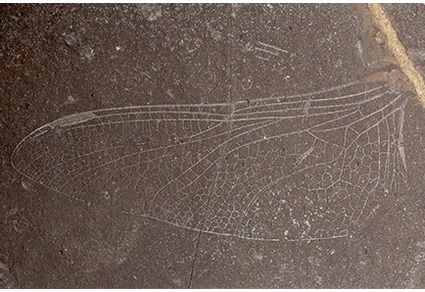
A new hemeroscopid species, Hemeroscopus jinjuensis Wei, Nam & Liu sp. nov., is described from the Lower Cretaceous Jinju Formation in the Jinju area of Gyeongsangnam Province, Republic of Korea based on the venational characteristics. The vannal region of wing is key for the taxonomy of Hemeroscopidae Pritykina, 1977, and compared to Prohemeroscopidae Bechly et al., 2002 the morphological variation of vannal region in Hemeroscopidae is outlined as follows: the anal loop enlarges and the MP–CuAa area expands, whereas the region between the basal and distal portions of CuAa, as well as the area between the anal loop and the anal triangle, becomes progressively reduced.
References
- Bechly, G. (1996) Morphologische untersuchungen am flügelgeäder der rezenten libellen und deren stammgruppenvertreter (Insecta: Odonatoptera), unter besonderer berücksichtigung der phylogenetischen systematik und des grundplanes der Odonata. Petalura, S2, 1–402.
- Bechly, G., Nel, A., Martinez-Delclos, X. & Fleck, G. (1998) Four new dragonflies from the Upper Jurassic of Germany and the Lower Cretaceous of Mongolia (Anisoptera: Hemeroscopidae, Sonidae, and Proterogomphidae fam. nov.). Odonatologica, 27 (2), 149–187.
- Bechly, G. & Ueda, K. (2002) The first fossil record and first new world record for the dragonfly clade Chlorogomphida (Insecta: Odonata: Anisoptera: Araripechlorogomphidae n. fam.) from the Crato Limestone (Lower Cretaceous, Brazil). Stuttgarter Beiträge zur Naturkunde, Series B, 328, 1–11.
- Fabricius, J.C. (1793) Entomologia systematica emendata et aucta, secundum classes, ordines, genera, species, adjectis synonymis, locis, observationibus, descriptionibus. Vol. 2. C.G. Proft, Hafniae [Copenhagen], 519 pp. https://doi.org/10.5962/bhl.title.125869
- Fang, R., Liu, P.H. & Zheng, D.R. (2025) Abrohemeroscopus yuanjiawaensis sp. nov. (Odonata: Anisoptera: Hemeroscopidae) from the late Jehol Biota of western Liaoning, northeastern China and its biogeographical implications. Historical Biology, 38 (2), 377–381. https://doi.org/10.1080/08912963.2025.2467979
- Nam, K.S. & Kim, J.H. (2016) Reconstruction and paleoecological implications of dragonfly Hemeroscopus baissicus Pritykina, 1977 (Hemeroscopidae) from the Lower Cretaceous Jinju formation in the Jinju area, Korea. Journal of the Geological Society of Korea, 52 (2), 105–112. https://doi.org/10.14770/jgsk.2016.52.2.105
- Nel, A., Martínez-Delclòs, X., Paicheler, J.C. & Henrotay, M. (1993) Les 1397967985Anisozygoptera1397969521 fossiles. Phylogénie et classification (Odonata). Martinia, Numéro Hors Série, 3, 1–311.
- Pritykina, L.N. (1977) New dragonflies from Lower Cretaceous deposits of Transbaikalia and Mongolia. Sovmestnaâ Sovetsko−Mongol1397969521skaâ Paleontologičeskaâ Ekspeditciâ, Trudy, 4, 81–96.
- Qi, P.L., Liu, P.H., Xiao, C.T. & Zheng, D.R. (2024) A new hemeroscopid dragonfly (Odonata, Anisoptera) from the Lower Cretaceous of the Jiuquan Basin, northwestern China. Zootaxa, 5432 (4), 567–572. https://doi.org/10.11646/zootaxa.5432.4.6
- Ren, D., Liu, J.Y. & Cheng, X.D. (2003) New hemeroscopid dragonfly from the Lower Cretaceous of Northeast China (Odonata: Hemeroscopidae). Acta Entomologica Sinica, 46, 622–628.
- Ren, D., Lu, L., Guo, Z. & Ji, S. (1995) Faunae and stratigraphy of the Jurassic– Cretaceous in Beijing and adjacent areas. Seismic Publishing House, Beijing, 222 pp. [in Chinese with English summary]
- Riek, E.F. (1976) A new collection of insects from the Upper Triassic of South Africa. Annals of the Natal Museum, 22, 791–820.
- Riek, E.F. & Kukalová-Peck, J. (1984) A new interpretation of dragonfly wing venation based upon Early Carboniferous fossils from Argentina (Insecta: Odonatoidea) and basic characters1397969521 states in pterygote wings. Canadian Journal of Zoology, 62, 1150–1166. https://doi.org/10.1139/z84-166
- Selys-Longchamps, E. de (1854) Monographie des Calopterygines. Mémoires de la Société royale des Sciences de Liège, 9, i–xi + 1–291. https://doi.org/10.5962/bhl.title.60461
- Ueda, K., Kim, T.W. & Aoki, T. (2005) A new record of Early Cretaceous fossil dragonfly from Korea. Bulletin Kitakyushu Museum of Natural History and Human History Series, A, 145–152.
- Vrsanský, P. (2008) New blattarians and a review of dictyopteran assemblages from the Lower Cretaceous of Mongolia. Acta Palaeontologica Polonica, 53 (1), 129–136. https://doi.org/10.4202/app.2008.0109
- Zheng, D.R., Zhang, H.C., Zhang, Q., Li, S., Wang, H., Fang, Y., Liu, Q., Edmund, A.J., Yan, E. & Wang, B. (2015) Discovery of an Early Cretaceous dragonfly Hemeroscopus baissicus Pritykina, 1977 (Hemeroscopidae) in Jiuquan, Northwest China, and its stratigraphic implications. Cretaceous Research, 52, 316–322. https://doi.org/10.1016/j.cretres.2014.02.020