

Abstract
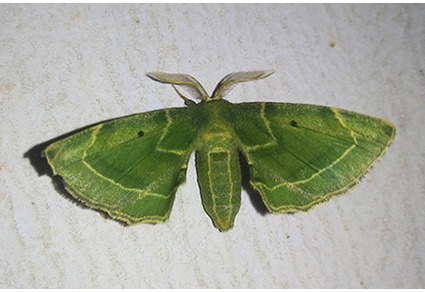
Phiditiidae is a small family of Bombycoidea, with 25 species and five genera. The monophyly of the genera has not been tested, and the family lacks a systematic review. Thus, the first step towards a stable classification system within Phiditiidae is to identify and define the type species of each genus. Here we illustrate and redescribe Rolepa delineata Walker, 1855 the type species of Rolepa Walker, 1855, and describe a new species for the genus. Rolepa delineata has the general characteristics of Phiditiidae: antenna with a midventral row of teeth; origin of M2, closer to M3 than to M1; and the totally or partially rolling of the wings when at rest. The two species share a similar wing pattern, but differ in forewing shape: elongated in R. delineata and triangular in R. variabilis sp. nov. Furthermore, in R. delineata, the costal margin of the forewing and the inner margin of the hindwing are greyish. Additionally, R. variabilis exhibits phenotypic plasticity, including green and brown phenotypes. In the male genitalia, three characteristics easily separate R. variabilis from R. delineata: 1) in dorsal view, costa of the valvae with a projection of quadrangular appearance in R. variabilis and horn-shaped in R. delineata; 2) the presence of a pair of finger-like socii in R. variabilis, which are absent or barely noticeable in R. delineata and; 3) vesica with smaller spicules in R. variabilis. than in R. delineata. We present a discussion about the morphological characters of Rolepa and their relevance to future studies of the systematics of Phiditiidae.
References
- CCDB (2013) The Canadian Centre for DNA Barcoding (CCDB). Available from: https://ccdb.ca/ (accessed 17 February 2025)
- Cramer, P. (1775) De uitlandsche Kapellen voorkomende in de drie waereld-deelen asia, africa en america, by een verzameld en beschreeven door den Heer Pieter Cramer/Papillons exotiques des trois parties du monde. L1397969521asie, l1397969521afrique et l1397969521amérique. rassemblés en décrits par Mr Pierre Cramer. Vol. 1. S. J. Baalde, Amsteldam [Amsterdam] & Barthelemy Wild, Utrecht, XXX + 151 pp., XCVI pls. https://doi.org/10.5962/bhl.title.43777
- Dognin, P. (1914) Hétérocères nouveaux de L1397969521Amerique du Sud. Fascicule VIII. Imprimerie Oberthür, Rennes, 101 pp.
- Hamilton, C.A., St Laurent, R.A., Dexter, K., Kitching, I.J., Breinholt, J.W., Zwick, A., Timmermans, M.J.T.N., Barber, J.R. & Kawahara, A.Y. (2019) Phylogenomics resolves major relationships and reveals significant diversification rate shifts in the evolution of silk moths and relatives. BMC Evolutionary Biology, 19, 182. https://doi.org/10.1186/s12862-019-1505-1
- Hebert, P.D.N., Cywinska, A., Ball, S.L. & deWaard, J.R. (2003) Biological identifications through DNA barcodes. Proceedings of the Royal Society of London, Series B: Biological Sciences, 270, 313–321. https://doi.org/10.1098/rspb.2002.2218
- Herbin, D. (2021) The Phiditiidae in French Guiana (Lepidoptera Bombycoidea). Antenor, 8 (1), 46–64
- Herbin, D. (2022) Supplement to the Phiditiidae in French Guiana (Lepidoptera Bombycoidea). Antenor, 9 (3), 101–104.
- Herrich-Schäffer, G.A.W. (1856) Systematische Bearbeitung der Schmetterlinge von Europa. Band 6. G.J. Manz, Regensburg, iv + 178 + 72 + 48 pp.
- Jones, E.D. & Moore, F. (1882) Metamorphoses of Lepidoptera from San Paulo, Brazil, in the free public museum, Liverpool, with nomenclature and descriptions of new forms. Proceedings of the Literary and Philosophical Society of Liverpool, 36, 327–377.
- Katoh, K. & Standley, D.M. (2013) MAFFT Multiple Sequence Alignment Software Version 7: Improvements in Performance and Usability. Molecular Biology and Evolution, 30 (4), 772–780. https://doi.org/10.1093/molbev/mst010
- Kitching, I.J., Rougerie, R., Zwick, A., Hamilton, C.A., St Laurent, R.A., Naumann, S., Mejia, L.B. & Kawahara, A.Y. (2018) A global checklist of the Bombycoidea (Insecta: Lepidoptera). Biodiversity Data Journal, 6, e22236. https://doi.org/10.3897/BDJ.6.e22236
- Kristensen, N.P. (2003) Skeleton and muscles: adults. In: Kristensen, N.P. (Ed.), Handbook of zoology. Volume IV Arthropoda: Insecta. Lepidoptera, Moths and Butterflies. Vol. 2. Morphology, Physiology, and Development. de Gruyter, New York, New York, pp. 39–131. https://doi.org/10.1515/9783110893724.39
- Minet, J. (1994) The Bombycoidea: phylogeny and higher classification (Lepidoptera: Glossata). Insect Systematics & Evolution, 25, 63–88. https://doi.org/10.1163/187631294X00045
- Ratnasingham, S. & Hebert, P.D. (2007) BOLD: The Barcode of Life Data System (http://www.barcodinglife.org). Molecular Ecology Notes, 7 (3), 355–364. https://doi.org/10.1111/j.1471-8286.2007.01678.x
- Schaus, W. (1920) New species of Lepidoptera in the United States National Museum. Proceedings of the United States National Museum, 57 (2307), 107–152. https://doi.org/10.5479/si.00963801.2307.107
- Schaus, W. (1927) Family: Lymantriidae. In: Seitz, A. (Ed.), Die amerikanischen Spinner und Schwärmer. Die Groß Schmetterlinge der Erde. Verlag des Seitzschen Werkes, Stuttgart, pp. 535–564.
- Snodgrass, R.E. (1935) Principles of insect morphology. McGraw Hill Book Company, Inc., New York and London, 667 pp.
- Tamura, K. & Nei, M. (1993) Estimation of the number of nucleotide substitutions in the control region of mitochondrial DNA in humans and chimpanzees. Molecular Biology and Evolution, 10 (3), 512–526. https://doi.org/10.1093/oxfordjournals.molbev.a040023
- Tamura, K., Stecher, G. & Kumar, S. (2021) MEGA11: Molecular Evolutionary Genetics Analysis Version 11. Molecular Biology and Evolution, 38 (7), 3022–3027. https://doi.org/10.1093/molbev/msab120
- Walker, F. (1855) List of the specimens of Lepidopterous insects in the collection of the british Museum. Trustees of the british Museum, Londres, 1090 pp.
- Walker, F. (1862) Characters of undescribed Lepidoptera in the Collection of W.W. Saunders, Esq. Transactions of the Entomological Society of London, 1 (3), 70–128. https://doi.org/10.1111/j.1365-2311.1862.tb00593.x
- Zwick, A., Regier, J.C., Mitter, C. & Cummings, M.P. (2011) Increased gene sampling yields robust support for higher-level clades within Bombycoidea (Lepidoptera). Systematic Entomology, 36 (1), 31–43. https://doi.org/10.1111/j.1365-3113.2010.00543.x