

Abstract
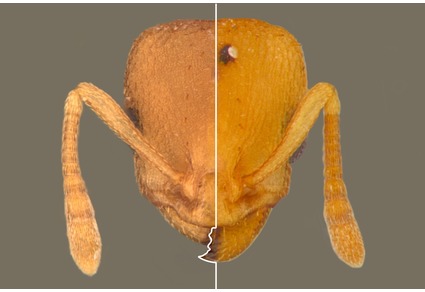
The ant genus Nesomyrmex Wheeler, 1910, is a species-rich lineage with a broad tropical and subtropical distribution; however, several of its Neotropical species remain poorly understood. Nesomyrmex clavipilis Wheeler, 1910, was described from a single gyne collected in Grenada and has not been recorded again, leading to speculation about its possible local extinction. Recent fieldwork has resulted in the collection of new material of N. clavipilis. This included gynes and workers from multiple localities, allowing for the first reliable association of castes. Based on this material, we redescribe the gyne, representing the rediscovery of N. clavipilis 116 years after its original description, and provide the first description of the worker caste, accompanied by high-resolution images. We document intraspecific morphological variation, refine diagnostic characters, and present new data on the geographic distribution and natural history of the species. We also describe a previously unnamed sculptural feature, herein termed the rosette fovea, documented by scanning electron microscopy. New records extend the known distribution of the species to Brazil, Colombia, French Guiana, Paraguay, and Peru, and provide the first natural history data for the species. These findings contribute to a more accurate understanding of species boundaries within Nesomyrmex and highlight the importance of renewed sampling efforts for resolving taxonomic gaps in Neotropical ant faunas.
References
- AntWeb (2026) AntWeb. Version 8.112. California Academy of Sciences, San Francisco, California. Available from: https://www.antweb.org (accessed 13 February 2026)
- Arredondo, B.S. & Guerrero, R.J. (2025) The ant genus Nesomyrmex Wheeler (Formicidae, Myrmicinae) from the threatened Colombian tropical dry forest: three new species, a new synonymy, and new distributional data. ZooKeys, 1232, 131–172. https://doi.org/10.3897/zookeys.1232.141693
- Blaimer, B.B., Ward, P.S., Schultz, T.R., Fisher, B.L. & Brady, S.G. (2018) Paleotropical diversification dominates the evolution of the hyperdiverse ant tribe Crematogastrini (Hymenoptera: Formicidae). Insect Systematics and Diversity, 2 (5), 1–14. https://doi.org/10.1093/isd/ixy013
- Bolton, B. (1994) Identification guide to the ant genera of the world. Harvard University Press, Cambridge, Massachusetts, 222 pp.
- Bolton, B. (1995) A new general catalogue of the ants of the world. Harvard University Press, Cambridge, Massachusetts, 504 pp.
- Bolton, B. (2000) The ant tribe Dacetini. Memoirs of the American Entomological Institute, 65, 1–1028.
- Bolton, B. (2003) Synopsis and classification of Formicidae. Memoirs of the American Entomological Society, 71, 1–370.
- Bolton, B. (2026) An online catalog of the ants of the world. Available from: https://antcat.org (accessed 20 January 2026)
- Boudinot, B.E. (2015) Contributions to the knowledge of Formicidae (Hymenoptera, Aculeata): a new diagnosis of the family, the first global male-based key to subfamilies, and a treatment of early branching lineages. European Journal of Taxonomy, 120, 1–62. https://doi.org/10.5852/ejt.2015.120
- Brandão, C.R.F. (1991) Adendos ao catálogo abreviado das formigas da região Neotropical (Hymenoptera: Formicidae). Revista Brasileira de Entomologia, 35, 319–412.
- Brown, W.L. (1973) A comparison of the Hylean and Congo-West African rain forest ant faunas. In: Meggers, B.J., Ayensu, E.S. & Duckworth, W.D. (Eds.), Tropical forest ecosystems in Africa and South America: a comparative review. Smithsonian Institution Press, Washington, D.C., pp. 161–185.
- De Andrade, M.L., Baroni Urbani, C., Brandão, C.R. & Wagensberg, J. (1999) Two new species of Leptothorax 1396984945Nesomyrmex1396986481 fossils in Dominican amber (Hymenoptera: Formicidae). Beiträge zur Entomologie, 49, 133–140. https://doi.org/10.21248/contrib.entomol.49.1.133-140
- Delsinne, T., Serna, F.J., Leponce, M. & Boudinot, B.E. (2019) Glosario de morfología. In: Fernández, F., Guerrero, R.J. & Delsinne, T. (Eds.), Hormigas de Colombia. Universidad Nacional de Colombia, Bogotá, pp. 387–457.
- Diniz, J.L.M. (1975) Leptothorax (Nesomyrmex) mirassolis, nova espécie de formiga da região norte-ocidental do estado de São Paulo, Brasil (Hymenoptera, Formicidae). Revista Brasileira de Entomologia, 19, 79–83.
- Emery, C. (1896) Studi sulle formiche della fauna neotropica. XVII–XXV. Bullettino della Società Entomologica Italiana, 28, 33–107.
- Emery, C. (1915) Formiche raccolte nell1397969521Eritrea dal Prof. F. Silvestri. Bollettino del Laboratorio di Zoologia Generale e Agraria della Reale Scuola Superiore d1397969521Agricoltura, Portici, 10, 3–26.
- Emery, C. (1924) Hymenoptera. Fam. Formicidae. Subfam. Myrmicinae. [concl.]. Genera Insectorum, 174C, 207–397.
- Evenhuis, N.L. (2026) The insect and spider collections of the world website. Bernice P. Bishop Museum, Honolulu, Hawaii. Available from: http://hbs.bishopmuseum.org/codens/ (accessed 22 January 2026)
- Forel, A. (1917) Cadre synoptique actuel de la faune universelle des fourmis. Bulletin de la Société Vaudoise des Sciences Naturelles, 51, 229–253.
- Harris, R.A. (1979) A glossary of surface sculpturing. Occasional Papers in Entomology, State of California Department of Food and Agriculture, 28, 1–31. https://doi.org/10.5281/zenodo.26215
- Janicki, J., Narula, N., Ziegler, M., Guénard, B. & Economo, E.P. (2016) Visualizing and interacting with large-volume biodiversity data using client-server web-mapping applications: The design and implementation of antmaps.org. Ecological Informatics, 32, 185–193. https://doi.org/10.1016/j.ecoinf.2016.02.006
- Kempf, W.W. (1959) A synopsis of the New World species belonging to the Nesomyrmex-group of the ant genus Leptothorax Mayr (Hymenoptera: Formicidae). Studia Entomologica, 2, 391–432.
- Longino, J.T. (2006) New species and nomenclatural changes for the Costa Rican ant fauna (Hymenoptera: Formicidae). Myrmecological News, 8, 131–143.
- MacGown, J.A., Boudinot, B.E., Deyrup, M. & Sorger, D.M. (2014) A review of the Nearctic Odontomachus (Hymenoptera: Formicidae: Ponerinae) with a treatment of the males. Zootaxa, 3802 (4), 515–552. https://doi.org/10.11646/zootaxa.3802.4.6
- Nascimento, I.C., Delabie, J.H.C. & Lucia, T.M.C.D. (2011) Phenology of mating flight in Ecitoninae (Hymenoptera: Formicidae) in a Brazilian Atlantic Forest location. Annales de La Société Entomologique de France, Nouvelle Série, 47 (1–2), 112–118. https://doi.org/10.1080/00379271.2011.10697702
- Pazmiño-Palomino, A., Troya, A. & Arredondo, B.S. (2025) Nesomyrmex paquisha: a new rough tree ant species from the isolated Cordillera del Cóndor, Ecuador. Journal of Natural History, 59 (17–20), 1181–1208. https://doi.org/10.1080/00222933.2025.2470961
- QGIS (2026) QGIS Geographic Information System. Open Source Geospatial Foundation. Available from: http://qgis.osgeo.org (accessed 10 January 2026)
- Serna, F. & Mackay, W.P. (2010) A descriptive morphology of the ant genus Procryptocerus (Hymenoptera: Formicidae). Journal of Insect Science, 10, 1–36. https://doi.org/10.1673/031.010.11101
- Smith, M.R. (1943) The first record of Leptothorax, subgenus Goniothorax Emery, in the United States, with the description of a new species. Proceedings of the Entomological Society of Washington, 45, 154–156.
- Smith, M.R. (1950) On the status of Leptothorax Mayr and some of its subgenera. Psyche, Cambridge, 57, 29–30. https://doi.org/10.1155/1950/80458
- Ward, P.S., Brady, S.G., Fisher, B.L. & Schultz, T.R. (2015) The evolution of myrmicine ants: phylogeny and biogeography of a hyperdiverse ant clade (Hymenoptera: Formicidae). Systematic Entomology, 40, 61–81. https://doi.org/10.1111/syen.12090
- Wetterer, J.K., Lubertazzi, D. & Wilson, E.O. (2019) Ants of Grenada (Hymenoptera, Formicidae). Bulletin of the Museum of Comparative Zoology, 162 (5), 309–346. https://doi.org/10.3099/0027-4100-162.5.263
- Wheeler, W.M. (1910) Three new genera of myrmicine ants from tropical America. Bulletin of the American Museum of Natural History, 28, 259–265.