

Abstract
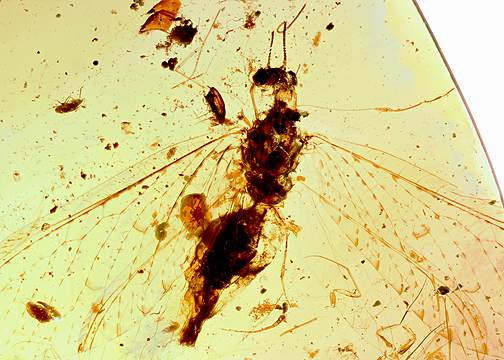
The mid-Cretaceous Kachin amber genus Punctocorydasialis Chen et al., 2026 is remarkable in many aspects. It is distinguished from others in the family by its spotted forewings (as noted by Chen et al., 2026), short hind wings (0.75 of forewing length) with a simple CuP, and the terminal segment of its presumed labial palps bears an additional minute sub-segment. Its mesonotum has an additional subdivision, i.e., a well-separated middle part, previously not recorded in Neuropterida. An area of modified microtrichia which may have a stridulatory function in the anal space of the forewing found in this species is previously unknown in fossil Neuropterida.
References
- Archibald, S.B. & Makarkin, V.N. (2015) The second genus and species of the extinct neuropteroid family Corydasialidae from early Eocene McAbee, British Columbia, Canada: do they belong to Megaloptera? Zootaxa, 4040 (5), 569–575. https://doi.org/10.11646/zootaxa.4040.5.5
- Breitkreuz, L.C.V., Winterton, S.L. & Engel, M.S. (2017) Wing tracheation in Chrysopidae and other Neuropterida (Insecta): A resolution of the confusion about vein fusion. American Museum Novitates, 3890, 1–44. https://doi.org/10.1206/3890.1
- Chen, Z.L., Xu, C.P. & Liu, X.Y. (2023) A remarkable palaeodiversity of the lacewing family Corydasialidae (Insecta: Neuroptera) from the mid-Cretaceous of northern Myanmar. Cretaceous Research, 151, 105668. https://doi.org/10.1016/j.cretres.2023.105668
- Chen, Z.L., Zhuo, D. & Liu, X.Y. (2026) A remarkable new genus and species of Corydasialidae (Insecta: Neuroptera) from the mid-Cretaceous of northern Myanmar. Zoological Systematics, 51 (2), 110–116. https://doi.org/10.11865/zs.2026203
- Engel, M.S., Winterton, S.L. & Breitkreuz, L.C.V. (2018) Phylogeny and evolution of Neuropterida: Where have wings of lace taken us? Annual Review of Entomology, 63, 531–551. https://doi.org/10.1146/annurev-ento-020117-043127
- Handlirsch, A. (1903) Zur Phylogenie der Hexapoden (vorläufige Mitteilung). Sitzungsberichte der Akademie der Wissenschaften in Wien, Mathematische-Naturwissenschaftliche Klasse (Abtheilung I), 112, 716–738.
- Jepson, J.E., Makarkin, V.N. & Coram, R.A. (2012) Lacewings (Insecta: Neuroptera) from the Lower Cretaceous Purbeck Limestone Group of southern England. Cretaceous Research, 34, 31–47. https://doi.org/10.1016/j.cretres.2011.10.001
- Killington, F.J. (1936) A monograph of the British Neuroptera. Vol. 1. Ray Society, London, xix + 269 pp.
- Liu, X.Y., Lu, X.M. & Zhang, W.W. (2017) Phylogenetic position of Corydasialidae (Insecta: Neuropterida) revisited based on a significant new fossil in Cretaceous amber of Myanmar. Journal of Systematic Palaeontology, 15, 571–581. https://doi.org/10.1080/14772019.2016.1200148
- Lu, X.M. & Liu, X.Y. (2021) The Neuropterida from the mid-Cretaceous of Myanmar: A spectacular palaeodiversity bridging the Mesozoic and present faunas. Cretaceous Research, 121, 104727. https://doi.org/10.1016/j.cretres.2020.104727
- Makarkin, V.N. (2022) A brown lacewing pupa (pharate adult) probably belonging to the genus Sympherobius (Neuroptera: Hemerobiidae) from Baltic amber. Zootaxa, 5195 (4), 395–400. https://doi.org/10.11646/zootaxa.5195.4.8
- Makarkin, V.N. & Perkovsky, E.E. (2020) A new species of Proneuronema (Neuroptera, Hemerobiidae) from the late Eocene Rovno amber. Zootaxa, 4718 (2), 292–300. https://doi.org/10.11646/zootaxa.4718.2.11
- Makarkin, V.N. & Staniczek, A.H. (2026) A remarkable new genus of Symphrasinae (Neuroptera: Mantispidae) from mid-Cretaceous amber of Myanmar, and the problem of the phylogenetic affinities of Rhachiberothidae. Cretaceous Research, 179, 106243. https://doi.org/10.1016/j.cretres.2025.106243
- Martins-Neto, R.G. (1994) Neurópteros (Insecta, Planipennia) da Formação Santana (Cretáceo Inferior), Bacia do Araripe, nordeste do Brasil—IX—Primeiros resultados da composição da fauna e descrição de novos táxons. Acta Geologica Leopoldensia, 17 (39/1), 269–288.
- Martins-Neto, R.G. (1997) Neurópteros (Insecta, Planipennia) da Formação Santana (Cretáceo Inferior), Bacia do Araripe, nordeste do Brasil. X—Descrição de novos táxons (Chrysopidae, Babinskaiidae, Myrmeleontidae, Ascalaphidae e Psychopsidae). Revista Universidade de Guarulhos, Série Ciências Exatas e Technológicas, 2 (4), 68–83.
- Nel, A., Delclòs, X. & Hutin, A. (2005) Mesozoic chrysopid-like Planippenia: a phylogenetic approach (Insecta: Neuroptera). Annales de la Société Entomologique de France (N.F.), 41, 29–68. https://doi.org/10.1080/00379271.2005.10697440
- Riek, E.F. (1967) Structures of unknown, possibly stridulatory, function of the wings and body of Neuroptera; with an appendix on other endopterygote orders. Australian Journal of Zoology, 15, 337–348. https://doi.org/10.1071/ZO9670337
- Shi, G.H., Grimaldi, D.A., Harlow, G.E., Wang, J., Wang, J., Yang, M.C., Lei, W.Y., Li, Q.L. & Li, X.H. (2012) Age constraint on Burmese amber based on U-Pb dating of zircons. Cretaceous Research, 37, 155–163. https://doi.org/10.1016/j.cretres.2012.03.014
- Smith, R.D.A. & Ross, A.J. (2018) Amberground pholadid bivalve borings and inclusions in Burmese amber: implications for proximity of resin-producing forests to brackish waters, and the age of the amber. Earth and Environmental Science Transactions of the Royal Society of Edinburgh, 107 (2-3), 239–247. https://doi.org/10.1017/S1755691017000287
- Wichard, W., Chatterton, C. & Ross, A. (2005) Corydasialidae fam. n. (Megaloptera) from Baltic amber. Insect Systematics & Evolution, 36, 279–283. https://doi.org/10.1163/187631205788838410