

Abstract
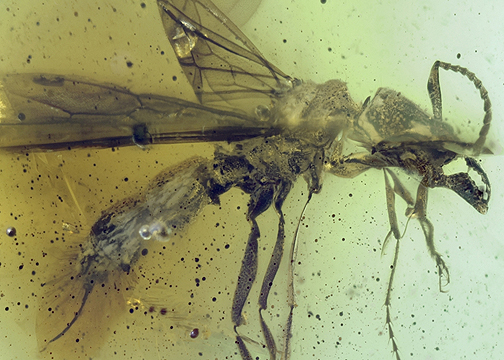
A new species of the fossil ant genus Siinikaponera Varela-Hernández, Riquelme & Guerrero, 2025, Siinikaponera balana sp. nov., is described based on a single alate gyne preserved in amber from Montecristo, Chiapas, Mexico. This species exhibits the primary diagnostic features of Siinikaponera, particularly the presence of paired protruding clypeal lobes, mandibles with asymmetrical dentition, a pronotum bearing a relatively long neck-like extension, and a serrate flagellum. Siinikaponera balana sp. nov. differs from Siinikaponera sulimata Varela-Hernández, Riquelme & Guerrero, 2025, by possessing a petiole with a short peduncle, a petiolar node that is approximately as tall as it is long with anterior and posterior margins meeting at an acute angle, and a spur on the forelegs.
References
- Araújo, J.P., Evans, H.C., Geiser, D.M., Mackay, W.P. & Hughes, D.P. (2015) Unravelling the diversity behind the Ophiocordyceps unilateralis (Ophiocordycipitaceae) complex: Three new species of zombie-ant fungi from the Brazilian Amazon. Phytotaxa, 220 (3), 224–238. https://doi.org/10.11646/phytotaxa.220.3.2
- Barden, P. (2017) Fossil ants (Hymenoptera: Formicidae): ancient diversity and the rise of modern lineages. Myrmecological News, 24, 1–30.
- Beutel, R.G., Richter, A., Keller, R.A., Hita García, F., Matsumura, Y., Economo, E.P. & S.N. Gorb. (2020) Distal structures of the Aculeata (Hymenoptera): A comparative evolutionary study of Sceliphron (Sphecidae) and Formica (Formicidae). Journal of Morphology, 281 (7), 737–753. https://doi.org/10.1002/jmor.21133
- Bolton, B. (2025) An online catalog of the ants of the world. Available from: https://antcat.org (Accessed on 05.09.2025).
- Borgmeier, T. (1940) Duas notas myrmecológicas. Revista de Entomologia (Rio de Janeiro), 11, 606.
- Cantone, S. (2018) Winged ants. The queen. Dichotomous key to genera of winged ants in the world. The wings of ants: morphological and systematic relationships. Catania, Italy, 246 pp.
- De Andrade, M.L. (1998) First description of fossil Acanthostichus from Dominican amber (Hymenoptera, Formicidae). Mitteilungen der Schweizerischen Entomologischen Gesellschaft, 71, 269–274.
- De Andrade, M.L. & Baroni-Urbani, C. (1999) Diversity and adaptation in the ant genus Cephalotes. Past and present (Hymenoptera: Formicidae). Stuttgarter Beiträge zur Naturkunde. Serie B (Geologie und Paläontologie), 271, 1–889.
- Dlussky, G.M. & Wedmann, S. (2012) The poneromorph ants (Hymenoptera, Formicidae: Amblyoponinae, Ectatomminae, Ponerinae) of Grube Messel, Germany: high biodiversity in the Eocene. Journal of Systematic Palaeontology, 10 (4), 725–753. https://doi.org/10.1080/14772019.2011.628341
- Doré, M., Borowiec, M.L., Branstetter, M.G., Camacho, G.P., Fisher, B.L., Longino, J.T., Ward, P.S. & Blaimer, B.B. (2025) Evolutionary history of ponerine ants highlights how the timing of dispersal events shapes modern biodiversity. Nature Communications, 16, 8297. https://doi.org/10.1038/s41467-025-63709-3
- Fernández, F. & Guerrero, R.J. (2019) Género Ponerinae. In: Fernández, F., Guerrero, R.J. & Delsinne, T. (Eds), Hormigas de Colombia. Universidad Nacional de Colombia. Facultad de Ciencias. Instituto de Ciencias. Bogotá, Colombia, pp. 509–554.
- Fiorentino, G., Lattke, J., Troya, A., Sosiak, C., Dong, M. & Barden, P. (2023) Deep time extinction of largest insular ant predators and the first fossil Neoponera (Formicidae: Ponerinae) from Miocene age Dominican amber. BMC Biology, 21 (26), 1–12. https://doi.org/10.1186/s12915-022-01488-9
- Keller, R.A. & Peeters, C. (2020) Poneroid ants. In: Starr, C. (Ed.), Encyclopedia of social insects. Springer, Cham, pp. 749–754. https://doi.org/10.1007/978-3-319-90306-4_99-1
- Latreille, P.A. (1802) Histoire naturelle générale et particulière des crustacés et des insectes. Tome 3.F. Dufart, Paris, xii + 467 pp. https://doi.org/10.5962/bhl.title.15764
- Lepeletier de Saint-Fargeau, A. (1836) Histoire naturelle des insectes. Hyménoptères. Tome I. Roret, Paris, 547 pp.
- Linnaeus, C. (1758) Systema Naturae per regna tria naturae, secundum classes, ordines, genera, species cum characteribus, differentiis, synonymis, locis. Editio decima, reformata. Tome I. Laurentii Salvii, Stockholm, 824 pp. https://doi.org/10.5962/bhl.title.542
- Longino, J.T. (2009) Additions to the taxonomy of New World Pheidole (Hymenoptera: Formicidae). Zootaxa, 2181 (1), 1–90. https://doi.org/10.11646/zootaxa.2181.1.1
- Mayr, G. (1887) Südamerikanische Formiciden. Verhandlungen der Kaiserlich-Königlichen Zoologisch-Botanischen Gesellschaft in Wien, 37, 511–632.
- Moreau, C.S. & Bell, C.D. (2013) Testing the museum versus cradle tropical biological diversity hypothesis: phylogeny, diversification, and ancestral biogeographic range evolution of the ants. Evolution, 67 (8), 2240–2257. https://doi.org/10.1111/evo.12105
- Riquelme, F., Ortega-Flores, B., Estrada-Ruiz, E. & Córdova-Tabares, V. (2025) Zircon U-Pb ages of the Chiapas Amber-Lagerstätte in the uppermost Simojovel Formation, southwest Mexico. Canadian Journal of Earth Sciences, 62 (6), 1088–1103. https://doi.org/10.1139/cjes-2024-0100
- Romiguier, J., Borowiec, M.L., Weyna, A., Helleu, Q., Loire, E., La Mendola, C., Rabeling, C., Fisher, B.L., Ward, P.S. & Keller, L. (2022) Ant phylogenomics reveals a natural selection hotspot preceding the origin of complex eusociality. Current Biology, 32 (13), P2942–P2947. https://doi.org/10.1016/j.cub.2022.05.001
- Schmidt, C. (2013) Molecular phylogenetics of ponerine ants (Hymenoptera: Formicidae: Ponerinae). Zootaxa, 3647 (2), 201–250. https://doi.org/10.11646/zootaxa.3647.2.1
- Schmidt, C.A. & Shattuck, S.O. (2014) The higher classification of the ant subfamily Ponerinae (Hymenoptera: Formicidae), with a review of ponerine ecology and behavior. Zootaxa, 3817 (1), 1–242. https://doi.org/10.11646/zootaxa.3817.1.1
- Solórzano-Kraemer, M.M. (2007) Systematic, palaeoecology, and palaeobiogeography of the insect fauna from the Mexican amber. Palaeontographica Abteilung A, 282, 1–133. https://doi.org/10.1127/pala/282/2007/1
- Varela-Hernández, F., Riquelme, F. & Estrada-Ruiz, E. (2024) Elektroformica azquil gen. et sp. nov., a new formicine ant from Oligo-Miocene Mexican amber. Palaeoentomology, 7 (5), 684–692. https://doi.org/10.11646/palaeoentomology.7.5.11
- Varela-Hernández, F., Riquelme, F. & Guerrero, R.J. (2025) New genus and species of ponerine ant (Hymenoptera: Formicidae) from Mexican amber. Historical Biology, 37 (5), 1134–1140. https://doi.org/10.1080/08912963.2024.2370000
- Varela-Hernández, F., Riquelme, F., Guerrero, R.J. & Vázquez-Franco, C.M. (2022) New ant species Schismiscapus exstinctum gen. et sp. nov. (Formicidae: Dolichoderinae) from Miocene Mexican amber. Historical Biology, 35 (7), 1209–1215. https://doi.org/10.1080/08912963.2022.2085568
- Wheeler, W.M. (1915) The ants of the Baltic amber. Schriften der Physikalisch-Ökonomischen Gesellschaft zu Königsberg, 55, 1–142. https://doi.org/10.5962/bhl.title.14207
- Wilson, E.O. (1985) Ants of the Dominican amber (Hymenoptera, Formicidae). 2. The first fossil army ants. Psyche, 92 (1), 11–16. https://doi.org/10.1155/1985/63693
- Wilson, E.O. & Hölldobler, B. (2005) The rise of the ants: a phylogenetic and ecological explanation. Proceedings of the National Academy of Sciences, 102 (21), 7411–7414. https://doi.org/10.1073/pnas.0502264102