

Abstract
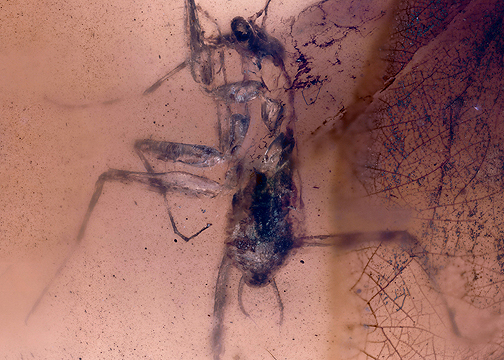
Animals have evolved a wide range of traits to avoid predation, and some of these defensive strategies can be traced in the fossil record. Recently, the first case of disruptive colouration was documented in a lacewing larva from Cretaceous Kachin amber, Myanmar. Here we report additional immature specimens from the same deposit that also exhibit disruptive colouration, expressed as alternating dark and bright stripes on the legs. The examples span a broad array of lineages, including another lacewing larva (Neuroptera: Crocinae), as well as planthoppers (Fulgoromorpha), a true bug (Heteroptera), a “predatory cricket” (Ensifera), cockroach-like forms (Dictyoptera), and several praying mantises (Mantodea). The repeated appearance of leg-based disruptive colouration in such distantly related groups suggests that this trait evolved multiple times already 100 million years ago, reflecting diverse predator-prey interactions and a complex Cretaceous food web.
References
- Barnett, J.B., Scott-Samuel, N.E. & Cuthill, I.C. (2016) Aposematism: balancing salience and camouflage. Biology Letters, 12, 20160335. https://doi.org/10.1098/rsbl.2016.0335
- Barnett, J.B., Cuthill, I.C. & Scott-Samuel, N.E. (2017) Distance-dependent pattern blending can camouflage salient aposematic signals. Proceedings of the Royal Society B: Biological Sciences, 284, 20170128. https://doi.org/10.1098/rspb.2017.0128
- Barnett, J.B., Cuthill, I.C. & Scott-Samuel, N.E. (2018) Distance-dependent aposematism and camouflage in the cinnabar moth caterpillar (Tyria jacobaeae, Erebidae). Royal Society Open Science, 5, 171396. https://doi.org/10.1098/rsos.171396
- Barnett, J.B., Yeager, J., McEwen, B.L., Kinley, I., Anderson, H.M. & Guevara, J. (2023) Size-dependent colouration balances conspicuous aposematism and camouflage. Journal of Evolutionary Biology, 36, 1010–1019. https://doi.org/10.1111/jeb.14143
- Bräunig, P., Krumpholz, K. & Baumgartner, W. (2012) Sensory pits—Enigmatic sense organs of the nymphs of the planthopper Issus coleoptratus (Auchenorrhyncha, Fulgoromorpha). Arthropod Structure & Development, 41, 443–458. https://doi.org/10.1016/j.asd.2012.06.001
- Caro, T., Argueta, Y., Briolat, E.S., Bruggink, J., Kasprowsky, M., Lake, J., Mitchell, M.J., Richardson, S. & How, M. (2019) Benefits of zebra stripes: Behaviour of tabanid flies around zebras and horses. PLoS One, 14, e0210831. https://doi.org/10.1371/journal.pone.0210831
- Chen, J., Wang, B., Zhang, H., Jiang, H., Jiang, T., An, B., Zheng, Y. & Wang, X. (2019) A remarkable new sinoalid froghopper with probable disruptive colouration in mid-Cretaceous Burmese amber (Hemiptera, Cicadomorpha). Cretaceous Research, 98, 9–17. https://doi.org/10.1016/j.cretres.2019.02.004
- Dai, R., Engel, M.S., Du, S., Ren, D., Li, S. & Yao, Y. (2025) Rare fossil insect (Zekuforma maculata sp. nov.) from the Tibetan plateau unveils adaptive innovations and extinction mechanisms. Communications Biology, 8, 1754. https://doi.org/10.1038/s42003-025-09134-0
- Dalingwater, J.E. (1987) Chelicerate cuticle structure. In: Nentwig, W. (Ed.), Ecophysiology of spiders. Springer, Berlin, Heidelberg, 3–15. https://doi.org/10.1007/978-3-642-71552-5_1
- Delclòs, X., Peñalver, E., Arillo, A., Engel, M.S., Nel, A., Azar, D. & Ross, A. (2016) New mantises (Insecta: Mantodea) in Cretaceous ambers from Lebanon, Spain, and Myanmar. Cretaceous Research, 60, 91–108. https://doi.org/10.1016/j.cretres.2015.11.001
- Dennell, R. (1944) Hardening and darkening of the insect cuticle. Nature, 154, 57–58. https://doi.org/10.1038/154057a0
- Fabrikant, D. & Novoselska, T. (2024) A peculiar large-eyed aposematic bug Miropictopallium coloradmonens n. gen., n. sp. (Heteroptera: Pentatomomorpha: Yuripopovinidae) from mid-Cretaceous Kachin amber. Israel Journal of Entomology, 53, 1–23. https://doi.org/10.5281/zenodo.10848699
- Fu, Y.Z. & Huang, D.Y. (2020) New data on fossil mimarachnids (Hemiptera, Fulgoromorpha, Fulgoroidea) in mid-Cretaceous Burmese amber. Palaeoentomology, 3, 317–331. https://doi.org/10.11646/palaeoentomology.3.3.12
- Grimaldi, D.A. (2003) A revision of Cretaceous mantises and their relationships, including new taxa (Insecta, Dictyoptera, Mantodea). American Museum Novitates, 3412, 1–48. https://doi.org/10.1206/0003-0082(2003)412<0001:AROCMA>2.0.CO;2
- Hackman, R.H. & Goldberg, M. (1971) Studies on the hardening and darkening of insect cuticles. Journal of Insect Physiology, 17, 335–347. https://doi.org/10.1016/0022-1910(71)90218-6
- Haug, C., Haug, G.T. & Haug, J.T. (2024) The first record of disruptive colouration in holometabolan larvae from about 100 million-year-old Kachin amber is a lacewing larva with dark stripes on the legs. Palaeoentomology, 7, 719–722. https://doi.org/10.11646/palaeoentomology.7.6.7
- Haug, C., Herrera-Flórez, A.F., Müller, P. & Haug, J.T. (2019) Cretaceous chimera—an unusual 100-million-year old neuropteran larva from the “experimental phase” of insect evolution. Palaeodiversity, 12 (1), 1–11. https://doi.org/10.18476/pale.v12.a1
- Haug, G.T., Baranov, V., Wizen, G., Pazinato, P.G., Müller, P., Haug, C. & Haug, J.T. (2021) The morphological diversity of long-necked lacewing larvae (Neuroptera: Myrmeleontiformia). Bulletin of Geosciences, 96, 1–27. https://doi.org/10.3140/bull.geosci.1807
- Haug, J.T., Hörnig, M.K., Kiesmüller, C., Pazinato, P.G., Baranov, V. & Haug, C. (2022) A 100-million-year-old ensiferan with unusual mouthparts and comments on the evolution of raptorial appendages within Polyneoptera. Geodiversitas, 44, 57–73. https://doi.org/10.5252/geodiversitas2022v44a4
- Hinkelman, J. (2023) Origins and diversity of spot-like aposematic and disruptive colorations among cockroaches. Biologia, 78, 1659–1677. https://doi.org/10.1007/s11756-022-01163-y
- Izquierdo-López, A., Kiesmüller, C., Gröhn, C., Haug, J.T., Haug, C. & Hörnig, M.K. (2025) Patterns of morphological evolution in the raptorial appendages of praying mantises. Insect Science, 32, 1061–1079. https://doi.org/10.1111/1744-7917.13423
- Jiang, T., Szwedo, J. & Wang, B. (2019) A unique camouflaged mimarachnid planthopper from mid-Cretaceous Burmese amber. Scientific Reports, 9, 13112. https://doi.org/10.1038/s41598-019-49414-4
- Kiesmüller, C., Haug, G.T., Haug, C., Müller, P., Hörnig, M.K. & Haug, J.T. (2024) New indications for the life habits of long-legged aphidlion-like larvae in about 100-million-year-old amber. PalZ, 98, 429–441. https://doi.org/10.1007/s12542-024-00693-x
- Liu, X.J., Jiang, H., Chen, J., Fu, Y.Z., Boderau, M., Bojarski, B., Bruthansová, J., Nyunt, T.T. & Szwedo, J. (2024) Investigation of Cretodorus (Hemiptera: Fulgoromorpha: Mimarachnidae) based on new adult and nymph fossils from mid-Cretaceous Myanmar amber. Mesozoic, 1, 235–254. https://doi.org/10.11646/mesozoic.1.3.4
- Sendi, H. & Azar, D. (2017) New aposematic and presumably repellent bark cockroach from Lebanese amber. Cretaceous Research, 72, 13–17. https://doi.org/10.1016/j.cretres.2016.11.013
- Šmídová, L. & Lei, X. (2017) The earliest amber-recorded type cockroach family was aposematic (Blattaria: Blattidae). Cretaceous Research, 72, 189–199. https://doi.org/10.1016/j.cretres.2017.01.008
- Szwedo, J. (2007) Nymphs of a new family Neazoniidae fam. n. (Hemiptera: Fulgoromorpha: Fulgoroidea) from the Lower Cretaceous Lebanese amber. African Invertebrates, 48, 127–143.
- Szwedo, J. (2009) First discovery of Neazoniidae (Insecta, Hemiptera, Fulgoromorpha) in the Early Cretaceous amber of Archingeay, SW France. Geodiversitas, 31 (1), 105–116. https://doi.org/10.5252/g2009n1a9
- Vinther, J. (2015) A guide to the field of palaeo colour: Melanin and other pigments can fossilise: Reconstructing colour patterns from ancient organisms can give new insights to ecology and behaviour. BioEssays, 37, 643–656. https://doi.org/10.1002/bies.201500018
- Vršanský, P., Šmídová, L., Sendi, H., Barna, P., Mueller, P., Ellenberger, S., Wu, H., Ren, X., Lei, X., Azar, D., Šurka, J., Su, T., Deng, W., Shen, X., Lv. J., Bao, T. & Bechly, G. (2019) Parasitic cockroaches indicate complex states of earliest proved ants. Biologia, 74, 65–89. https://doi.org/10.2478/s11756-018-0146-y
- Wang, B., Xia, F., Engel, M.S., Perrichot, V., Shi, G., Zhang, H., Chen, J., Jarzembowski, E.A., Wappler, T. & Rust, J. (2016) Debris-carrying camouflage among diverse lineages of Cretaceous insects. Science Advances, 2, e1501918. https://doi.org/10.1126/sciadv.1501918
- Wang, Z., Feng, K., Yang, F., Liang, Y., Yun, X., Tihelka, E., Bai, M., Cai, C. & Lei, M. (2022) Breathing colour into fossils: A tomographic system for reconstructing the soft tissue microstructure of amber inclusions. Optics and Lasers in Engineering, 148, 106775. https://doi.org/10.1016/j.optlaseng.2021.106775
- Wilson, S.W. (2005) Keys to the families of Fulgoromorpha with emphasis on planthoppers of potential economic importance in the southeastern United States (Hemiptera: Auchenorrhyncha). Florida Entomologist, 88, 464–481.
- Xia, F., Yang, G., Zhang, Q., Shi, G. & Wang, B. (2015) Amber: Life Through Time and Space. Science Press, Beijing, China, 196 pp.
- Xu, C., Luo, C., Jarzembowski, E.A., Fang, Y. & Wang, B. (2022) Aposematic coloration from mid-Cretaceous Kachin amber. Philosophical Transactions of the Royal Society B, 377, 20210039. https://doi.org/10.1098/rstb.2021.0039
- Zenner, G., Stöckmann, M. & Niedringhaus, R. (2005) Preliminary key to the nymphs of the families and subfamilies of the German Auchenorrhyncha fauna:(Hemiptera, Fulgoromorpha et Cicadomorpha). Cicadina, 8, 59–78.
- Zhang, W.W. (2017) Frozen Dimensions. The Fossil Insects and Other Invertebrates in Amber. Chongqing: Chongqing University Press, 692 pp.
- Zhang, X., Ren, D. & Yao, Y. (2018) A new genus and species of Mimarachnidae (Hemiptera: Fulgoromorpha: Fulgoroidea) from mid-Cretaceous Burmese amber. Cretaceous Research, 90, 168–173. https://doi.org/10.1016/j.cretres.2018.04.012