

Abstract
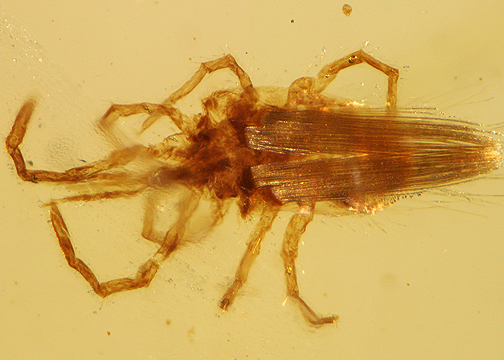
The similar morphological traits produced by convergent evolution represent a primary source of taxonomic confusion. The porcupine-like mites from mid-Cretaceous Burmese amber, which can be readily recognized by four tufts of extremely long setae on their backs, have recently been reported by several researchers as members of the family Chyzeriidae Womersley, 1954. However, detailed morphological examination of newly discovered specimens reveals that these similarities are superficial. Some important higher-level taxonomic characters (e.g., retractable gnathosoma, needle-like chelicerae, and two pairs of genital acetabula) of these extinct mites are not clearly presented in reported specimens, obscuring their true phylogenetic position. Here we demonstrate that the hair tufts in these Cretaceous mites represent a case of convergent evolution and that the fossils belong to a previously unrecognized lineage. We revisit 62 new fossils of this group using various imaging technologies, including stereomicroscopy, fluorescence microscopy, and laser confocal scanning microscopy, and we also examined three slide-mounted specimens from three extant families: Chyzeriidae Womersley, 1954, Smarididae Kramer, 1878, and Calyptostomatidae Oudemans, 1923, were also examined for morphological comparison. Newly discovered morphological evidence supports the establishment of a new family Acarohystricidae fam. nov. to accommodate these extinct Cretaceous mites, which is placed in its own superfamily—Acarohystricoidea superfam. nov.—distantly related to the extant Chyzeriidae. A new genus and species, Acarohystrix magnifica gen. et sp. nov., is erected and the genera Punkochyzeria Kolesnikov, Turbanov & Vorontsov, 2025 and Cretachyzeria Liu, Fan & Ren, 2025 are transferred to this new family. Additionally, a new species, Punkochyzeria obtusa sp. nov., is described and P. khoyi Kolesnikov, Turbanov & Vorontsov, 2025 is proposed as a junior synonym of P. makolae Kolesnikov, Turbanov & Vorontsov, 2025. A revised diagnosis of Punkochyzeria is provided. Furthermore, phylogenetic analyses based on a limited set of morphological characters provide preliminary evidence for a sister-group relationship between Acarohystricidae fam. nov. and the extant family Calyptostomatidae Oudemans, 1923 within Erythraeina, justifying the establishment of Acarohystricoidea superfam. nov. We also include the ontogenetic and sexually dimorphic character states within the new family.
References
- Bittleston, L.S., Pierce, N.E., Ellison, A.M. & Pringle, A. (2016) Convergence in multispecies interactions. Trends in Ecology & Evolution, 31 (4), 269–280. https://doi.org/10.1016/j.tree.2016.01.006
- Blanke, A., Greve, C., Wipfler, B., Beutel, R.G., Holland, B.R. & Misof, B. (2013) The identification of concerted convergence in insect heads corroborates Palaeoptera. Systematic Biology, 62 (2), 250–263. https://doi.org/10.1093/sysbio/sys091
- Costa, S.G.S., Klimov, P.B. & Pepato, A.R. (2023) Two new species of Brazilian Johnstonianidae (Trombidiformes: Parasitengona). Systematic & Applied Acarology, 28, 680–694. https://doi.org/10.11158/saa.28.4.5
- Costa, S.G.S., Tolstikov, A., Saboori, A., Batista-Ribeiro, D., Noei, J., Harvey, M.S., Shaw, M.D., Klimov, P.B., Zhang, Z.-Q. & Pepato, A.R. (2024) A comprehensive molecular phylogeny of the terrestrial Parasitengona (Acariformes, Prostigmata) provides insights into the evolution of their metamorphosis, invasion into aquatic habitats and classification. Molecular Phylogenetics and Evolution, 199, 108147. https://doi.org/10.1016/j.ympev.2024.108147
- Costa, S.G.S., Welbourn, C., Klimov, P. & Pepato, A.R. (2021) Integrating phylogeny, ontogeny and systematics of the mite family Smarididae (Prostigmata, Parasitengona): classification, identification key, and description of new taxa. Systematic & Applied Acarology, 26 (1), 85–123. https://doi.org/10.11158/saa.26.1.6
- Feider, Z. (1959) Etude des caracteres sexuels chez les Trombidioidea. Acarologia, 1, 56–85.
- Harvey, M.S. (1996) A revised systematic placement for Austrotrombella Southcott (Acarina: Hydryphantidae). Transactions of the Royal Society of South Australia, 120, 37–40.
- Harvey, M.S. (1998) Unusual new water mites (Acari: Hydracarina) from Australia, part 1. Records of the Western Australian Museum, 19, 91–106.
- Hirst, S. (1924) On three new acari belonging to the superfamily Trombidioidea (Erythraeidae and Teneriffiolidae). Proceedings of the Zoological Society of London, 1924, 1075–1080.
- Hirst, S. (1926) Descriptions of new mites including four new species of “red spider”. Proceedings of the Zoological Society of London, 1926, 825–841.
- Kolesnikov, V.B., Turbanov, I.S. & Vorontsov, D.D. (2025) Punks not dead? Punkochyzeria gen. nov. (Acari: Chyzeriidae) from Cretaceous Myanmar amber. Zootaxa, 5686 (4), 451–484. https://doi.org/10.11646/zootaxa.5686.4.1
- Krantz, G.W. & Walter, D.E. (Eds), (2009), A manual of acarology. (3rd ed.). Texas Tech University Press, Lubbock, Texas, 807 pp.
- Li, H., Jin, D. & Guo, J. (2021) A new species of the genus Stygothrombium, representing a newly recorded superfamily Stygothrombioidea Mullen & Vercammen-Grandjean, 1980 (Acari: Stygothrombiae) from China. Zoological Systematics, 46 (4), 281–288. https://doi.org/10.11865/zs.2021402
- Li, H.-S., Xue, X.-F. & Hong, X.-Y. (2014) Homoplastic evolution and host association of Eriophyoidea (Acari, Prostigmata) conflict with the morphological-based taxonomic system. Molecular Phylogenetics and Evolution, 78, 185–198. https://doi.org/10.1016/j.ympev.2014.05.014
- Liu, W., Golovatch, S., Wesener, T. & Tian, M. (2017) Convergent evolution of unique morphological adaptations to a subterranean environment in cave millipedes (Diplopoda). PloS One, 12 (2), e0170717. https://doi.org/10.1371/journal.pone.0170717
- Liu, Y., Fan, Q.-H. & Ren, D. (2025) A Cretaceous mite with ultra-long setae possibly reveals the early survival strategy of Chyzeriidae. Fossil Record, 28 (2), 241–248. https://doi.org/10.3897/fr.28.158587
- Masoumi, H., Saboori, A. & Seiedy, M. (2020) Descriptions of all active instars of a new species of Calyptostoma (Trombidiformes: Calyptostomatidae) from Iran. Experimental and Applied Acarology, 82, 1821–1839. https://doi.org/10.11158/saa.25.10.7
- Meyer (Smith), M.K.P. & Ueckermann, E.A. (1987) A taxonomic study of some Anystidae (Acari: Prostigmata). Entomology Memoir, Department of Agriculture and Fisheries, Republic of South Africa, 68, 1–37.
- Newell, J.M. (1957) Studies on the Johnstonianidae (Acari, Parasitengona). Pacific Science, 11, 396–466.
- Perkins, E.M., Donnellan, S.C., Bertozzi, T., Chisholm, L.A. & Whittington, I.D. (2009) Looks can deceive: molecular phylogeny of a family of flatworm ectoparasites (Monogenea: Capsalidae) does not reflect current morphological classification. Molecular Phylogenetics and Evolution, 52 (3), 705–714. https://doi.org/10.1016/j.ympev.2009.05.008
- Schäffer, S., Koblmüller, S., Pfingstl, T., Sturmbauer, C. & Krisper, G. (2010) Ancestral state reconstruction reveals multiple independent evolution of diagnostic morphological characters in the “Higher Oribatida” (Acari), conflicting with current classification schemes. BMC Evolutionary Biology, 10 (1), 246. https://doi.org/10.1186/1471-2148-10-246
- Selden, P.A. & Ren, D. (2017) A review of Burmese amber arachnids. Journal of Arachnology, 45, 324–343. https://doi.org/10.1636/JoA-S-17-029
- Söller, R., Wohltmann, A., Witte, H. & Blohm, D. (2001) Phylogenetic relationships within terrestrial mites (Acari: Prostigmata, Parasitengona) inferred from comparative DNA sequence analysis of the mitochondrial cytochrome oxidase subunit I gene. Molecular Phylogenetics and Evolution, 18 (1), 47–53. https://doi.org/10.1006/mpev.2000.0855
- Southcott, R.V. (1961) Studies on the systematics and biology of the Erythraeoidea (Acarina), with a critical revision of the genera and subfamilies. Australian Journal of Zoology, 9 (3), 367–610. https://doi.org/10.1071/ZO9610367
- Southcott, R.V. (1991) A new trombellid mite (Acarina: Trombellidae) from South Australia. Transactions of the Royal Society of South Australia, 115, 207–212.
- Stayton, C.T. (2015) What does convergent evolution mean? The interpretation of convergence and its implications in the search for limits to evolution. Interface focus, 5 (6), 20150039. https://doi.org/10.1098/rsfs.2015.0039
- Treat, A.E. & Flechtmann, C.H.W. (1979) Charletonia rocciai n. sp. (Acari, Prostigmata, Erythraeidae), an ectoparasite of the Amazon fly. International Journal of Acarology, 5, 117–122. https://doi.org/10.1080/01647957908683134
- von Frauenfeld, G. (1868) Zoologische miscellen. Verhandlungen der Zoologisch-Botanischen Gesellschaft in Wien, 18, 884–902.
- Walter, D.E. & Proctor, H. (2013) Mites: ecology, evolution and behaviour: life at a microscale, second edition. Netherlands, Dordrecht, Springer, 494 pp. https://doi.org/10.1007/978-94-007-7164-2.
- Welbourn, W.C. & Young, O.P. (1987) New genus and species of Erythraeinae (Acari, Erythraeidae) from Mississippi with a key to the genera of North American Erythraeidae. Annals of the Entomological Society of America, 80, 230–242. https://doi.org/10.1093/aesa/80.2.230
- Welbourn, W.C. (1991) Phylogenetic studies of the terrestrial Parasitengona. In: Dusbábek, F. & Bukva, V. (Eds), Modern acarology. SPB Academic Publishing, The Hague, pp. 163–170.
- Wohltmann, A. (2010) Notes on the taxonomy and biology of Smarididae (Acari: Prostigmata: Parasitengona). Annales Zoologici (Warszawa), 60, 355–381. https://doi.org/10.3161/000345410X535361
- Womersley, H. (1954) On the subfamily Trombellinae Sig Thor, 1935 (Acarina: Trombidiidae) with the diagnosis of the nymph of Audyana thompsoni Womersley. Records of the South Australian Museum, 11, 121–128.
- Zhang, Z.-Q. (1998) Review Biology and ecology of trombidiid mites (Acari: Trombidioidea). Experimental & Applied Acarology, 22 (3), 139–155. https://doi.org/10.1023/A:1006002028430
- Zhang, Z.-Q. & Fan, Q.-H. (2007) Allotanaupodidae, a new family of early derivative Parasitengona (Acari: Prostigmata). Zootaxa, 1517 (1), 1–52. https://doi.org/10.11646/zootaxa.1517.1.1
- Zhang, Z.-Q. & Saboori, A. (1996) Descriptions of the larva, deutonymph and adult of Trombidium southcotti sp. nov. (Acari: Trombidiidae) from Iran. Systematic & Applied Acarology, 1, 157–164. https://doi.org/10.11158/saa.1.1.19
- Zhang, Z.-Q., Schatz, H., Pfingstl, T., Goldschmidt, T., Martin, P., Pešić, V., Ramirez, M., Schmidt, K.H., Fan, Q.-H., Mironov, S., Seeman, O. & Halliday, B. (2021) Discovering and documenting Acari: the first twenty years in Zootaxa. Zootaxa, 4979 (1), 115–130. https://doi.org/10.11646/zootaxa.4979.1.13
- Zmudzinski, M. (2022) “Tiny dancer in my hand…” 100-million-year-old case of mite flamboyance. Zoosymposia, 22, 224. https://doi.org/10.11646/zoosymposia.22.1.130