

Abstract
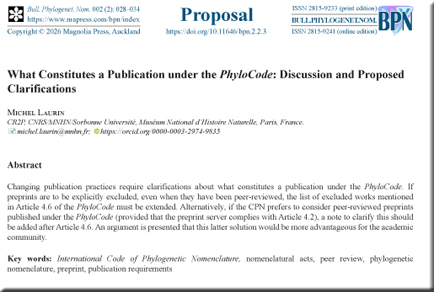
Changing publication practices require clarifications about what constitutes a publication under the PhyloCode. If preprints are to be explicitly excluded, even when they have been peer-reviewed, the list of excluded works mentioned in Article 4.6 of the PhyloCode must be extended. Alternatively, if the CPN prefers to consider peer-reviewed preprints published under the PhyloCode (provided that the preprint server complies with Article 4.2), a note to clarify this should be added after Article 4.6. An argument is presented that this latter solution would be more advantageous for the academic community.
References
- Asher, R. 2019. The origins of Lissamphibia. Peer Community in Paleontology 1:100002. https://doi.org/10.24072/pci.paleo.100002
- Avissar-Whiting, M. 2021. How the world is adapting to preprints. Nature portfolio. https://www.nature.com/articles/d42473-021-00026-5
- Avissar-Whiting, M., F. Belliard, S. M. Bertozzi, A. Brand, K. Brown, G. Clément-Stoneham, S. Dawson, G. Dey, D. Ecer, and S. C. Edmunds. 2024. Recommendations for accelerating open preprint peer review to improve the culture of science. PLoS Biology 22:e3002502. https://doi.org/10.1371/journal.pbio.3002502
- Bourguet, D., and T. Guillemaud. 2024. Peer-reviewed preprints and the publish-review-curate model. Plan S https://www.coalition-s.org/blog/peer-reviewed-preprints-and-the-publish-review-curate-model/
- Bourne, P. E., J. K. Polka, R. D. Vale, and R. Kiley. 2017. Ten simple rules to consider regarding preprint submission. PLoS Computational Biology 13:e1005473. https://doi.org/10.1371/journal.pcbi.1005473
- Buranyi, S. 2017. Is the staggeringly profitable business of scientific publishing bad for science? The Guardian 27 June 2017. https://www.theguardian.com/science/2017/jun/27/profitable-business-scientific-publishing-bad-for-science?
- Cantino, P. D., and K. de Queiroz. 2020. International Code of Phylogenetic Nomenclature (PhyloCode). CRC Press – Taylor & Francis Group, Boca Raton, Florida. https://doi.org/10.1201/9780429446320
- Cobb, M. 2017. The prehistory of biology preprints: A forgotten experiment from the 1960s. PLoS biology 15:e2003995. https://doi.org/10.1371/journal.pbio.2003995
- Douglas, K. 1990. The serials crisis: Adjusting to change. The Serials Librarian 18:111–121. https://doi.org/10.1300/J123v18n01_08
- Eleftheriadi, K., N. Guiglielmoni, J. Salces-Ortiz, C. Vargas-Chavez, G. I. Martínez-Redondo, M. Gut, J.-F. Flot, A. Schmidt-Rhaesa, and R. Fernández. 2023. The genome sequence of the Montseny horsehair worm, Gordionus montsenyensis sp. nov., a key resource to investigate Ecdysozoa evolution. bioRxiv:2023.2006. 2026.546503. https://doi.org/10.1101/2023.06.26.546503
- Grossmann, A., and B. Brembs. 2021. Current market rates for scholarly publishing services. F1000Research 10:20. https://doi.org/10.12688/f1000research.27468.2
- Guillemaud, T., B. Facon, and D. Bourguet. 2019. Peer Community In: A free process for the recommendation of unpublished scientific papers based on peer review. Proceedings of the ElPub Conference. https://doi.org/10.4000/proceedings.elpub.2019.23
- Haak, L. L., M. Fenner, L. Paglione, E. Pentz, and H. Ratner. 2012. ORCID: A system to uniquely identify researchers. Learned Publishing 25:259–264. https://doi.org/10.1087/20120404
- Henriques, S. O., N. Rzayeva, S. Pinfield, and L. Waltman. 2023. Preprint review services: Disrupting the scholarly communication landscape? SocArXiv:1–31. https://doi.org/10.31235/osf.io/8c6xm_v3
- Hindle, S., and D. Saderi. 2017a. Preprint journal clubs: Your opinions revealed. Authorea. https://doi.org/10.22541/au.151193754.44459059
- Hindle, S., and D. Saderi. 2017b. PREreview—a new resource for the collaborative review of preprints. eLife Labs. https://elifesciences.org/labs/57d6b284/prereview-a-new-resource-for-the-collaborative-review-of-preprints
- Inglis, J. R., and R. Sever. 2016. BioRxiv: A progress report. ASAPbio. https://asapbio.org/biorxiv/ Accessed March 9, 2026.
- Laurin, M. 2023. The Advent of PhyloCode: The Continuing Evolution of Biological Nomenclature. CRC Press, Boca Raton, Florida. https://doi.org/10.1201/9781003092827
- Laurin, M., O. Lapauze, and D. Marjanović. 2019. What do ossification sequences tell us about the origin of extant amphibians? Peer Community in Paleontology:1–36. https://doi.org/10.1101/352609
- Lemberger, T., and B. Pulverer. 2019. Review commons—pre‐journal peer review. The EMBO Reports 20:EMBR201949663. https://doi.org/10.15252/embr.201949663
- Mercier, M., V. Magloire, and M. Karnani. 2020. Enhancing scientific dissemination in neuroscience via preprint peer-review: “Peer Community In Circuit Neuroscience”. Neuroanatomy and Behaviour 2:e9. https://doi.org/10.35430/nab.2020.e9
- Mougin, C., W. Sanchez, and P. Labadie. 2021. Peer Community in Ecotoxicology and Environmental Chemistry in Colloque 2021 de la Société d’Ecotoxicologie Fondamentale et Appliquée. https://hal.science/hal-03229307/
- Muñoz-Tamayo, R., K. Barragán-Fonseca, M. Gagaoua, R. Gervais, F. Gondret, F. Meurens, C. Nawroth, S. Rafat, and Y. Ramayo-Caldas. 2025. Peer community in animal science: a free open science publication model. Animal-Science Proceedings 16:466–467. https://doi.org/10.1016/j.anscip.2025.07.297
- Odlyzko, A. M. 2015. Open Access, library and publisher competition, and the evolution of general commerce. Evaluation Review 39:130–163. https://doi.org/10.1177/0193841X13514751
- Pennington, C. R., and D. Heim. 2022. Reshaping the publication process: Addiction research and theory joins Peer Community In Registered Reports. Addiction Research & Theory 30:1–4. https://doi.org/10.1080/16066359.2021.1931142
- PREreview. 2017. <https://www.prereview.org> Accessed 12 March 2026.
- Queffelec, A., B. Maureille, M. Arzarello, R. Blasco, O. Crandell, L. Doyon, S. Halcrow, E. Karoune, A. Ruiz-Redondo, and P. Van Peer. 2023. Peer Community In Archaeology: A community-driven free and transparent system for preprints peer-reviewing. Archeologia e Calcolatori 34:125–134. https://hdl.handle.net/11392/2518070
- Razmjooei, M. J., and N. Thibault. 2022. Morphometric changes in two Late Cretaceous calcareous nannofossil lineages support diversification fueled by long-term cooling. PaleorXiv:nfyc9, ver. 4. https://doi.org/10.31233/osf.io/nfyc9
- Richter, F. C., E. Gea‐Mallorquí, A. Mortha, N. Ruffin, and N. Vabret. 2023. The preprint club: A blueprint for community‐based peer review. EMBO reports 24:e57258. https://doi.org/10.15252/embr.202357258
- Stern, B. M., and E. K. O’Shea. 2019. A proposal for the future of scientific publishing in the life sciences. PLoS Biology 17:e3000116. https://doi.org/10.1371/journal.pbio.3000116
- Sicilia, M.-A., E. García-Barriocanal, and S. Sánchez-Alonso. 2017. Community curation in open dataset repositories: Insights from Zenodo. Procedia Computer Science 106:54–60. https://doi.org/10.1016/j.procs.2017.03.009
- Vale, R. D. 2015. Accelerating scientific publication in biology. Proceedings of the National Academy of Sciences 112:13439–13446. https://doi.org/10.1073/pnas.1511912112
- Zoccali, C., and F. Mallamaci. 2023. Reimagining peer review: The emergence of peer community in registered reports system. Journal of Nephrology 36:2407–2411. https://doi.org/10.1007/s40620-023-01709-6